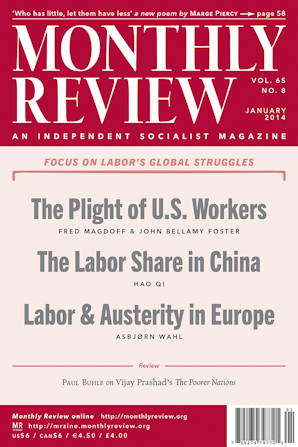
From Financial Crisis to Socialist Resistance
A specter is haunting Ireland—the specter of James Connolly.… Connolly was shot to death by a British firing squad for his role in Ireland’s 1916 rising for home rule. Celebrated as a hero of Irish independence by Irish political parties of both left and right, his socialism is all too conveniently overlooked. The Irish struggle is one that speaks to the challenges of independence, sovereignty, and democratic freedom, both then and now, for people of all countries. What value is formal political independence if it is not backed up by economic control; if the real decisions of public policy are made in boardrooms and backrooms rather than main streets and parliaments?… | more |
Water—On Women’s Burdens, Humans’ Rights, and Companies’ Profits
How is it possible that a person living in a water-rich region uses more water by flushing the toilet than a person in a water-scarce region has available for drinking, food-preparation, hygiene, and cleaning—for a whole day? How is it possible that a woman living in a water-rich region only needs to open the tap to get enough water for herself and her family, while a woman in a water-scarce region has to…walk for miles and miles to get far less water of much worse quality? Why is that so? Is it bad fortune? Unfair? Destiny? Undeserved? Is it unjust? It is all these, but also much more. Water is the essence of life. It is the precondition of life.… This article has two parts. The first deals with dominant positions concerning water: the neoliberal agenda, consequences of water privatization, and the UN stance. The second part looks at what is missing in this picture and ignored by the dominant perspectives—namely, global inequalities and gender discrimination.… | more |
The Crisis of Capitalism in Europe, West and East
There are three dimensions to the current, unprecedented global crisis of capitalism: economic, ecological, and political.… | more |
Let us look first at the economic dimension, which will be our main concern in this article. Capitalism is facing a major realization crisis—an inability to sell the output produced, i.e., to realize, in the form of profits, the surplus value extracted from workers’ labor. Neoliberalism can be viewed as an attempt initially to solve the stagflation crisis of the 1970s by abandoning the “Keynesian consensus” of the “golden age” of capitalism (relatively high social welfare spending, strong unions, and labor-management cooperation), via an attack on labor. It succeeded, in that profit rates eventually recovered in the major capitalist economies by the 1990s… | more |
The Reichstag Fire Trial, 1933–2008: The Production of Law and History
In the opening decade of the twentieth century the German national state united the great majority of the German speaking population of Europe, excluding only those in Switzerland and the Austro-Hungarian Empire, and was among the leading states of the world. It boasted technologically advanced industry, among the highest per capita GDP, and the second largest army and third largest navy in the world. Germany was at peace, save for minor military operations against disobedient natives in Southwest Africa. It was a state that was among world leaders in providing basic social insurance, yet held sacred private property and the rule of law, except only in strictly prescribed areas of national security. In the opening decade of the twenty-first century the German national state unites the great majority of the German speaking population of Europe, excepting only those in Switzerland and Austria, its industry is technologically advanced and its per capita GDP high. Its military budget is the sixth largest in the world, and it is at peace, save for minor military operations against disobedient natives in Afghanistan. Despite cutbacks, few states in the world have better provision of basic social insurance, and Germany today prides itself on holding private property to be sacred and on its adherence to the rule of law, except for a few strictly prescribed areas of national security. In the fourth and fifth decades of the twentieth century the German national state committed crimes universally agreed to be the most horrendous in human history.… | more |
America Right or Wrong: Anglo-American Relations Since 1945
British subordination to the United States, the so-called special relationship as it is optimistically known in London, is so taken for granted that it is seldom subjected to critical scrutiny. Why is it that the British ruling class and its agents have since 1945 come to embrace a junior partnership in the U.S. empire so wholeheartedly? Most recently, the “special relationship” has seen the New Labor government actively support and take part in the invasion and occupation of Iraq in the face of a hostile public opinion. Indeed, the largest demonstration in British history, on February 15, 2003, was against British participation in this unprovoked war of imperialist aggression. The lying, dishonest pretext for the invasion together with… | more |
The Danish Disease: A Political Culture of Islamophobia
In trying to comprehend the virus of Islamophobia now infecting Europe, the small country of Denmark offers powerful insights. Shakespeare’s phrase that “something is rotten in the state of Denmark” seems appropriate to describe the transformation taking place in this former bastion of tolerance and conviviality.… | more |
From Borderline to Borderland: The Changing European Border Regime
All along the European border, the year 2006 set new records: Spanish authorities reported 6,000 refugees dead, drowned in the Atlantic Ocean while trying to reach the Canary Islands, off West Africa.1 Hundreds more suffocated in containers, trucks, and cargo boats in the ports of London, Dublin, and Rotterdam, or froze to death in Eastern Europe. Others, locked up in one of the innumerable internment camps spread all over the heart of Europe and North Africa, desperately decided to end their own lives.2 At the same time, Europe reported the lowest rate in years of refugees officially seeking asylum. This list obviously doesn’t point to a more peaceful world. What it indicates instead is that in Europe the criteria and procedures for securing legal refugee status have become so restrictive that most migrants no longer bother to apply for it. In 2006, Germany for example counted only 20,000 petitions for political asylum, the lowest number since 1977. If we include the member states of the European Union (EU), that number rises to 200,000.3 However, the real story of the border regime, and its constriction of the category for legal entrance and residence, is in the rising body count… | more |
October 2007, Volume 59, Number 5
It is almost unheard of for a whole issue of MR (other than occasionally one of our special July-August issues) to be devoted to a single contribution. The typical MR issue consists of a lot of short articles. We have no intention of changing that. Nevertheless, we are making a rare exception in the case of Edward S. Herman and David Peterson’s “The Dismantling of Yugoslavia,” which we regard as the definitive critique at this stage both of the U.S./NATO role in the exploitation and exacerbation of the Yugoslavian tragedy and of the “Western Liberal-Left Intellectual and Moral Collapse” that made this possible. So effective has been the media propaganda system at presenting the imperialist wars in Yugoslavia in the 1990s as “humanitarian interventions” that this not only bolstered support for the invasions and occupations in Afghanistan and Iraq (in defiance of international law), but is now being offered as a justification for further possible “humanitarian interventions” elsewhere, such as Iran, the Sudan (Darfur), Nigeria, and even Venezuela… | more |
The Christian-Democratic Union (CDU) is experiencing right now what the Social-Democratic Party (SPD) had to learn after the accession to power of a Red-Green Coalition in 1998: People’s parties are elected because they promise to reconcile the interests of businesses, working people, and the receivers of any sort of social assistance. They lose approval if they pursue policies that one-sidedly benefit the corporate sector. Although cabinet ministers occasionally bemoan the exorbitant salaries received by top managers and the unpatriotic behavior of a company that decides to relocate, most voters do not fail to notice that such company policies are encouraged by a politically driven redistribution of income in favor of profits. People who expected more socially oriented policies from the CDU are turning away from that party, but only some are turning toward the SPD. The latter gained somewhat in recent polls and was able to win state elections in Berlin and Mecklenburg-Western Pomerania, but it still is nowhere near its former approval rates. Moreover, the relative distribution of votes hides the absolute decline in voter turnout… | more |
The Myths of ‘Democracy Assistance’: U.S. Political Intervention in Post-Soviet Eastern Europe
One of the notable shifts in post-Soviet world politics is the almost unimpeded involvement of Western agents, consultants, and public and private institutions in the management of national election processes around the world—including those in the former Soviet allied states. As communist party apparatuses in those countries began to collapse by the late 1980s and in almost bloodless fashion gave way to emerging political forces, the West, especially the United States, was quick to intercede in their political and economic affairs. The methods of manipulating foreign elections have been modified since the heyday of CIA cloak and dagger operations, but the general objectives of imperial rule are unchanged. Today, the U.S. government relies less on the CIA in most cases and more on the relatively transparent initiatives undertaken by such public and private organizations as the National Endowment for Democracy (NED), the U.S. Agency for International Development (USAID), Freedom House, George Soros’s Open Society, and a network of other well-financed globetrotting public and private professional political organizations, primarily American, operating in the service of the state’s parallel neoliberal economic and political objectives. Allen Weinstein, who helped establish NED, noted: “A lot of what we [NED] do today was done covertly 25 years ago by the CIA.”… | more |
Three Moments of the French Revolt
In quick succession in May and October-November 2005 and in April 2006, French society experienced three moments of what is clearly a major revolt against neoliberalism. To understand these new class struggles in France and where they might lead it is necessary to view these three moments of revolt together as part of a single dialectical movement-full of contradictions and hidden potentials… | more |
The End of Habeas Corpus in Great Britain
The British Parliament adopted a new antiterrorist law, the Prevention of Terrorism Act, on March 11, 2005. By doing so, Parliament made it possible for the government to carry out the long-standing project of expanding the emergency provisions to which foreigners are subjected within the context of the war on terrorism to cover the whole population, including citizens. This change is important because it calls into question the notion of habeas corpus. The law attacks the formal separation of powers by giving to the secretary of state for home affairs judicial prerogatives. Further, it reduces the rights of the defense practically to nothing. It also establishes the primacy of suspicion over fact, since measures restricting liberties, potentially leading to house arrest, could be imposed on individuals not for what they have done, but according to what the home secretary thinks they could have done or could do. Thus, this law deliberately turns its back on the rule of law and establishes a new form of political regime… | more |
Can Germany’s Corporatist Labor Movement Survive?
For seven years Germany has been governed by a center-left coalition. This government was elected in 1998 because a majority of the electorate was tired of conservatives promising that fiscal austerity, lower unemployment benefits and social security, and restrained wage growth would bring prosperity and full employment. However, the new government’s program has made that of its predecessor look like neoliberalism with a human face. The new government, led by the Social Democratic Party of Germany (SPD), has launched the most severe attacks on labor and social standards since the establishment of a welfare state after the Second World War. Since, for most of its history, the SPD has presented itself as the main force pushing for expansion of the welfare state, its anti-worker actions have deeply disappointed its followers and surprised its opponents… | more |
European Labor: The Ideological Legacy of the Social Pact
Europe’s trade union movement is on the defensive. It is also in a deep political and ideological crisis. At present, the trade unions are unable to fulfill their role as the defenders of the immediate economic and social interests of their members. They have lost ground in all sectors and industries. What was, in the post–Second World War period, the strongest and most influential trade union movement in the capitalist world is today openly confused, lacks a clear vision, and hesitates in its new social and political orientation. Ironically, the same theories, analyses, and policies which gave it its strength in the postwar period have now become a heavy burden. The ideological legacy of the “social pact” is now leading the trade union movement astray… | more |
Human Rights and the Ideology of Capitalist Globalization
A View from Slovenia
Ideologies are a constant of human societies, though they have become more explicit in modern society. Since the eighteenth century, they have been increasingly distinguished from religious doctrines and popular religion. Ideologies make a claim to knowledge about society. This knowledge is, of course, biased and distorted in accordance with the interests of certain groups in society, with historical conditions and circumstances. Ideologies claim to be complete accounts of reality, but they are not. They can be critiqued. They rise and pass away, and are perpetuated with certain interests in mind. The “truth” of ideology is political. Therefore, in Marx’s words, ideology is a “false consciousness”… | more |
March 2000, Volume 51, Number 10
What do Helmut Kohl and Elián Gonzáles have in common? What could possibly unite the destinies of the huge former Chancellor of Germany, who for so many years dominated European politics and played the part of senior statesman on the global stage, and the little boy whose only political role so far has been as pawn in the hands of fading right-wing Cuban fanatics in Miami? … | more |
Kosovo and “the Jewish Question”
Whether or not it is true, as Vaclav Havel famously claimed, that NATO’s attack on Yugoslavia represents the first war to be waged “in the name of principles and values,” the first “ethical war,” it might well be the case that it is the first act of armed aggression against a sovereign state whose popular legitimization relied almost wholly upon an alleged historical analogy. NATO spokespersons and apologists could not allude often enough to the Second World War,Hitler, and the Nazi regime’s persecution of the Jews. They did this in lieu of providing reasoned justification for NATO’s action, perhaps because under existing international law there was surely no such
justification to be found … | more |
When the Berlin Wall came down in 1989, it was not simply the Soviet Union or the “communist idea” or the efficacy of Marxist solutions that collapsed. Western European social democracy, too, was severely dented. In the face of a triumphalist capitalist storm that swept the world it, too, had to trim its sails. The fact that, barring Spain, social democratic parties or coalitions govern most of Western Europe today is of inter- est largely because of the collective experience it provides: these parties can no longer deliver effective policies that improve the conditions of the majority of electors whose votes have placed them in power. Capitalism, unchallenged from any quarter, no longer feels the need to protect its left flank by conceding reforms… | more |
September 1998, Volume 50, Number 4
The left has more than once heard calls for a “third way”. In decades gone by, people talked about a “third way” between Communism and capitalism, which was social democracy. Now that both the Communism of that period and the social democratic alternative have both more or less died, we’re beginning to hear about a new “third way”. The main exponent of this new alternative is the British Prime Minister, Tony Blair. But there’s talk of a “third way” partnership between Blair and Clinton, or even a troika with the man who may become the next Chancellor of Germany, the German Social-Democratic Party’s Gerhard Schroder … | more |


Communists Return to Power in Moldavia
Hope for a Communist Democracy in the Former Soviet Union?
The February 25, 2001 electoral victory of the Moldovan Communist party marked the first return to power of a Communist party in any of the sovereign fragments of the Former Soviet Union (“FSU”). If you have left wing politics and can use a dose of optimism, this event is a positive portent for—at last—an end to the Mafia capitalist regimes of “democratic reform” that constitute the glory of the U.S. victory in the cold war. The most interesting question is not what the Moldovan Communists can achieve in their sovereign ministate, but what can be hoped to happen as a result in the rest of the FSU community. But, you ask, in 2001 is the FSU a “community” in the sense that the Soviet Union was in, say, 1988? The only plausible answer is “yes and no.” The “no” side is easy enough to lay out, all you need is a current map and almanac. The “yes” side requires more effort … | more |