Monday May 20th, 2013, 7:29 am (EDT)

Education

Education

Monthly Review Volume 64, Number 8 (January 2013)

Monthly Review Volume 64, Number 8 (January 2013)

» Notes from the Editors

As Fred Magdoff notes in his article in this issue, the Royal Society of London—one of the world’s oldest (founded in 1660) and most respected scientific bodies—declared in its 2012 report, People and the Planet, that the environmental threat to the planet as a place of human habitation is now so serious that it is necessary for humanity to “develop socio-economic systems and institutions that are not dependent on continued material consumption growth.” In other words, a radical break with capitalism’s laws of motion is called for.… Behind this startling conclusion on the part of the Royal Society lies a nascent revolt of climate scientists against the dominance of capitalist economics in determining climate-change policy.… | more |

The Anthropology Wars

In 1929 Bronislaw Malinowski, the primogenitor of twentieth century anthropology, published an article extolling the merits of his science in the process of colonial administration.… It was essentially a fundraising pitch for the Institute, which was seeking a subsidy from the Rockefeller Foundation by demonstrating the workaday virtues of what was until then an obscure discipline with little apparent importance to the vast powers stretching outward from the heart of capitalism to envelope the world. Eight decades later anthropology’s quest for investment perseveres…. Yet the tables have strangely turned: it is now imperial powers, cash in hand, which turn to a reluctant anthropology, seeking scientific means of domination through a form of cultural warfare. In Weaponizing Anthropology, David Price documents the latest form of blood alimony proffered by the custodians of empire to the discipline which was once styled the “child of western imperialism.”… | more |

Monthly Review Volume 64, Number 6 (November 2012)

Monthly Review Volume 64, Number 6 (November 2012)

» Notes from the Editors

From September 10–18, 2012, …[the] rank-and-file-led Chicago Teachers Union went on strike in what is the third-largest school district in the nation with some 350,000 students.… Working-class communities in Chicago came massively to the aid of the strikers. More than a strike simply over wages, teachers were fighting against the corporatization, privatization, and degradation of schools, including: education cutbacks; school closings; teacher layoffs; merit-based pay and removal of teacher-seniority protections; loss of benefits; increased class sizes; shortages of textbooks and equipment; longer school days and longer working hours for teachers; excessive testing; teacher evaluation based mainly on student test scores…; the imposition of an increasingly standardized, corporate-derived curriculum; the charterization of schools; and a highly segregated school district.… The Chicago teachers won a number of partial victories as a result of the strike…. This struggle over elementary and secondary education…is at the very heart of class/social conflict in the United States today. Moreover, neoliberal attacks on public education are now occurring on a global level. Consequently, we intend to devote added attention to the battle over K–12 education in future issues of MR.… | more |

Monthly Review Volume 64, Number 5 (October 2012)

Monthly Review Volume 64, Number 5 (October 2012)

» Notes from the Editors

In universities today research, promotion, and tenure are increasingly based on publication in peer-reviewed academic journals. These journals are supposed to constitute the highest level of intellectual inquiry in the disciplines they represent. Yet, they are being transformed more and more into commodities subject to capitalist market conditions, subverting their purpose. Academic journal publication is now an oligopolistic industry with the five biggest commercial publishers accounting for about 40 percent of a $10 billion sector. Commercial academic journal publishers charge between three and nine times as much per page as scholarly society journals. Between 1970 and 1997 academic journal prices increased by a factor of thirty, growing by an average annual rate of more than 13 percent. Consequently, commercial publishers in this sector are currently reaping outsized profit margins on the order of 30–40 percent.… Given the growing monopolistic nature of academic journal publishing conflicts are inevitably deepening between the editors and authors, on the one hand, and the corporations that publish these journals, on the other.… | more |

Cuba: The New Global Medicine

Cuba is remaking medicine in a remarkable diversity of cultures in Latin America, the Caribbean, Africa, Asia, and the Pacific Islands. Its efforts go far beyond providing medical care to other parts of the world as a Western approach might limit itself to doing. The Cuban project develops bilateral agreements with host countries to rethink, redesign, and recreate medicine.… | more |

Khalil Gibran International Academy: Racism and a Campaign of Resistance

This article appears in two parts. “The Story of Khalil Gibran International Academy” is Debbie Almontaser’s account of the anti-Arab and anti-Muslim hysteria that was whipped up when she helped found the first Arabic Dual Language public school in New York City. Instead of backing her against the attacks, the Department of Education turned on Almontaser and forced her to resign. However, she fought in the courts, who in the end ruled in her favor. Donna Nevel’s “The Campaign of Resistance” describes the organizing campaign that emerged in support of Almontaser, which was a coalition of Arab, Muslim, Jewish, immigrant, labor, and peace groups. They engaged in extensive outreach and mounted a media-intensive counterattack in defense of the school and its principal. … | more |

July-August 2011, Volume 63, Number 3

July-August 2011, Volume 63, Number 3

» Notes from the Editors

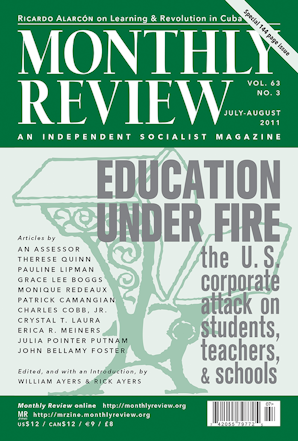
For MR this [special issue] represents only a starting point and we hope to continue to address the education question in future issues—not only in relation to the United States but also globally. Except for the crucial, concluding essay on Cuban education, provided by Ricardo Alarcón (President of Cuba’s National Assembly of Peoples’ Power), which points to what can be achieved in the realm of education once the barriers represented by capitalist society are removed, all of the articles in this special issue are concerned with the changing context of schooling in the United States. This is not meant, however, to ignore the rest of the world, but to constitute a warning of what may be in the offing for much of the global population—since the United States is the fountainhead of neoliberal policy.… It is clear…that education is under fire within much of global capitalist society.… Yet, the global struggle in this area is only just beginning and remains undetermined. The final outcome will depend to a considerable degree on the actions we take now.… | more |

Education Under Fire: Introduction

Education at the beginning of the twenty-first century is in crisis and contestation. The economic instability of capitalism—reflected in the slowdown in the economic growth trend since the mid-1970s, worsening financial crises, and the growth of draconian neoliberal policies—has had the effect of further compromising a capitalist educational system already beset with problems.… The conflict over the agenda of the powerful with respect to schools is increasingly apparent. On the one side we find: privatization; drastically lowered expectations for students and families; the demonization of teachers; zero-tolerance as a cat’s paw for surveillance and control; sort-and-punish curricula; a culture of obedience and conformity; and narrowing definition of learning as job-training and education, i.e., as a product to be bought and sold in the market. On the other side we find: a growing fight-back based on the principle that all human beings are of incalculable value and that life in a just and free society must be geared toward and powered by a profoundly radical idea: that the fullest development of all human beings—regardless of race or ethnicity, origin or background, gender identity, ability or disability—is the necessary condition for the full development of each person; and, conversely, the fullest development of each is the condition for the full development of all.… | more |

1. Education and Capitalism

Schooling in the twenty-first century United States is not the product mainly of educational philosophies and resources—together with whatever imagination and initiative that teachers, students, parents, and communities can bring to bear. Instead, it is dominated by the changing demands of capitalist society for an increasingly stratified and regimented workforce. In the first article in this section, John Bellamy Foster analyzes the political economy of education in capitalist society; the relation of this to the evolution of U.S. schools from the early twentieth century on; and the current corporate reform movement aimed at the restructuring and privatization of education—symbolized by the Bush No Child Left Behind and the Obama Race to the Top programs.… | more |

Education and the Structural Crisis of Capital

The U.S. Case

Today’s conservative movement for the reform of public education in the United States, and in much of the world, is based on the prevailing view that public education is in a state of emergency and in need of restructuring due to its own internal failures. In contrast, I shall argue that the decay of public education is mainly a product of externally imposed contradictions that are inherent to schooling in capitalist society, heightened in our time by conditions of economic stagnation in the mature capitalist economies, and by the effects of the conservative reform movement itself. The corporate-driven onslaught on students, teachers, and public schools—symbolized in the United States by George W. Bush’s No Child Left Behind (NCLB) legislation—is to be explained not so much by the failure of the schools themselves, but by the growing failures of the capitalist system, which now sees the privatization of public education as central to addressing its larger malaise.… | more |

Education: The Great Obsession

We are reprinting this essay by Grace Lee Boggs from the September 1970 issue of Monthly Review with only slight editing because of the historical perspective it offers and what we regard as its direct importance to the present struggle over public eduction.… | more |

Another Education Is Happening

The mainstream media has created the myth that community people are waiting for Superman, the White House, or state-appointed Emergency Financial Managers to resolve the escalating crises in our schools.… The following article by Julia Pointer Putnam tells the story of how the deindustrialization of Detroit has made Dewey’s more democratic view of education an idea whose time has come. —Grace Lee Boggs

2. Lessons from the New Corporate Schooling

As the articles in this section indicate, the new corporate schooling in the United States combines many of the worst aspects of capitalist schooling in a period of economic stagnation, financialization, and militarization/securitization together with a strategy of privatization of the schools. Public education is being degraded, regimented, and increasingly racially segregated—while the resulting worsening conditions in the schools are used to justify the restructuring of the entire education system.… | more |

Testing, Privatization, and the Future of Public Schooling

Standardized testing occupies a central place in the ongoing reorganization—or demolition—of public education in the United States. The key question is not whether leading sectors of capital—major foundations from Gates on down, business groups including the Business Roundtable and Chamber of Commerce, a near-endless array of think tanks and policy groups, major media, well-funded “Astroturf” (faux grassroots) groups such as Stand for Children, and leading forces in both major political parties at the state and national levels—promote standardized tests as a tool for making major, “high-stakes” decisions about students, educators, and schools. The better, and unanswered, questions are: Why are tests such an important weapon, What are the goals of the test-driven offensive, How does testing interact with other corporate school “reform” goals, and What can be done to turn this around?… | more |

Militarism and Education Normal

With the military’s ready and waiting personnel, infrastructure, and resources, no one should be surprised that the JROTC [Junior Reserve Officer Training Corps] is now offered as the alternative to physical education in urban school districts, or that the Department of Defense has responded to the educational crisis by opening and staffing public military schools. Currently, the military is education normal.… [P]ublic schools [have become] recruiting entities, and their targeting is not race, class, or gender neutral.… | more |

Reflections on the Racial Web of Discipline

One of the most powerful metaphors in critical education literature is “the school to prison pipeline.” The phrase conjures a vivid, unambiguous image, the meaning of which few would debate: poor and black and brown children being sucked into a vortex from mainstream educational environments and heaved onto a conveyor belt carrying them onto a one-way path toward privatized prisons, where the economic outcome of under-education and discipline is most evident.… Excessive discipline is often a critical first step out of schools for select youth—black boys, in this case—who disproportionately find themselves in prison. Being designated as disabled nudges the other foot out of the schoolhouse door.… | more |

The Culture of Poverty Reloaded

Although the student body in the United States is becoming more and more diverse, the teaching staff is strikingly homogenous… [W]hile many legislators may be unaware of the role of cultural competence, i.e., the ability to relate to diverse cultures, in teaching children in the United States, those who are on the ground in classrooms and schools everyday recognize its importance.… Education consultant Ruby Payne [—a self-proclaimed expert on the “mindset of poverty”—] represents one particular response to the culture clashes in the classroom. Her widespread success at once highlights the salience of race and class inequities, and speaks to the absence of practical educational strategies to confront them.… | more |

Inclusive Education, High Stakes Testing and Capitalist Schooling

This article is about our educational system and how it is working. I do not say how it is “failing,” because that would imply that it is not working. We need a different set of more nuanced questions. I want to ask: Working for whom? Working to do what? Failing whom? And failing to do what?… If we are concerned that we are failing to educate all children, or failing to prepare our future citizens, or failing some commitment to equity and social justice—then, yes, the system is failing. But one could also argue that our system is actually succeeding perfectly. It does a superb job sorting out the winners from the losers, perpetuating a highly-classed society, and creating the work force that our stratified, capitalist society requires.… | more |

3. Fight-Back: Education’s Radical Future

The Declaration of Independence says that we are all created equal and endowed with unalienable rights to life, liberty, and the pursuit of happiness. However, these lofty ideals can be realized only through struggle. They are incompatible with the logic of capitalism, but this logic can be and has been attacked by working men and women, and victories have been won.… | more |

Freedom’s Struggle and Freedom Schools

Throughout U.S. history, the “truths” [Thomas] Jefferson declared as axiomatic [in the Declaration of Independence] have hardly been evident in the lives of many “Americans,” certainly not in the lives of the two hundred or so slaves Jefferson held on his plantation.… [The recurring] contradiction between ideal and reality is the root of a continuing struggle over what the United States is to be as a nation.… For black people especially, this contradiction has been most persistent and destructive in “education.”… | more |