
In ‘New York Magazine:’ Mohammad Mhawish, contributer to “A Land With A People”
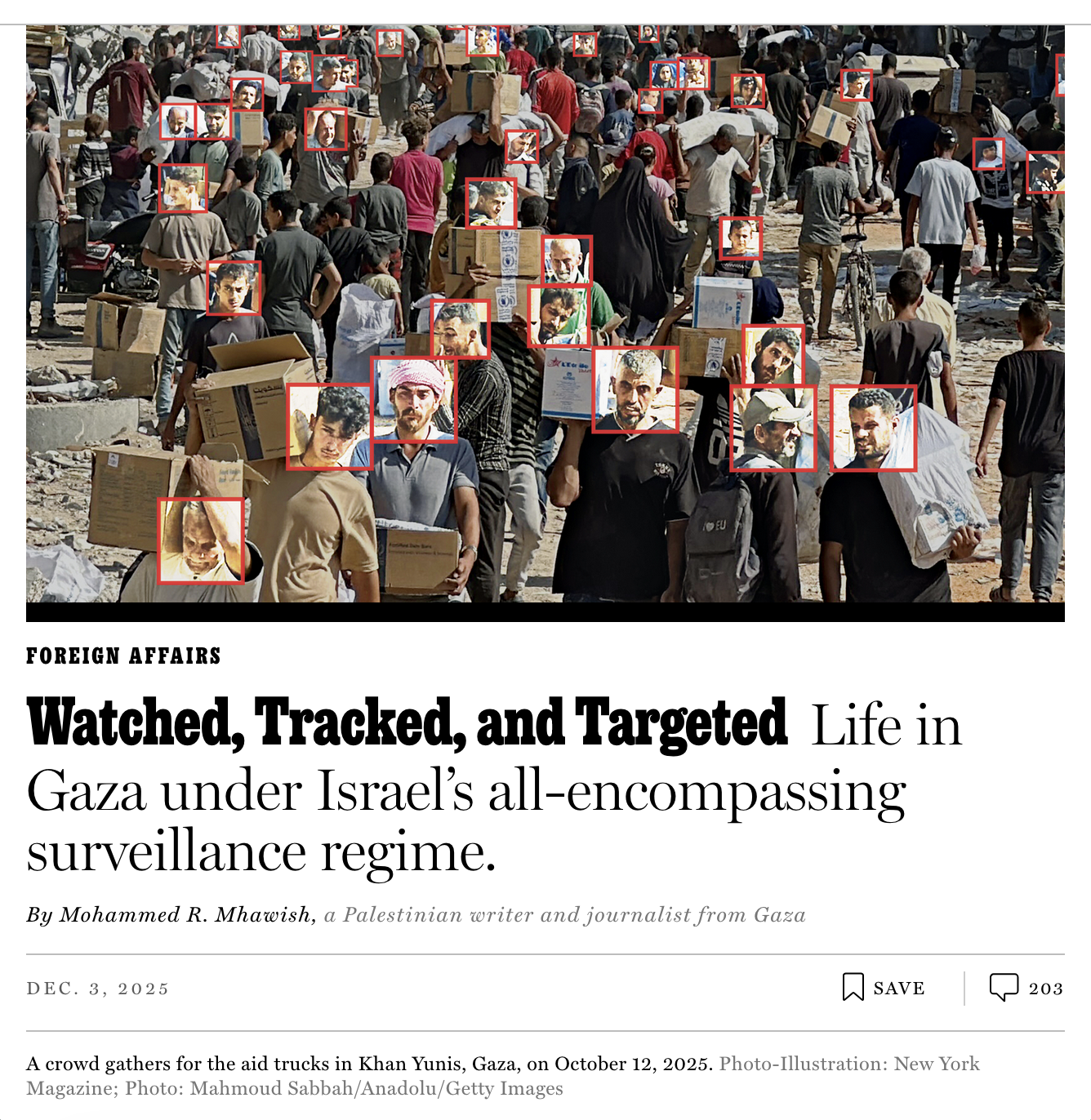
Life in Gaza under Israel’s all-encompassing surveillance regime
BY MOHAMMED R. MHAWISH
THE INTELLIGENCER
In the days before we reached the Netzarim checkpoint in Gaza in early April 2024, my wife and I rehearsed a stripped-down version of ourselves. We had already lived through six months of war, but this would be the first time we stood before Israeli soldiers. After seeing journalists killed, hospitals bombed, and bullets ripping through children, we believed that how we told our story could mean everything — for our lives and our chances of getting out.
We would tell the truth. But we would keep it to the parts least likely to invite suspicion: that we were a displaced family obeying Israel’s orders, which often came via air-dropped flyers and anonymous, automated phone calls, to evacuate south after our neighborhood in Gaza City was left devastated by months of bombardment; that Asmaa was pregnant; and that our 2-year-old son, Rafik, was weak from malnutrition. We planned to avoid identifying ourselves as journalists. And we would say nothing to betray that we intended for this journey to be the start of our escape from Gaza, that we planned to exit into Egypt through the Rafah crossing. I practiced my answers until the words felt cold. I was prepared to speak only as a father and husband trying to survive.
We walked through a shell-scarred stretch of road by the Mediterranean. The stroller wheels scraped against broken concrete; drones hummed above. My hawiya — the green Israeli-authorized ID Gazans carry — was in my pocket. After about two hours of walking, we arrived at Netzarim. A coastal stretch where families once walked the beach, it was now a militarized corridor of tanks, berms, and scanners. Two tanks sat ahead of us, snipers stood above the mounds of debris, and a line of soldiers grew clearer with every step.
At the checkpoint, soldiers herded the crowd into groups of five. I kept my eyes on Rafik. A soldier motioned us forward toward a camera: a dark orb behind glass on a tripod, a red light blinking beneath its lens. While Asmaa gripped our son’s hand, soldiers watched a screen behind the camera. Asmaa and Rafik went first. We stared into it and held our breath, waiting for their thumbs-up — the signal soldiers had used for people to move on. Others were pulled aside.
The seconds stretched. “Mohammed,” the soldier finally said. I didn’t react at first. Mine is a common name. Then he said my last name. I felt my breath stop. The soldier, his face masked, a rifle slung across his chest, gestured for me to step forward. The fear wasn’t of what they might find out about me but of what they already knew. My ID was still in my pocket. The practiced version of myself went dead. None of it mattered now. I had just been confirmed….
…Life in Gaza for the past two years has been a process of losing everything visible — our families, homes, streets. It also means losing what cannot be seen: the private space of the mind, the intimacy between people, and the ability to speak without fear of being monitored by a machine. A poll conducted just weeks before the October cease-fire by the Palestine-based research organization Institute for Social and Economic Progress found that nearly two-thirds of Gazans believed they were constantly watched by the Israeli government. This is the dystopian consequence of technology, supplied in part by American companies, being placed into the hands of authorities who have virtually unlimited control over a captive population they have openly villainized. It is the culmination of decades of monitored occupation, a totalitarian nightmare spliced with genocidal terror, a system that is already evolving and growing for whatever comes next. The old admonition of authoritarian regimes everywhere — If you have nothing to hide, you have nothing to be afraid of — has no meaning in Gaza….
Read the rest at New York Magazine, and watch Mhawish’s interview on the article, on Democracy Now!