
January 29-31 Conference: Unequal Exchange in the Twenty-First Century
Join a two-part conference on “Imperialism and Resistance Today” /Where: Amsterdam / See: https://ue21.org/
This January, scholars and activists from around the world will come together for the inaugural convening of UE21, Unequal Exchange in the Twenty-First Century, hosted by the Arghiri Emmanuel Association, and Anti-Imperialist Network.
Why the conference:
Arghiri Emmanuel (1911-2001) was one of the leading theoreticians of the political economy of imperialism from the mid-60s and up through the 70s, accompanying the wave of national liberation struggle against imperialism. Emmanuel put forward the idea of “Unequal Exchange,” which was the economic backbone of the theory. The concept and especially its political implications were widely discussed among academics as well as political activists at the time.
When Emmanuel passed away in 2001, the world was very different. It was at the height of neoliberal globalization. The national liberation struggle had not managed to continue into an economic liberation from the grip of imperialism. Instead, transnational capital had outsourced industrial production to the Global South, taking advantage of the low wage level of hundreds of millions of new proletarians, making the concept of “Unequal Exchange” more relevant than ever. However, at the time, the discourse of “imperialism”, not to speak of “anti-imperialism,” was considered something “retro” from the 70s. Few were interested in the legacy of Emmanuel, and his archive and papers was stored in the cellar of his friend and collaborator Claudio Jedlicki.
Twenty years have passed, and the world has changed again. The globalization of production, in the form of transnational supply chains, in the intervening period, have even further enhanced the importance of Unequal Exchange as the principal mechanism of imperialist exploitation. Neoliberal globalization is now in crisis, China has become the factory of the world, and the U.S has turned to military geopolitical struggle to uphold its hegemony. Today we see a new wave of resistance in the Global South against the dominance of the center. Imperialism has returned as a theme of interest, and so have the ideas of Emmanuel, reflected in many new books and articles.
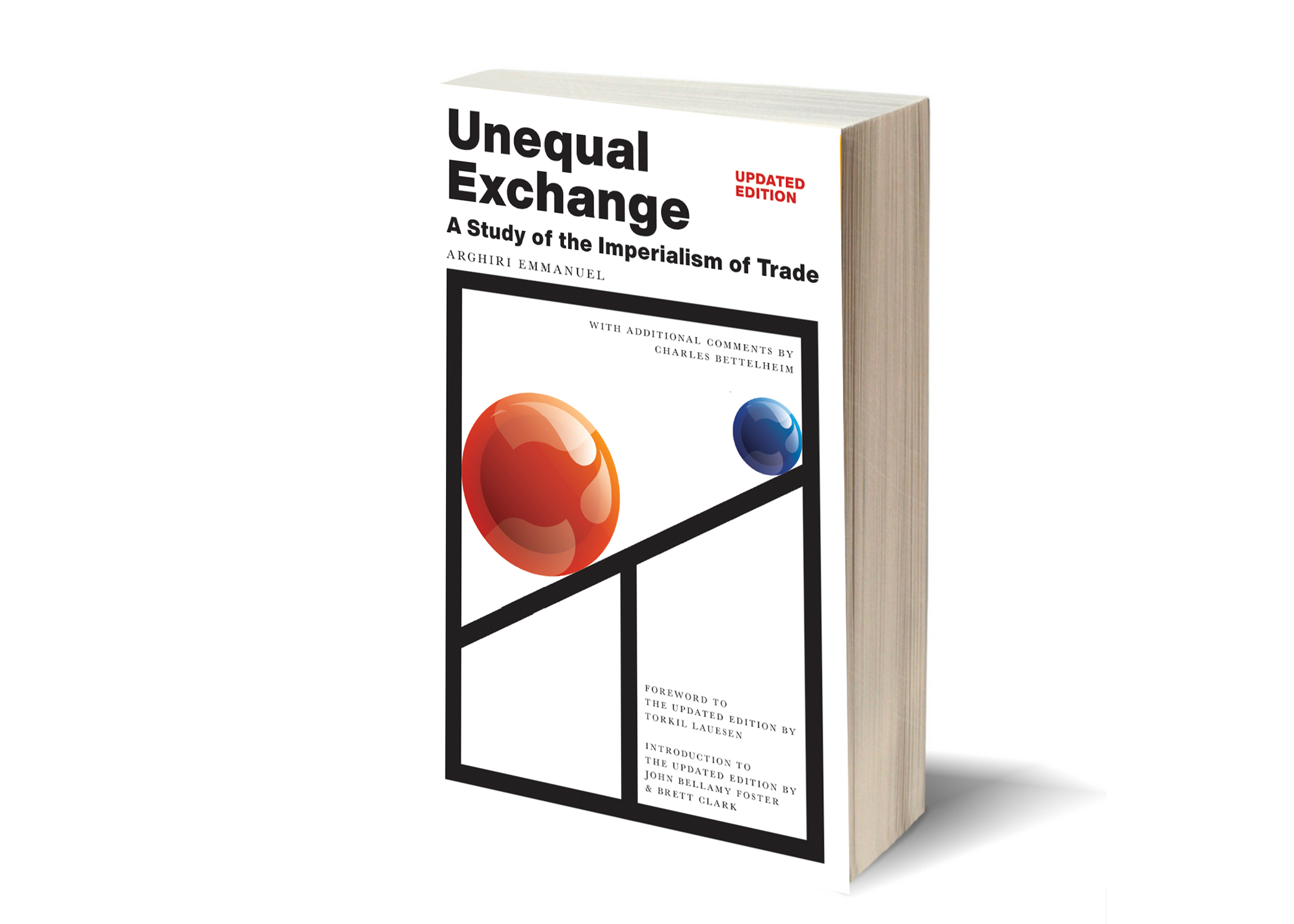
In the public eye: Arghiri Emmanuel’s Unequal Exchange
How one nation can grow rich at the expense of another is one of the central problems of economics in the era of neo-colonialism. Traditional doctrine, resting on Ricardo’s theory of comparative costs, which has dominated investigation of this issue for a century and a half, has proven itself incapable of providing an answer. Emmanuel’s path-breaking study, now itself a classic, upends the conventional assumptions, subjecting the phenomena of international trade to critical scrutiny, both systematically and with logical rigor. It integrates the theory of international value (and unequal exchange) into the general theory of value as propounded by the classical economists and Marx.
Enmanuel’s theory of unequal exchange generated a widespread world debate on its first appearance, part of which, emanating from French economist Charles Bettelheim, is included in this volume. It has remained the foundation of critical analysis of international exchange relations ever since, and has gained even more importance today in the age of global value chains.