Category: Reviews /

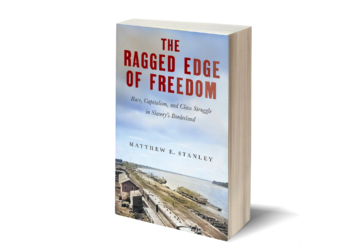
New! Matthew Stanley’s “The Ragged Edge of Freedom”

New! Matthew Stanley’s “The Ragged Edge of Freedom”

The latest, from Paul Buhle: "Abolitionists and social reformers of all kinds, with a wide Yankee following augmented by many recent German immigrants, sought to take things beyond the uneasy accommodation of white populations to each other across existing political lines. In Wisconsin and in Chicago most notably, these would include “Abe’s Boys” enrolling in the army of the Union. Not so in the Southern Illinois, two hours’ drive from my hometown. The whites who immigrated northward from the near South, largely uneducated and lacking skills, came to be considered almost a species in themselves...."
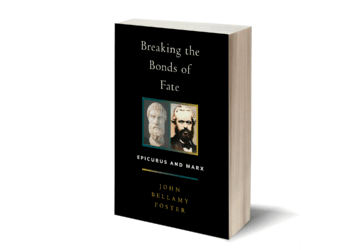
John Bellamy Foster’s “Breaking the Bonds of Fate”

John Bellamy Foster’s “Breaking the Bonds of Fate”

The latest: "....Epicurus for Marx was a plus because he was very critical of religion or teleology – the notion that the gods or God determined things on earth. He rejected that without rejecting religion completely. And he emphasized that the basis of human life was community, friendship; building a society based on friendship. He was the first to bring women into philosophy – allowing them to emerge as major philosophers within the Epicurean school – and also slaves. He couldn’t do anything about slavery itself, but he brought slaves into Epicurean philosophy...."
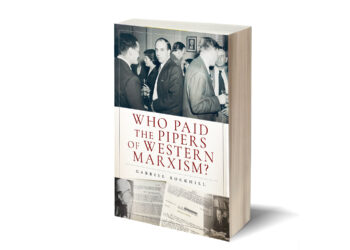
Gabriel Rockhill’s “Who Paid the Pipers of Western Marxism?”

Gabriel Rockhill’s “Who Paid the Pipers of Western Marxism?”

The latest, in Le Monde: "En 1999, une historienne britannique, Frances Stonor Saunders, a décrit dans Who Paid the Piper? CIAand the Cultural Cold War ( Qui mène la danse ? La CIA et la guerre froide culturelle , Denoël, 2003) comment la CIA infiltrait la culture des années 1950 et 1960 par l’entremise de fondations commeFord ou Rockefeller. Gabriel Rockhill prolonge cette enquête en montrant comment les Etats-Unis ontutilisé ces mêmes canaux pour influencer les théoriciens de gauche – notamment ceux de l’école deFrancfort – afin de rendre leurs idées compatibles avec le capitalisme...."
Andy Merrifield’s “Roses for Gramsci”

Andy Merrifield’s “Roses for Gramsci”

The latest: "....Is 'subaltern' a code for the working classes? Is 'hegemony' an economic force or a cultural power? Are 'organic intellectuals' inherently more progressive? The answers to such questions depend upon your choice of scholar—whether, say, you’re reading a Foucauldian literary critic or a Marxist sociologist, a subaltern historian or a posthuman anthropologist. Over the years, Gramsci’s writing has been polished by critics of such diverse persuasions that it has now become a mirror: One opens his books only to confirm one’s own beliefs....when the English writer Andy Merrifield arrived in Rome, feeling 'washed out intellectually,' Gramsci came to the rescue...."
“Silencing Fighting Bob: The Attack on Antiwar Progressives During the First World War”

“Silencing Fighting Bob: The Attack on Antiwar Progressives During the First World War”

The latest: "Chester weaves a nuanced story of heroic activism and governmental abuses that extended all the way to the office of the President. He recognizes the complexities of the circumstance and does not look away from the compromises by La Follette and others as they faced overwhelming pressure to get in line with the war effort. The editor of The Forward would eventually announce that the paper was “absolutely loyal” after the United States entered the war. As 1917 gave way to 1918, the Senator from Wisconsin took a lower profile, stopped giving fiery speeches and, finally, softened some of his criticism of Wilson...."

The Digital Mask of Class Power (Forthcoming: “Digitalization in India”)

The latest: "What has happened in the 15 years when digitalisation was expected to clean up systems, make governments more efficient, make services more inclusive, reduce poverty, and reduce dependence on the state and reduce inequality? Okay, that last was perhaps never said to have been on the agenda, but it should have been. The articles brought together by the Research Unit in Political Economy (RUPE) analyse, through field surveys and policy documents, the experience of those whom the system has so far failed to serve…."

In the public eye: Contributors to “A Land With A People”

The latest from Mohammed Mhawish: "We have to ask ourselves: Do we know Hind? Of course we’ve heard her voice, or maybe have seen the building someone renamed after her at Columbia in her honor — which matters, and which she would have deserved, and which is still not the same as knowing her. But do we know her laughter, the way she moved through a room, what she was afraid of, what she loved, the world she was building inside herself at six years old? We learn none of it from the film. We learn it, if we learn it at all, from the interviews her mother gave on the side, on other people’s platforms. The film that claims her voice does not make space for her life."