May 28: LIVE + IN PERSON, Socialist Register 2026

May 28: LIVE + IN PERSON, Socialist Register 2026

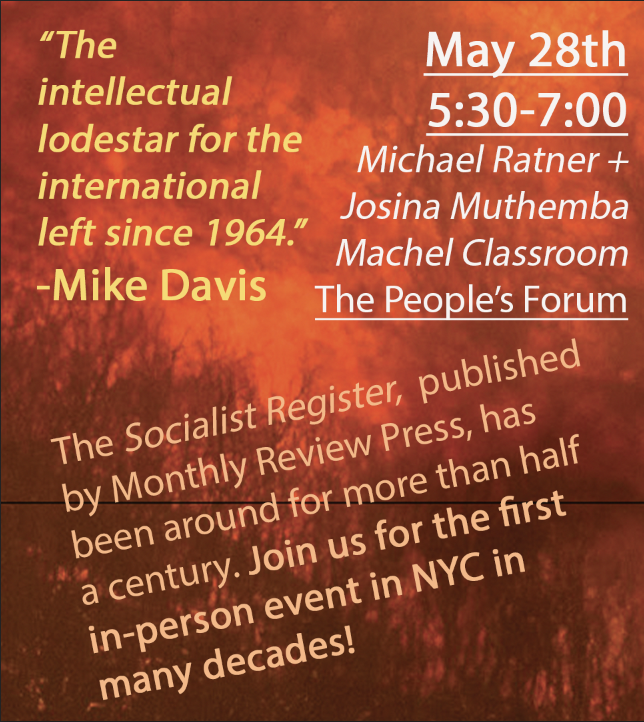
May 28th: 5:30-7:00
320 W 37th St, NYC: Michael Ratner Classroom + Josina Muthemba Machel Classroom

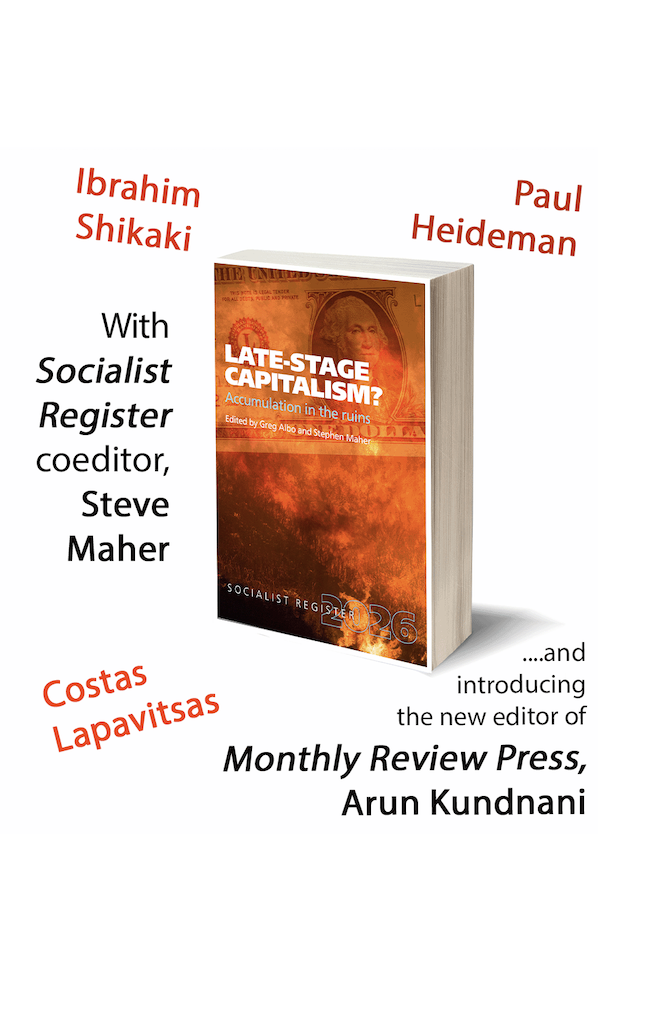
Join us 5/28 for the first-ever in-person launch of the Socialist Register in New York City, at The People’s Forum! This is your chance to come meet, in person, our new editor, Arun Kundnani, alongside the relatively new coeditor of the Socialist Register, Steve Maher, joined by three contributors to this year’s volume: Ibrahim Shikaki, Costas Lapavitsas, and Paul Heideman.

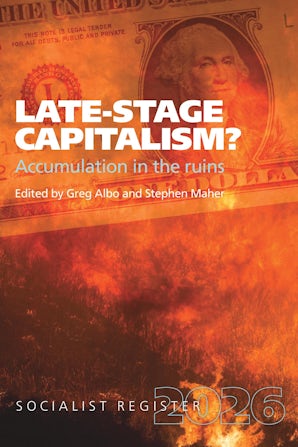
Building upon more than a half century of sustained analysis of the evolving political economy of contemporary capitalism—and in particular the challenges it poses to the left—Socialist Register 2026, Late-Stage Capitalism? Accumulation in the Ruins puzzles through the rubble left behind after decades of rampant neoliberalism.
Maher and Kundnani, together with three contributors to this year’s volume, Ibrahim Shikaki, Costas Lapavitsas and Paul Heideman, will consider these and other questions:

What kind of world order is now emerging?
-Is capitalism entering a terminal crisis, or being violently reconstituted?
-How is American empire being reshaped from Palestine to New York?
-And what possibilities remain for socialist politics in an age of ecological breakdown, geopolitical fracture, and resurgent authoritarianism?

Watch above for a full list of contributors to this year’s Socialist Register 2026, Late-Stage Capitalism? Accumulation in the Ruins.

Do we interpret these remains as the hoard left after ‘escalating plunder’, or should we rather see them as puzzle pieces in a novel techno-feudal mode of production that is a distinct, even ‘mutant’, form of capitalism?

Can we simply understand the current context as the advanced stage of post-industrialism in which the provision of non-standardized services has somehow replaced commodity production as the central economic activity?

Or, is it enough to see neoliberalism as more or less yielding to an unstable interregnum of increasingly authoritarian states, far-right movements, and intensification of labor exploitation and ecological degradation?

In contrast, what would happen if we instead took the ‘accelerationism’ tack, perceiving potential egalitarian ‘techno-futurisms’ ahead?