
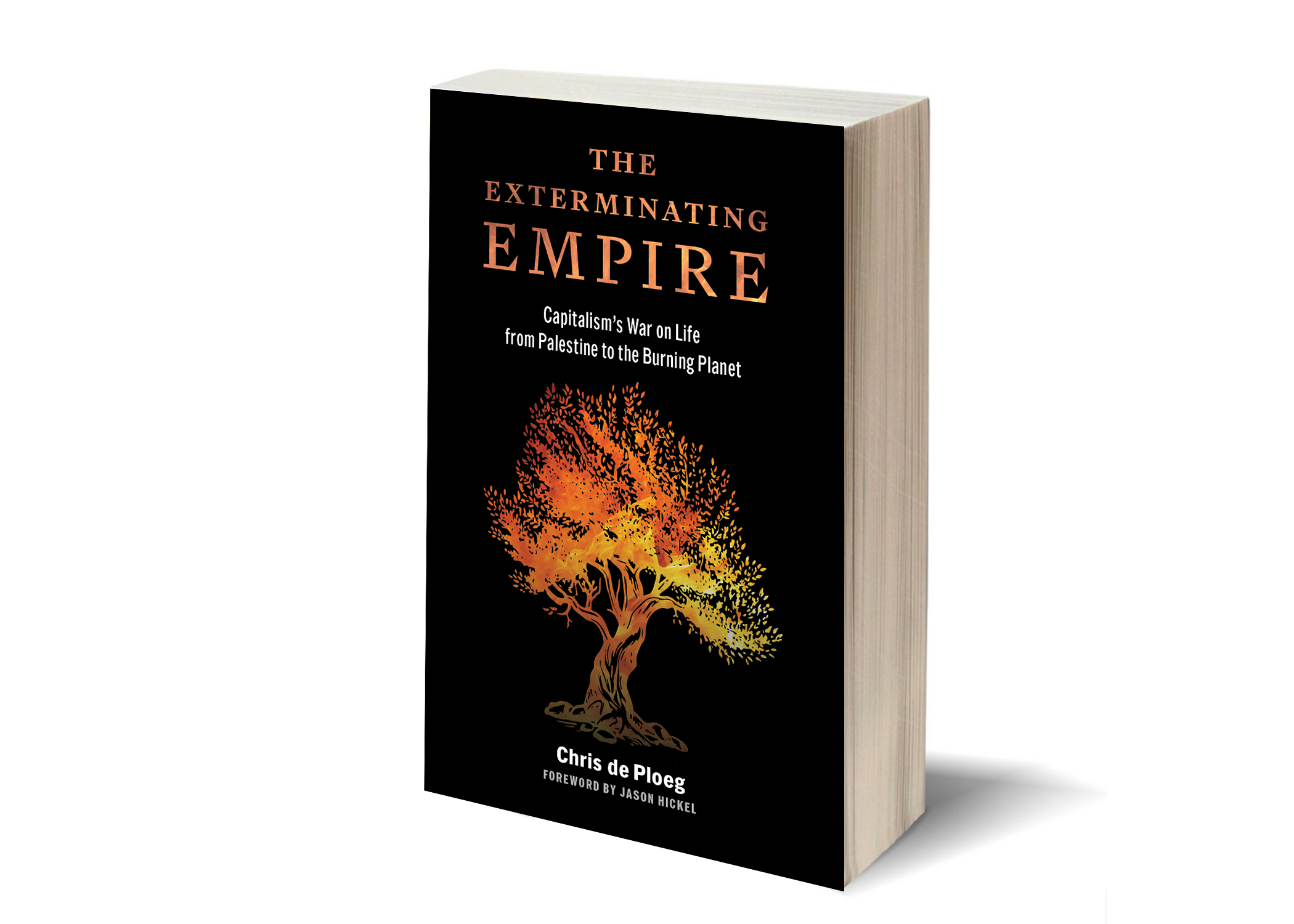
New! Chris dePloeg’s “The Exterminating Empire”
REVIEWS:
Counterpunch, “Capitalism is Waging War on Palestine While Creating a Burning Planet” by Daniel Falcone:
Daniel Falcone: What is the central argument of The Exterminating Empire and how is the book structured? It looks as though the book serves as an intervention as well as an addition to current scholarship.
Chris Kaspar de Ploeg: I open the book with some jarring facts that seem paradoxical at first sight. We need about 30 percent of our productive capacity to give everyone on the planet a good life. Not just the basics like housing, clothing and healthcare, but also modern appliances like refrigerators, laptops, access to the internet and more. At the same time, that standard of living is denied to about 80 percent of the world population. Green energy has been cheaper than fossil fuels for years, yet climate breakdown is only accelerating. We could solve world hunger with about 0.03 percent of global GDP, but hunger is only increasing.
That looks like an extraordinarily wasteful system, and it is. The point, however, is that under capitalism, these are not paradoxes at all. In fact, they are signs of capital’s success. Under our current economic system, the primary goal, ruthlessly pursued, is profit maximization. That profit maximization is reached through pushing down costs–and we are those costs, our labour, our environments, our lives–and by conquering markets, often through a mix of military and economic warfare. That essentially puts capitalism on a warpath against life. The system is working exactly as it is supposed to.
We see, for example, that profit rates are higher in the fossil fuel industry because it essentially functions through monopolies, despite the higher costs. We see that the military-industrial complex is growing exponentially, targeting any vestiges of resistance against US-led global hegemony, which globalized harsh budget cuts in social welfare, healthcare and education. These very conditions of structural impoverishment then create the conditions of desperation necessary for people and countries to accept their status as sources for cheap labour, resources and land for global corporations, mostly centered in the Global North.
In the book I write about a dialectic between slavery and genocide, and between structural genocide and active genocide. A good way to understand that relationship is by going back to the We Charge Genocide petition, which was presented in 1951 at the United Nations by William L. Patterson, on behalf of the Civil Rights Congress. He estimated that, since the abolition of slavery, some 10,000 black people had been lynched, often for something as small as looking a white woman in the eyes. These lynchings were not hidden affairs, but were a public spectacle, for which neighbors came together, and pictures were spread on postcards across the country.
Patterson goes on to argue that this kind of active violence serves a deeper purpose. It was meant to intimidate the black masses to accept lower living standards, functioning as a dehumanized workforce for corporations. At the time, this led 32,000 excess deaths every year among Black Americans compared to white death rates. Patterson charges this as a ‘genocide for profit’, based on the article in the UN convention that lists “deliberately inflicting on the group conditions of life calculated to bring about its physical destruction.” Combining two studies that were done since that time, I show that between 1940 and 2020 the total excess death toll of African Americans is 6 million.
Nowadays, scholars tend to call this ‘structural genocide’. And I argue that this is a global phenomenon under capitalism. In a sense, the active genocide in Palestine is a lynching aimed at intimidating the Global South into accepting its role as devalued lives for Western profits. The blatant, live-streamed and openly announced nature of that genocide is exactly the point, just as the lynchings of the American South were broadcast widely. It is aimed to intimidate people, because the active genocide serves the broader, structural genocide.
The histories of genocide and slavery are deeply intertwined. In fact, almost every genocide in history also deployed slave labor–even in the archetypical death camp, Auschwitz – and chattel slavery also contained genocidal dynamics of cheapened lives and heightened death rates. In a sense, even in Gaza the exterminated are forced to labor as guinea pigsfor the global arms industry, whose weapons are then sold as ‘battle tested.’ But on a more structural level, the survival mode that is forced upon the global masses makes them accept conditions they normally never would. Generations of workers used to call this ‘wage slavery’, to emphasize the lack of freedom underlying these conditions. Indeed, the global peasantry first had to be robbed of their communal lands – where they could often provide for themselves – before they could be forced to work under the hierarchical system of capitalism. Essentially, then, the global architecture of capitalism promotes various modes and gradations of extermination and slavery.
The book marshals a lot of data and history to demonstrate how this system has functioned so consistently throughout the centuries. I also fuse ecology and climate breakdown deeply into this analysis, both theoretically and empirically, as any attack on human life tends to be equally fused with attacks on their environments. Ecocide and genocide go hand in hand, both on the active and structural level. The very idea that we can separate the humans from ecology is itself a colonial and capitalist phantasy. But the book is not only gloom and doom. I end with a long chapter on strategizing how to beat this system, learning both from the accomplishments and failures of resistance movements from the past and the present. Honestly, the pace of the book is quite high, so it is impossible to summarize everything in one interview.
Daniel Falcone: To what extent does the spirit of resistance become the prime target for annihilation? Also, how is cultural genocide related to capitalist alienation? You discuss the cogs in the hierarchical machine, but I am wondering how this idea explains your thesis and impacts collective identity.
Chris Kaspar de Ploeg: When the Polish-Jewish legal scholar Raphael Lemkin coined the term genocide in 1944 in his Axis Rule in Occupied Europe, he was not thinking primarily about mass killings. Rather, he saw in Nazi rule an attempt to wipe out the collective coherence of peoples, their languages, their institutions, their intelligentsia, cultures, all of it. He defined genocide as imposing ‘the national pattern of the oppressor’, either on the people themselves or on their territory after their deportation or slaughter…..
Read more at Counterpunch
APPEARANCES:
Just hours after its release, the first interview with Chris De Ploeg immediately went live!
Adnan Husain‘s Office Hours 39
Taking the ongoing genocide in Palestine as a point of departure, The Exterminating Empire traces capital’s centuries-long war against life itself. From the slave plantations and scorched-earth campaigns of early colonialism, to Vietnam, Haiti, Iraq, and today’s climate apartheid, Chris de Ploeg shows that, not only has exterminatory violence against peoples and ecosystems been central to the imperial project, but omnicidal tendencies—the drive to kill everything—have always been present. Operating at different scales, these tendencies possess the potential to annihilate even the imperial core itself, along with the rest of the planet. Read more….