
Gabriel Rockhill’s “Who Paid the Pipers of Western Marxism?”
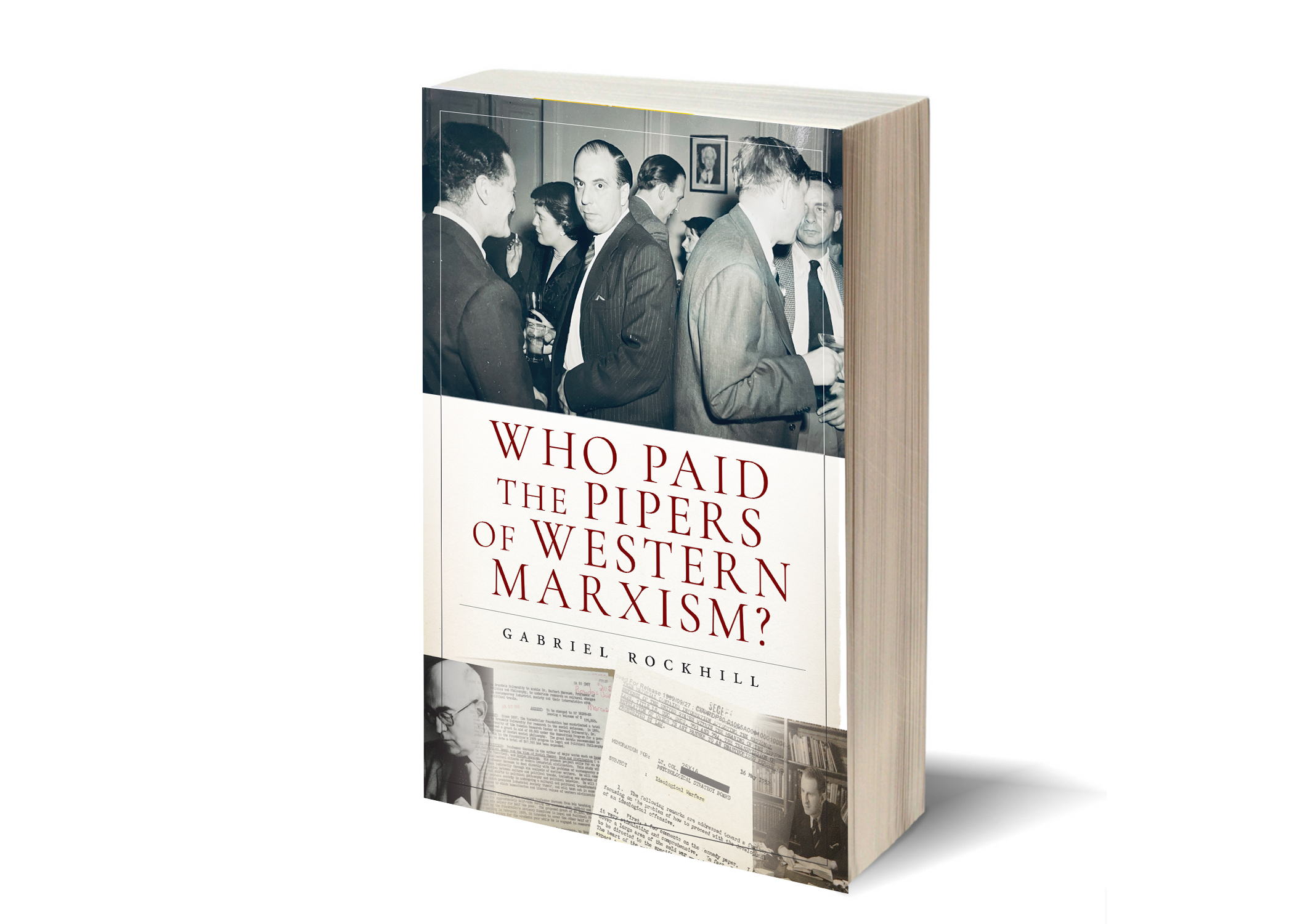
Controversy, controversy…it’s no surprise that this book is selling very well. See more on this from Bisharat Abbasi, in his post: “In Defence Of Gabriel Rockhill’s Who Paid the Pipers of Western Marxism: Anti-Imperialist Marxism Versus The Imperial Theory Industry.“
DIGEST: Reviews, interviews, appearances
Marx Memorial Library in London hosted a dual book launch for Requiem for French Theory and Who Paid the Pipers of Western Marxism? with Gabriel Rockhill, Aymeric Monville, and Jennifer Ponce de León, who engaged in a discussion regarding the effects of imperialism on the production and dissemination of knowledge. Far from simply engaging in a critique of the faux radicalism of the prominent discourses within the imperial theory industry, the discussion was grounded in a reasoned defense of the vibrant international tradition of anti-imperialist Marxism. Topics included the imperial promotion of Western Marxism and postmodern French Theory, the international war of ideas, the failed efforts to discredit anti-imperialist Marxism, culturalism and identity politics vs. a materialist analysis of the colonial question, fascism past and present, the dialectics of actually existing socialism, and the current state of global class struggle in theory and practice. Watch here or below
The Left Chapter, reviewed by Leo Schwarz:
“Shortly before his death, Herbert Marcuse wrote an essay on Rudolf Bahro’s book The Alternative in Eastern Europe. In the essay, Marcuse hailed Bahro’s ‘critique of actually existing socialism’ as ‘the most important contribution to Marxist theory and practice in decades.’ This statement was part of a coordinated campaign for the book and for Bahro that swept through the major media outlets of the Western world between 1977 and 1979–80. As we now know (or can know), a striking number of the key figures in this campaign maintained connections in the postwar decades to the Central Intelligence Agency or to various institutions and organizations that were either controlled, funded, or considered ‘friendly’ by the CIA or the U.S. State Department. In the first volume of his three-volume reconstruction of the ‘intellectual world war’ against actually existing socialism, Gabriel Rockhill examines the history and specific function of these networks of the ‘imperial theory industry’ that emerged after 1945, with his interest focused primarily on the Frankfurt School and the academic “Marxisms” of the Western world, which are usually categorized as ‘Western Marxism’…..” Read more….
Kaanan, reviewed by Adel Samara
“…I was among those who criticized the Soviet system in its post-Stalin decades, and the lesson learned was that the greatest losers were the peripheral countries, especially the Arab nation, since the Soviets had long acted as a force restraining the imperialist beast. More importantly, this collapse was, in historical-materialist terms, a setback—an exception—because history fundamentally advances upward. Though our wounds were deep, the class enemy emerged victorious but also wounded, most notably by becoming the sole superpower, exposing its flaws and unleashing its brutality. In this brief context, I attempt to summarize Gabriel Rockhill’s book—a painstaking and rigorously documented scholarly work. Yet its timing is no less important than the work itself, for it constitutes a bold revolutionary confrontation that demonstrates the author’s profound communist commitment in an era when loyalty to communism has become rare and the fungi of internalized defeat have spread everywhere, filling the burrows with fleeing rats….” Read more at Kaanan.online
Red Ant Collective: “Checking out of the Hotel Abyss,” by Brendan Duncan-Shah
“Marxism in the imperial core is currently going through a process of reorientation, regroupment, and renewal. The period from 1991 to 2008 constituted what Samir Amin has called the second belle epoque of capital.1 Emerging out of a period of relative defeat for socialism, capitalism was ascendant. The wave of privatisations and the relocation of manufacturing to the Global South injected a wash of surplus into the system. Emboldened by the dissolution of the Soviet Union, the U.S. led imperialist alliance consolidated its hold on the world capitalist economy through its organs, the International Monetary Fund, the World Bank, and the World Trade Centre. The U.S. itself indulged in unrestricted, ‘naked’ imperialism, carrying out a slate of invasions with complete impunity in Iraq (1991), Afghanistan (2001) and Iraq again (2003), to mention just the well known ones.2 In the Global North, “radical” thought withdrew from Marxism. Laclau and Mouffe’s Hegemony and Socialist Strategy in 1985 heralded a trend that was to consolidate itself up to 2008: the retreat from class politics. Various kinds of “post-Marxisms” emerged and became dominant in the centres of intellectual production. Non-class based forms of political organisation entered the scene with increasing frequency—tailed theoretically by works like Hardt and Negri’s Multitude (2004). The spontaneous working class movement itself fell into a lull, settling into a total divorce from Marxism. Unions, softened by the sop from half a century of unequal exchange, either made peace with their integration into the bourgeois state or vanished as a serious social force. The result was that working people were deeply unprepared to contest the slow rollback of the social wage. All of these trends should be seen for what they were: symptoms of a period of defeat for the real movement….” Read more….
Morning Star: “What is (or was), ‘Western Marxism?'”
“The term “Western Marxism” was popularised by Perry Anderson, editor of the journal New Left Review, in his book Considerations on Western Marxism, published in September 1976. For Anderson Western Marxism was “a product of defeat”: of the failure of the Russian Revolution to spread throughout Europe and the impact on the Soviet Union’s development by its encirclement by hostile forces — before, during and subsequent to the second world war. Some “left” intellectuals were unable to come to terms with the contradictory realities of building a state capable of withstanding the military and economic aggression of imperialism and dismissed or ignored the way that the consolidation of power in what became the USSR inspired anti-colonial revolutions elsewhere, not least in China, Vietnam and Cuba as well as Africa and Latin America….’
Counterview: “Patronage of dissent? Examining the cold war roots of western Marxist thought’, by Harsh Thakor
“…The narrative begins with the CIA’s pursuit of Che Guevara, using it as an entry point to discuss ideological warfare. Rockhill highlights Guevara’s own belief in the importance of media and ideology, shaped by his experience of U.S. propaganda during the Guatemalan coup. The book is structured in three parts: first, outlining the “imperial intellectual apparatus” of the Cold War; second, a detailed examination of the Frankfurt School’s integration into U.S. and West German institutions, with a focused case study on Herbert Marcuse’s documented ties to U.S. government projects; and finally, a conclusion contrasting what he terms “imperial” Marxism with anti-imperialist traditions. Rockhill’s work challenges the perception that “Western Marxism” emerged organically solely from within the Western workers’ movement or intelligentsia. He proposes that powerful external forces consciously nurtured certain theoretical directions. His ultimate conclusion is that the dominant Marxist tradition inherited in Western academia is a depoliticized one, shaped by the very powers it claimed to critique, and thus ill-suited for building concrete revolutionary alternatives…. Read the rest
MR Online: “An Insider Critique of the Imperial Theory Industry: Gabriel Rockhill Interviewed by Michael D. Yates”
“Michael Yates: Gabriel, what we are as adults is conditioned by our childhoods. Tell us something about where and how you grew up. How do you think this influenced who you are now?
Gabriel Rockhill: I grew up on a small farm in rural Kansas, and manual labor was an integral part of my life from an early age. This included work on the farm, of course, but I also worked construction. My father is a builder and an architect, so when I wasn’t working on the farm, I spent most of my time, outside of school and sports, on construction sites.
Before I even knew the word, I had the lived experience of exploitation (farm work was never waged, nor was construction work early on). This is clearly one of the things that drove me to the life of the mind: I enjoyed school as a welcome reprieve from manual labor.
My father is deeply passionate about design, and his motto is ‘hand and mind,’ meaning that to be a true architect, you need to have the practical knowledge to build (hand) what you design (mind). I was desperate for more of the latter when I was young, but I have also remained deeply attached to the former. In retrospect, this approach obviously had a lasting impact on me, since I have definitely embraced what I would now call the dialectical relationship between practice and theory….”
Excerpt of a book review by Gabriella Golea, RN, MN, CPMHN(C), Ontario, for the Canadian Federation of Mental Health Nurses newsletter:
“The Book as a Psychological Case Study: As a seasoned mental health nurse, the writer of this review was particularly intrigued by some of the psychological perspectives that Rockhill appeared to offer. From a psychological standpoint, Who Paid the Pipers of Western Marxism?, offers several important lessons about how power, especially institutional power, can shape cognition, identity, motivation, and collective belief systems. Below are some psychological insights that appear to be weaved throughout the book, presented here without judgement, so that readers of the book can form their own opinions….
- Critical Thinking Is Not the Same as Political Agency
•High levels of sophisticated thinking can coexist with low capacity for collective action.
•Intelligence does not immunize people against ideological conditioning.
•Overemphasis on critique can weaken confidence in action (“analysis paralysis”)
•Endless critique can undermine people’s belief in change and alternative possibilities. (Should there be an online link to the CPMHN newsletter, we will link to it here…)
MLT – Marxism-Leninism Today: Joseph Jamison on Rockhill vs. Saunders and the term “Western Marxism”
“’He who pays the piper calls the tune’ is the proverb alluded to in the title of Gabriel Rockhill’s outstanding new book Who Paid the Pipers of Western Marxism? subtitled “The Intellectual World War. Marxism Versus the Imperial Theory Industry.” [1] The title of Rockhill’s book calls to mind the British title of a well-known earlier book Who Paid the Piper? The CIA and The Cultural Cold War by Frances Stonor Saunders.[2] While rich in factual detail, the Saunders work rarely went beyond liberal outrage about CIA deceit, corruption, contempt for democracy, and brutal violence.
Gabriel Rockhill’s book is a far deeper and more ambitious work. It strives to make a number of advances in Marxist theory, and it focuses on a specific aspect of the Cold War of ideas by concentrating on the capitalist ruling class’s attempt to destroy its communist nemesis by consciously shaping a form of bogus ‘Marxism’ — ‘Western Marxism’ — that would not threaten the capitalist status quo.
Rockhill’s main contention is that much of what is known as ‘Western Marxism’ — especially the strain associated with Frankfurt School and what he calls French Theory — was not a genuine revolutionary or anti-capitalist current. Rather, it functioned as a vehicle of ideological control under capitalism and imperialism. Rockhill shows through a massive amount of archival evidence that powerful capitalist interests — including states, foundations, and institutions tied to imperialist powers — actively funded and promoted this so called ‘critical theory’ tradition. The aim of all this funding and promotion was to produce a ‘compatible left’ — a left-leaning intelligentsia that would appear critical but would ultimately serve the needs of the ruling capitalist order by diverting attention away from systemic class struggle, revolutionary social change, and the achievements of actual socialism.” Read the rest here…
Counterpunch: “When Marxist Intellectuals Collaborated With the CIA“, by Charles Reitz
“In agreement with the highly respected recent work of Daniel Immerwahr and David Vine and other contemporary radical scholars, Gabriel Rockhill’s new book, Who Paid the Pipers of Western Marxism, The Intellectual World War. reinforces the by now quite widely-held notion that there is a US empire. Following World War II and the establishment of cold war and the US national security state, a global intellectual contest was underway between those promoting and those opposing the political/philosophical hegemony of US imperial interests. A key element in the political economy of the US knowledge production system was (and is) a CIA partnership with elite universities and Cold War scholars, key corporate foundations, federal research projects, and the top leaders of the corporate mass media. Utilizing wide-ranging archival documentation, Rockhill’s book establishes these interconnections anew (previously adumbrated by Parenti, Mills, Domhoff, etc), and he does so in admirable depth. There was a concerted endeavor to draw critical social commentary into the ‘compatible’ (150) Western Marxist camp and away from what Rockhill sees as the incompatible revolutionary Marxism practiced by Che (whom he lionizes in his first several pages and sees as emblematic of a Marxist fighter and leader in Cuba and Bolivia, in the end assassinated by CIA-linked operatives. Rockhill views Che’s legacy as consistent with other leading lights, such as Lenin, Mao, Ho Chi Minh, and Fidel Castro (338), who were at the helm of real socio-economic alternatives to capitalism in practice.
Given the accompanying context of ideological contestation, Rockhill investigates the systems of US knowledge production and counterrevolution for what they were [and continue to be]. This is a worthy project, and Rockhill’s skepticism is warranted with regard to radical intellectuals (like Marcuse, Neumann and many others) serving with the intelligence services of the US government during and after WW II, especially in connection with certain New Left criticisms of Old Left policies. He sees himself as defending anti-imperialist Marxism against the ‘imperial theory industry.’ This industry is considered to be part of the US imperial project, and his mission is unveiling the intellectual ‘pipers’ it paid and those who paid them.” Read more at Counterpunch….
Weaponized Information: Who Paid the Pipers? Empire’s Safe Marxism and the War on Revolutionary Consciousness, by “Prince Kapone”
“This book arrives not a moment too soon. Who Paid the Pipers of Western Marxism? is not a contribution to academic debate. It is an intervention into a global struggle over consciousness, one that determines whether the working classes of the world will recognize their enemies—or continue to fight shadows while empire tightens its grip. Gabriel Rockhill’s work speaks directly to the material reality facing billions of people today: escalating imperial violence, permanent war, economic strangulation, ecological collapse, and an ideological environment carefully engineered to make all of this appear inevitable….” Read more here…
Beyond the anglosphere….
Parabol: “Did Western Marxism serve the interests of the United States?” by Mikael Lovgren
“What was it above all that hindered imperialist expansion during the 20th century? Gabriel Rockhill argues that it is not about the theory generated by the intellectual labor aristocracy in our universities or about the left that has flirted with the reactionary philosophy of Nietzsche or Heidegger – but about actually existing socialist states. Rockhill therefore argues that a successful anti-imperialist policy has historically run parallel to and in symbiosis with the expansion of these states. So-called critical theory, which primarily prizes more and more theory over socially transformative and emancipatory practice for the majority, is, according to this reasoning, hardly fleas in the coat of empire. This is an aspect of so-called Western Marxism that Rockhill explores by following the Frankfurt School and the leading names of critical theory on their heels….” Read more… (also in the original Swedish)
Le Monde, by Pascal Riché:
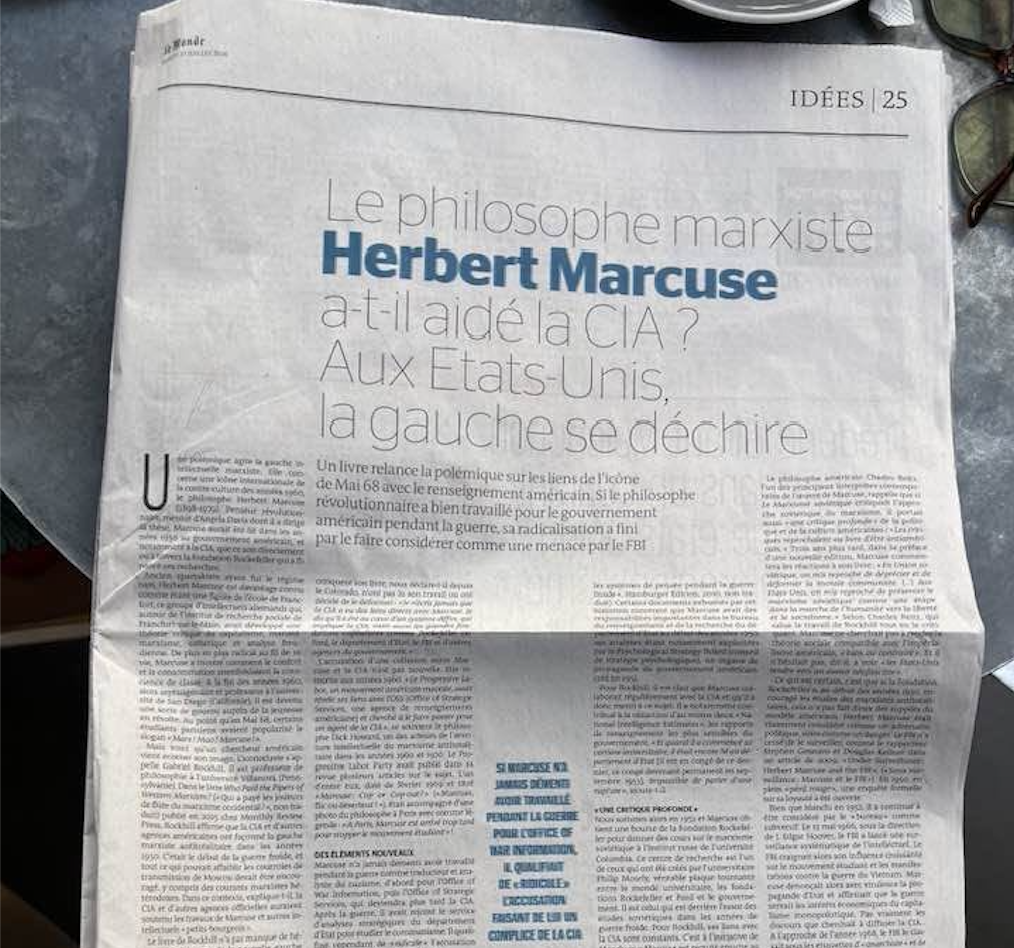
“Une polémique agite la gauche intellectuelle marxiste. Elle concerne une icône internationale de la contre-culture des années 1960, le philosophe Herbert Marcuse (1898-1979). Penseur révolutionnaire, mentor d’Angela Davis dont il a dirigé la thèse, Marcuse aurait été lié dans les années 1950 au gouvernement américain, et notamment à la CIA, que ce soit directement ou à travers la Fondation Rockefeller qui a financé ses recherches….”Read more…
‘Imperialism med mänskligt ansikte, in Parabol, by Kajsa Ekis Ekman:
“Under de två och ett halvt år som folkmordet på palestinier i Gaza pågått har vi inte sett någon svensk partiledare delta i de massiva folkliga demonstrationer som ordnats varje vecka över hela landet. Att högern inte är där förvånar inte – men var är vänsterpartiet och socialdemokraterna? När en kolonialmakt och tillika apartheidstat genomför ett folkmord med hjälp av USA-imperialismen, vem ska vara där om inte vänstern? Visst, deras medlemmar är där, deras väljare är där, men ledarskapet syns inte till. Normalt sett hade ett socialistiskt parti i en sådan situation arrangerat demonstrationer, forslat dit högtalarutrustning, hållit brandtal och stigit fram som en central kraft i protesterna. Kort sagt, visat det ledarskap så många hett trängtar efter, att de är beredda att kasta sig i armarna på vem som helst vid det här laget….” Read more…
‘Nymarxister ble sponset av CIA’, in Klassekampen:
“….Over dammen var livet enklere. I løpet av krigen utviklet Frankfurterskolen sin virksomhet og bygget opp det som skulle bli deres ubestridte merkevare: «kritisk teori». Gjennom de neste tiårene skulle denne gruppa av tyske eksilanter opparbeide seg heltestatus blant akademikere over hele verden. Nå har imidlertid den amerikanske filosofen Gabriel Rockhill kastet sine kritiske øyne på aktiviteten til dette intellektuelle arbeidslaget – også kjent som Frankfurterskolen….” Read more…
In Cuba Debate:
“Conocí a Gabriel Rockhill por casualidad, mas no por azar. Nos presentó Helen Yaffe, amiga entrañable de Cuba, en enero de este año durante el Congreso Internacional que conmemoró —en la Universidad de La Habana— los 60 años de la Conferencia Tricontinental (1966). La actual coyuntura política le agregó al evento una peculiaridad: los allí presentes estaban desafiando esa reciente manifestación de agresividad contra nuestro país que incluye la posibilidad de una agresión armada. De ahí que la confluencia no fuera por azar. Fue por convicciones….” Read more…
In Canarias Samanal:
“Durante décadas, la lucha de clases no solo se libró en fábricas, calles y frentes militares, sino también en universidades, en las editoriales y en círculos intelectuales. Bajo la apariencia de un “debate teórico” , el imperialismo desplegó una estrategia sistemática para vaciar al marxismo de su potencia revolucionaria y sustituirlo por una “izquierda aceptable” al orden capitalista. El último libro de Gabriel Rockhill desvela con rigor histórico esta ofensiva ideológica…..” Read more…
In Batalla de Ideas, “Marxismo occidental e imperialismo: Un diálogo”, John Bellamy Foster y Gabriel Rockhill
Editor of MR Magazine, John Bellamy Foster spoke with Rockhill about his book on the Monthly Review Magazine website, and this was quickly translated into Spanish at Batalla de Ideas. Read here or see below…
And the same dialogue in French, in Histoire et Societe:
Voilà un très bon sujet soumis à notre réflexion par Danielle, et qui mérite un moment d’étude ce dimanche. Il donne envie de lire Samir Amin et Losurdo au plus vite. En guise d’entrée en matière et d’illustration j’ai mis en ligne samedi « Alex Nodinot et le pacifisme de l’agneau pascal« , mais ici il s’agit plutôt du combat contre l’idéalisme que de celui contre la métaphysique. Si Marcuse, « qui appartenait généralement à la tradition philosophique marxiste occidentale, a été profondément touché par la révolution vietnamienne », il n’y croyait pas, ajoutant dans la préface de « L’homme unidimensionnel » : « même si ces hommes sont à la fin battus ce qui est vraisemblable… ». Et c’est bien souvent sa conception charitable, pitoyable et non marxiste, qui a inspiré nombre de progressistes opposés à la guerre aux USA et en Europe. Mais la particularité de cet homme unidimensionnel écrasé par la « société de consommation » c’est-à-dire une société de l’abondance (on pourrait dire du « communisme déjà là » de Friot), c’est que cet homme est un pur consommateur. Il ne produit pas. Il est en somme un rentier, pur produit lui-même d’un impérialisme qui aurait externalisé toute sa production dans le tiers monde. Cette réflexion critique et autocritique nous est nécessaire pour nous différencier de la social-démocratie et du « communisme de bobos« , celui-là même qui a coulé le parti communiste dans la considération populaire….” Read more….
WATCH:
Marx Memorial Library
Watch their interview with Rockhill, here: https://www.marx-memorial-library.org.uk/events-archive/who-paid-pipers-western-marxism-gabriel-rockhill-interview
