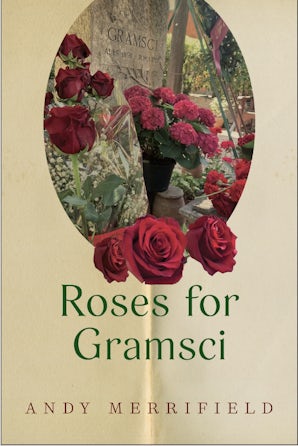
Andy Merrifield’s many books, from “Roses for Gramsci” to “Marx, Dead and Alive”
DIGEST: Reviews, Appearances
In The Nation, “The Ghosts of Antonio Gramsci”, reviewed by Aditya Bahl:
“….Is ‘subaltern’ a code for the working classes? Is ‘hegemony’ an economic force or a cultural power? Are ‘organic intellectuals’ inherently more progressive? The answers to such questions depend upon your choice of scholar—whether, say, you’re reading a Foucauldian literary critic or a Marxist sociologist, a subaltern historian or a posthuman anthropologist. Over the years, Gramsci’s writing has been polished by critics of such diverse persuasions that it has now become a mirror: One opens his books only to confirm one’s own beliefs….when the English writer Andy Merrifield arrived in Rome, feeling ‘washed out intellectually,’ Gramsci came to the rescue….
In Counterfire:
“Merrifield is a beautiful writer: closer in spirit to John Berger than to Gramsci himself. He reaches politics through the particular: a red rose on a marble casket, the semi-feral cats prowling the cemetery, the Sardinian stones that gave a young Antonio his patience and his sense of deep time. His account of Gramsci’s prison letters – translating Brothers Grimm fairy tales for nephews who would never know their uncle, writing to his son in Moscow who was becoming Russian and slipping beyond reach – is genuinely moving….” Read more…
In Marx & Philosophy Review of Books, reviewed by Christian Garland:
“Marx Dead and Alive offers much succour and cause for hope. Merrifield’s own ‘school’ of Marxism he has defined as ‘Magical Marxism’, but this should not be misunderstood. It can be taken to mean a non-doctrinaire Marxism drawing on the heart and soul as much as the head, a bold and exhilarating philosophy dialectically synthesising the two, never however, underplaying its materialism. All of Marx’s work – from the 1844 Manuscripts and the Theses on Feuerbach to Capital – is an unfinished project, and it is for his historical heirs to ‘update his work, explore the layer upon layer of Marx’s paint, and do our own touching up along the way’ (15). As readers of this publication will be aware, the materialist method is one of analysis and critique of the conditions of which it finds itself a part. To understand and explain the urgent present in order to change it and create the future is our task: one that is both necessary and possible, albeit vertiginous in its scope: ‘Marx’s plane of immanence incorporates the whole wide capitalist world’…” Read more…
In Domestic Left, reviewed by Jonathan Kissam:
“…we learn how, as a child, Gramsci fashioned crude dumbbells for himself out of round stones to do exercises to compensate for the malformation of his spine. We see him writing letters from prison to his landlady, his mother, and his sons. We learn about his wide-ranging intellectual interests (among other things, he translated two dozen of the Brothers Grimm’s fairy tales into Italian), and the fact that he wrote an animal story for children (“The Mouse and the Mountain”) which is, according to Merrifield, often read to children in Italy’s elementary schools today….” Read more…
WATCH
Marxist Education Project: Like “the two Ivans” – with Andy Merrifield (January 2022)
Pragmatism versus theory. Vertical party formations versus the on-the-ground realities of the rank-and-file. Fights between leftists that blinded everyone to the rise of the Right. But were the original rifts within the French left in Henri Lefebvre’s and Louis Althusser’s time, so genuine and lasting that these two figures could not themselves have overcome them?
In January, Andy Merrifield offered a stimulating and vibrant lecture to the Marxist Education Project on the lives, works, and relationships of Lefebvre and Althusser, and the many misunderstandings surrounding French Continental theory and beyond. The themes Merrifield represented in this talk are important for conceiving next steps for an internationalist left, now more than half a century past the class battles of 1968-1969 in France and Italy.
*A note of credit from Andy Merrifield: “The letters of exchange between Henri Lefebvre and Louis Althusser, mentioned in the presentation, were discovered in the archives of L’Institut Mémoires de l’édition contemporaine (IMEC) by Dr. Roberto Mozzachiodi of Goldsmiths, University of London. Roberto is in fact Scottish, not Italian.”
During the Q&A, Peter Bratsis of the Institute for the Radical Imagination raised questions regarding Humanism and anti-Humanism which led to a discussion of John Bellamy Foster’s effort to trace ontologies around the dialectics of nature and the metabolic rift. You can watch above or head to the Marxist Education Project*
Marxist Education Project: Joyce, Marx, Lefebvre – with Andy Merrifield (June 2022)
Said Andy Merrifield, author of Marx, Dead and Alive, during a program on James Joyce, Marx, and Henri Lefebvre with the Marxist Education Project: “Capital circulated through Marx the same way the Liffey circulated through Joyce-‘a commodius vicus of recirculation.’ Each book is a ‘hyper-text,’ a big, intricately entangled, introverted yet expansive text, historical yet somehow universal, exuberant and imaginative and at times colossally difficult to understand. Joyce said his principal character H. C. Earwicker was a ‘fargazer,’ whose ‘patternmind’ dreamed the vastest dream, whose sigla HCE meant ‘Here Comes Everybody.’ Capital was Marx’s dreaming fargazing, his Here Comes Everybody, a condition, he thought, where all countries were headed, his image of everybody’s future.”
A very sad note: Michael Lardner, a longtime key member of The Marxist Education Project (MEP) produced this event with Andy Merrifield. We are sorry to inform you that Michael Lardner died very recently, of a short illness.
EXCERPT:
(As selected by Knock Knock, in Tamil Nadu, India)
‘THE MAN IN THE WHITE VEST AND I SHAKE HANDS AND bid each other arrivederci. Wandering back to my duties at the cemetery’s Visitor’s Center, leaving him with Gramsci and that red rose, I realized I’d forgotten to ask if it was he who had laid the flower there. I never got the chance to talk with him, either, about the significance of roses for Gramsci and how growing them became almost as much a passion as filling his thirty-three scholastic notebooks.
After Gramsci was transferred in July 1928 to the Turi prison for the infirm and disabled in Bari, Calabria, he began, in a little plot of soil along a sidewall of its courtyard, to grow different plants and flowers. His letters to Tatiana and Giulia thereafter fill up with news of their progress. On April 22, 1929, he wrote Tatiana: “On one fourth of a square meter I want to plant four or five seeds of each kind and see how they turn out.” He asks his sister-in-law if she can get hold of sweet pea, spinach, carrot, chicory, and celery seeds.
Gramsci says he’s become more patient, “but only by virtue of a great effort to control myself.” He seems to take inspiration from his flowers and plants, from their slow and persistent growth, from the rose he’s trying to cultivate, patiently and persistently—against all odds. “The rose has fallen victim of a dreadful sunstroke,” he says, “all the leaves in the more tender parts are burnt and carbonized; it has a desolate, sad aspect, but it is putting out new buds.” Seemingly referring to himself, he adds: “It isn’t dead, at least not yet.” In Gramsci’s letters, the plight of his dear rose strikes as an allegory of his own dear plight.
“The seeds have been very slow in pushing up small sprouts,” he tells Tatiana, again maybe referring to himself and to the life of a Marxist radical; “an entire series obstinately insists on living an underground life.” Each day, Gramsci says, he’s seized by the temptation to pull at them a little, making them grow a little faster.
“I remain undecided,” he admits, “between two concepts of the world and of education: whether to follow Rousseau and leave things to nature, which is never wrong and is basically good, or to be a voluntarist and force nature, introducing into the evolution the expert hand of humanity and the principle of authority. Until now the uncertainty persists and the two ideologies joust in my head.”
Still, Gramsci’s voluntarist environmentalism—the intervention of human authority and action—doesn’t impose itself brutally on nature. He lovingly cares for his rose, admires its beauty and tenderness, the delicate texturing of its petals, its poetic quality, the radiance of its blossoming, often sounding the way Saint-Exupéry’s Petit Prince would sound a decade on, nurturing his own rose; at the same time, Gramsci marvels at how robust his rose is, how hardy, struggling to survive, persisting on living, sometimes on the point of death, yet pulling through with new buds despite the impending “solar catastrophe.”
Elsewhere, Gramsci says to Tatiana: “The rose is beginning to bud after it had seemed reduced to desolate twigs. But will it manage to survive the approaching summer heat? It looks puny and run-down to be up to the task. It is true of course that, at bottom, the rose is nothing but a wild thorn bush, and therefore very vital.” Again, maybe with himself in mind, we might recall one revealing letter he’d written Tatiana, earlier in his incarceration (February 19, 1927), taking the boat with other prisoners to Ustica. One of the banished was an “anarchist type,” Gramsci says, called “Unico,” a sort of superintendent, who upon hearing Gramsci introduce himself to other inmates, “stared at me for a long time, then he asked: ‘Gramsci, Antonio?’ ‘Yes, Antonio!’ I answered. ‘That can’t be,’ he retorted, ‘because Antonio Gramsci must be a giant and not a little squirt like you.’”
On February 10, 1930, Gramsci writes Tatiana: “So, then, become more energetic; cure your will too, do not let the southern winds fill you with languor. The bulbs have sprouted already, indeed some time back; one of the hyacinths already shows the colors of its future flower. Provided the frost doesn’t destroy everything. The rose has also borne new buds; it is wilder than ever, it seems a thorn bush instead of a rose, but the vegetal vigor of the thorn bush is also interesting. I embrace you affectionately, Antonio.”
TODAY, OCTOBER 17, 2023, GRAMSCI’S GRAVE IS COVERED with brilliant flowers, blooming everywhere, a sight to behold. Who could have placed them all here? Today as well I began to think about what it was I wanted to stress in this book. If earlier I spoke of stones and a sense of obligation—obligation to Gramsci, to Marxist politics, to the left, a sentiment somehow reinforced by the grapefruit-size rocks a deformed Gramsci lifted as a child—now, I think it’s the rose I want to emphasize, a rose for Gramsci, and the notion of resilience. Not just of our intervening to nurture nature, to sustain ourselves ecologically, but of an individual capacity for resilience, a stoicism to resist, to learn and educate oneself, to promulgate a politics of emancipation even in incarceration, even in an inferno resembling Dante’s.
“It seems to me that under such conditions prolonged for years,” Gramsci told his younger brother Carlo (December 19, 1929), “and with such psychological experience, a person should have reached the loftiest stage of stoic serenity and should have acquired such a profound conviction that humans bear within themselves the source of their own moral strength, that every- thing depends on them, on their energy, on their will, on the iron coherence of the aims they set for themselves and the means they adopt to realize them, that they will never again despair and lapse into those vulgar, banal states of mind that are called pessimism and optimism. My state of mind synthesizes these two emotions and overcomes them: I’m a pessimist because of intelligence, but an optimist because of will.”…..’
OTHER MERRIFIELD WORKS:
Beyond Plague Urbanism
Our cities have been plagued by economic injustices and inequalities long before COVID-19 upended urban life everywhere. Beyond Plague Urbanism delves into this zone of urban pathology and asks what successive lockdowns and exoduses, remote work and small-business collapse, redundant office space and unaffordable living space portend for our society in cities? Andy Merrifield journeys intercontinentally as he reflects on these questions, in a narrative that moves imaginatively between plague and populist politics, the U.S. Main Street and the British High Street, overcrowding and undercrowding, the right to the city today and eco-cities of tomorrow. Blending jazz with French Surrealism, Thomas Pynchon’s rocket science with the odyssey of James Joyce, Henri Lefebvre’s Marxism with the street ballets of Jane Jacobs, this challenging book appears at a timely moment in our fraught political history and opens up an urgent humanist conversation about the future of city life.
Marx, Dead and Alive
A contemporary interrogation of Marx’s masterwork
Karl Marx saw the ruling class as a sorcerer, no longer able to control the ominous powers it has summoned from the netherworld. Today, in an age spawning the likes of Donald Trump and Boris Johnson, our society has never before been governed by so many conjuring tricks, with collusions and conspiracies, fake news and endless sleights of the economic and political hand. And yet, contends Andy Merrifield, as our modern lives become ever more mist-enveloped, the works of Marx can help us penetrate the fog.
In Marx, Dead and Alive—a book that begins and ends beside Marx’s recently violated London graveside—Merrifield makes a spirited case for a critical thinker who can still offer people a route toward personal and social authenticity. Bolstering his argument with fascinating examples of literature and history, from Shakespeare and Beckett, to the Luddites and the Black Panthers, Merrifield demonstrates how Marx can reveal our individual lives to us within a collective perspective—and within a historical continuum. Who we are now hinges on who we once were—and who we might become. This, at a time when our value-system is undergoing core “post-truth” meltdown.
See an excerpt, posted on David Harvey’s website
Dialectical Urbanism
Life in the city can be both liberating and oppressive. The contemporary city is an arena in which new and unexpected personal identities and collective agencies are forged and at the same time the major focus of market forces intent on making all life a commodity. This book explores both sides of the urban experience, developing a perspective from which the contradictory nature of the politics of the city comes more clearly into view.
Dialectical Urbanism discusses a range of urban issues, conflicts and struggles through detailed case studies set in Liverpool, Baltimore, New York, and Los Angeles. Issues which affect the quality of everyday life in the citygentrification and development, affordable rents, the accountability of local government, the domination of the urban landscape by new corporate giants, policingare located in the context of larger political and economic forces. At the same time, the narrative constantly returns to those moments in which city dwellers discover and develop their capacity to challenge larger forces and decide their own conditions of life, becoming active citizens rather than the passive consumers.
Merrifield draws on a wide range of sourcesfrom interviews with activists and tenants fighting eviction to government and corporate reportsand uncovers surprising connections, for example, between the rise of junk bonds in the 1980s and urban improvement schemes in a working-class neighborhood in Baltimore. This lively and many-sided narrative is constantly informed by broader analyses and reflections on the city and engages with these analyses in turn. It fuses scholarship and political engagement into a powerful defense of the possibilities of life in the metropolis today.