Category: Excerpts /

In the public eye: Andy Merrifield’s “Roses for Gramsci”

In the public eye: Andy Merrifield’s “Roses for Gramsci”

The latest: "....Is 'subaltern' a code for the working classes? Is 'hegemony' an economic force or a cultural power? Are 'organic intellectuals' inherently more progressive? The answers to such questions depend upon your choice of scholar—whether, say, you’re reading a Foucauldian literary critic or a Marxist sociologist, a subaltern historian or a posthuman anthropologist. Over the years, Gramsci’s writing has been polished by critics of such diverse persuasions that it has now become a mirror: One opens his books only to confirm one’s own beliefs....when the English writer Andy Merrifield arrived in Rome, feeling 'washed out intellectually,' Gramsci came to the rescue...."
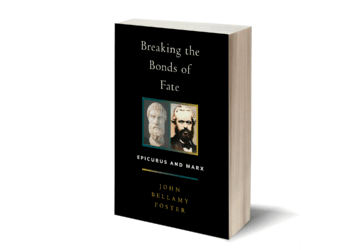
In the public eye: John Bellamy Foster’s “Breaking the Bonds of Fate”

In the public eye: John Bellamy Foster’s “Breaking the Bonds of Fate”

The latest: "Epicurus set up schools, first in Lampsacus (in modern day Turkey), then later in Athens. Other philosophical schools in the city used public space for lectures and attracted young, well educated, aristocratic Greek men. His critique of the ruling classes that dominated these schools that “'Nothing is enough for those for whom enough is too little' is as applicable today as in his age...."
In the public eye: “Silencing Fighting Bob: The Attack on Antiwar Progressives During the First World War”

In the public eye: “Silencing Fighting Bob: The Attack on Antiwar Progressives During the First World War”

The latest: "Chester weaves a nuanced story of heroic activism and governmental abuses that extended all the way to the office of the President. He recognizes the complexities of the circumstance and does not look away from the compromises by La Follette and others as they faced overwhelming pressure to get in line with the war effort. The editor of The Forward would eventually announce that the paper was “absolutely loyal” after the United States entered the war. As 1917 gave way to 1918, the Senator from Wisconsin took a lower profile, stopped giving fiery speeches and, finally, softened some of his criticism of Wilson...."

In the public eye: Contributors to “A Land With A People”

The latest from Mohammed Mhawish: "We have to ask ourselves: Do we know Hind? Of course we’ve heard her voice, or maybe have seen the building someone renamed after her at Columbia in her honor — which matters, and which she would have deserved, and which is still not the same as knowing her. But do we know her laughter, the way she moved through a room, what she was afraid of, what she loved, the world she was building inside herself at six years old? We learn none of it from the film. We learn it, if we learn it at all, from the interviews her mother gave on the side, on other people’s platforms. The film that claims her voice does not make space for her life."