
Aymeric Monville, Jennifer Ponce de León and Gabriel Rockhill’s “Requiem for French Theory”
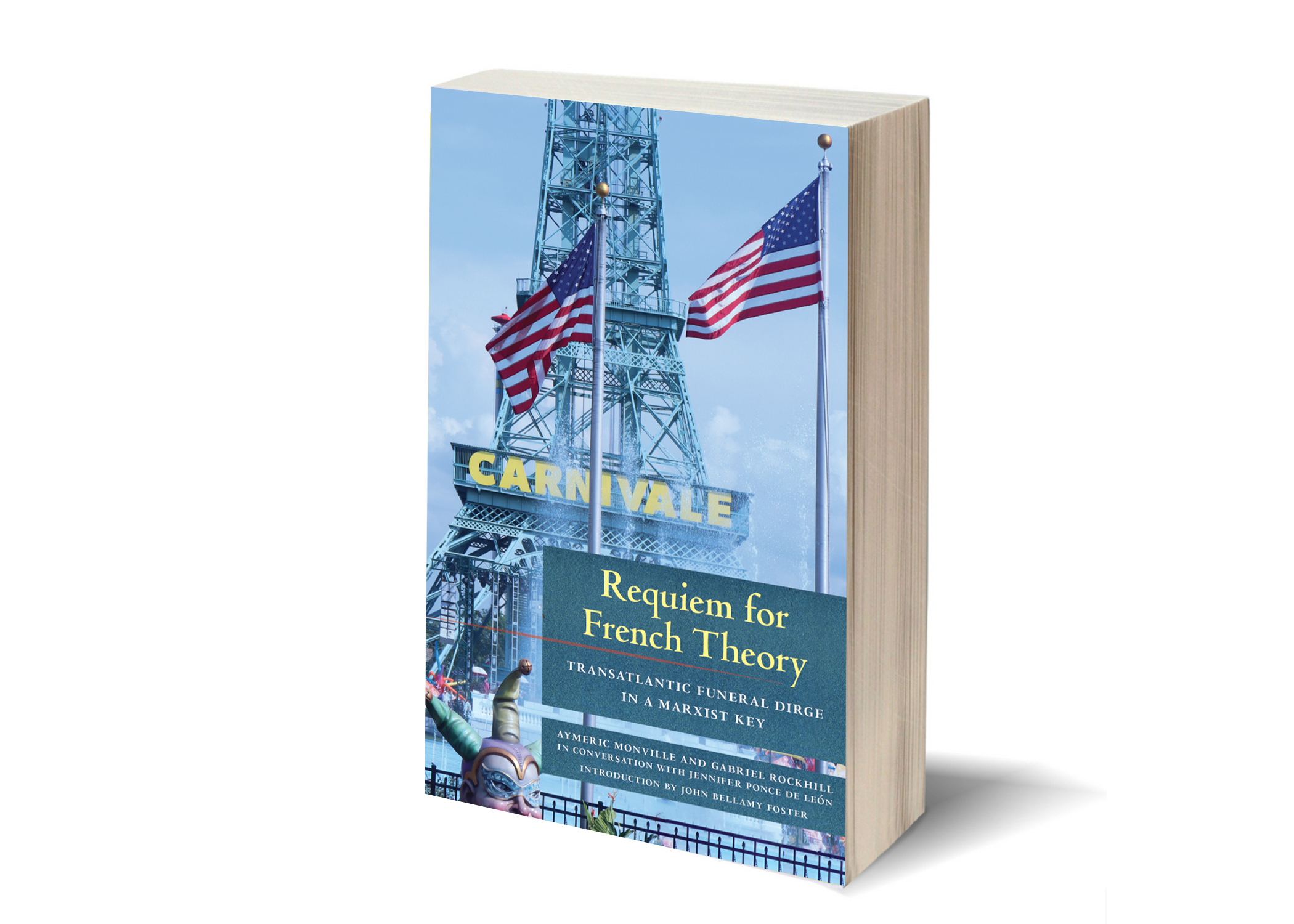
In the public eye: “Requiem for French Theory”
Coming from Left Field (Episode 152)
In this episode of Coming From Left Field, philosopher and cultural critic Gabriel Rockhill joins Greg Godels & Pat Cummings to explore the Ford Foundation, the 1966 Johns Hopkins conference often cited as a launching point for French Theory in the United States, Cold War cultural politics, and the wider political economy of academic knowledge production. Rockhill argues for rebuilding a class-centered, internationalist Marxism and joins a thoughtful exchange on China, Vietnam, socialism, imperialism, inequality, and the challenges of assessing existing socialist projects without demonization or uncritical celebration….
REVIEWS
Marxism-Leninism Today, by Greg Godels:
“During the 1960s and 1970s, it was an oft-repeated quip that the European left was long on theory and short on practice, while the North American left was strong on action, but allergic to theory. In West Germany, Italy, and France, young leftists would often passionately debate theoretical questions deep into the night, while seldom coming to a common commitment to action the next day. Their youthful U.S. counterparts—revived after the retreat from High McCarthyism–counted on spontaneous action and a firm commitment to common, inherited political values rather than the ideas buried in deep theoretical tracts. But those observations were far from completely true. The often student-driven U.S. New Left developed a thirst for a broader, deeper explanation of the injustices that they were rejecting. Many of those committed to action turned to left classics–quite often a reconsidered Marx–and others favored a wave of West European radical-oriented thinkers….” Read more…
ZZ’s Blog, as reviewed by Zigedy:
“During the 1960s and 1970s, it was an oft-repeated quip that the European left was long on theory and short on practice, while the North American left was strong on action, but allergic to theory. In West Germany, Italy, and France, young leftists would often passionately debate theoretical questions deep into the night, while seldom coming to a common commitment to action the next day. Their youthful US counterparts–revived after the retreat from High McCarthyism– counted on spontaneous action and a firm commitment to common, inherited political values rather than the ideas buried in deep theoretical tracts. But those observations were far from completely true. The often student-driven US New Left developed a thirst for a broader, deeper explanation of the injustices that they were rejecting. Many of those committed to action turned to left classics– quite often a reconsidered Marx– and others favored a wave of West European radical-oriented thinkers. It is the rise and importation to the US of one particularly influential “brand” of European theory to which Aymeric Monville and Gabriel Rockhill’s new book is devoted. In Requiem for French Theory: Transatlantic Funeral Dirge in a Marxist Key (New York, Monthly Review Press, 2026, $22.00, 168 pp.), Monville and Rockhill show that what became known as “French Theory” in the US was both a calculated interruption of the rediscovery and study of Marxism and an intellectual trend hostile to anti-capitalist and socialist currents….”
In translation….
Al-Akhbar (UK), by Said Mohammed:
يقدّم كتاب «مرثية للنظرية الفرنسية» مساهمة نقدية لافتة في تشخيص البنية المؤسسية التي احتضنت” صعود النظرية الفرنسية في الأكاديميا الغربية، وإعادة فتح الجدل الماركسي مع التيارات التفكيكية وما بعد البنيوية التي هيمنت على قطاعات واسعة من الفكر النقدي خلال العقود الأخيرة…يمثل كتاب «مرثية للنظرية الفرنسية: نشيد جنائزي عبر الأطلسي على مقام ماركسي» («منشورات مونثلي ريفيو»، 2026) للمفكرين أيمريك مونفيل وغابرييل روكهيل، بالاشتراك مع جينيفير بونسي دي ليون وتقديم جون بيلامي فوستر، محطة مهمة في مسار نقدي يهدف إلى مساءلة البنية المادية والمؤسسية لإنتاج المعرفة داخل الأكاديميا الغربية، وربط التحولات الفكرية نحو ما بعد البنيوية وما بعد الحداثة بالشروط السياسية والاقتصادية التي سمحت بصعودها وانتشارها….”
La Haine: In advance of the book’s release in summer of 2026, John Bellamy Foster’s introduction to Requiem for French Theory has already been translated into Spanish by the publication La Haine: “Del 18 al 21 de octubre de 1966, se celebró en el Centro de Humanidades de la Universidad Johns Hopkins de Baltimore una conferencia internacional aparentemente inocua titulada «Los lenguajes de la crítica y las ciencias del hombre». La conferencia se anunciaba como un encuentro en EEUU de las principales figuras del pensamiento estructuralista francés. Entre los ponentes de la conferencia se encontraban filósofos y críticos literarios franceses de renombre como Roland Barthes, Jacques Derrida, Lucien Goldmann, Jean Hyppolite y Jacques Lacan. Michel Foucault no pudo asistir, pero desempeñó un papel fundamental en la organización de la conferencia. Gilles Deleuze, aunque invitado, tampoco asistió, pero envió una comunicación para que fuera leída. En la conferencia, Derrida conoció a Paul de Man (antiguo colaborador nazi), que se convirtió en uno de los principales deconstructivistas de la crítica literaria estadounidense….” Read the rest at La Haine
APPEARANCES
Marx Memorial Library in London hosted a dual book launch for Requiem for French Theory and Who Paid the Pipers of Western Marxism? with Gabriel Rockhill, Aymeric Monville, and Jennifer Ponce de León, who engaged in a discussion regarding the effects of imperialism on the production and dissemination of knowledge. Watch here or below
Far from simply engaging in a critique of the faux radicalism of the prominent discourses within the imperial theory industry, the discussion was grounded in a reasoned defense of the vibrant international tradition of anti-imperialist Marxism. Topics included the imperial promotion of Western Marxism and postmodern French Theory, the international war of ideas, the failed efforts to discredit anti-imperialist Marxism, culturalism and identity politics vs. a materialist analysis of the colonial question, fascism past and present, the dialectics of actually existing socialism, and the current state of global class struggle in theory and practice.
Watch Rockhill speak about this collaborative work, below…
Requiem for French Theory soundly criticizes this tradition’s chameleonic ideological permutations under new names, such as postcolonial thought, decolonial theory, new materialism, and other trendsetting discourses. But it also reveals how these theoretical developments are all part of a broader anticommunist cultural front. Most importantly, Monville and Rockhill develop the positive project of anti-imperialist Marxism as the ultimate antidote to French theoretical sophistry. Far from indulging in the political defeatism characteristic of the Western Marxist critiques of postmodernism, this intellectual exchange issues a clarion call for revitalizing revolutionary theory and putting it into practice.
EXCERPTS
From the Introduction (by Monthly Review editor John Bellamy Foster)
On October 18–21, 1966, a seemingly innocuous international conference titled “The Languages of Criticism and the Sciences of Man” took place at the Humanities Center of Johns Hopkins University in Baltimore. The conference was billed as bringing the main luminaries of French structuralist thought to the United States. Those who spoke at the conference included such celebrated French philosophers and literary critics as Roland Barthes, Jacques Derrida, Lucien Goldmann, Jean Hyppolite, and Jacques Lacan. Michel Foucault was unable to attend but played a principal role in the organization of the conference. Gilles Deleuze, though invited, was also not in attendance, but sent a communication to be read. At the conference, Derrida met Paul de Man (the former Nazi collaborator) who was to become a leading deconstructionist within U.S. literary criticism. The Johns Hopkins conference was to be universally designated as the point of origin of what came to be known in the late 1960s and ’70s as “French Theory,” a term never fully accepted in France, but representing an international amalgamation of French and American structuralist thought that generated what came to be known as postmodernism.1
Despite all appearances, the 1966 Johns Hopkins conference was not simply an ordinary academic meeting, on no matter how grand a scale, but rather a politically motivated attempt to create a beachhead for French structuralism in the United States that would counter the radicalization then taking place. French philosophical thought in the 1960s, emerging from a period in which Jean-Paul Sartre was the preeminent philosopher, was increasingly enamored with the anti-humanist philosophies of Fredrich Nietzsche and Martin Heidegger, the latter an unrepentant Nazi ideologue. The turn to Nietzsche and Heidegger was combined with the French tradition of structuralism, based in linguistics, anthropology, and Freudian psychoanalytic theory. Structuralism was opposed to all traditional forms of inquiry that relied principally on historical analysis, the (human) subject, and dialectics. The organizers of the conference at Johns Hopkins, Richard Macksey and Eugenio Donato, indicated their intention to bring together thinkers in the traditions of Nietzsche and structuralism, thus casting the conference in conservative and anti-Marxist terms.2
In 1966, French thought was moving away from Karl Marx at the very same time that a reemerging radicalism in the United States was generating an increasing interest in Marxism. Lacan’s Écrits and Foucault’s The Order of Things both appeared in 1966 and became bestsellers in France. Both works trivialized G. W. F. Hegel and Marx. In France, the examination of Hegel’s philosophy was highly selective and approached subjectively, heavily influenced by Alexandre Kojève’s interpretation of Hegel’s Phenomenology, focusing on the master-slave dialectic. In Écrits, Lacan presented Hegel’s master-slave dialectic as an “iron law” of conflict prior to Charles Darwin, which Lacan was to incorporate into his Freudian structuralism.3 Foucault dismissed Marxism by claiming that it had existed “in nineteenth-century thought like a fish in water,” which was “unable to breathe anywhere else.” In contrast, Nietzsche, with his combination of philosophy and philology and his eternal return, had a meaning that “burned for us” in the twentieth century.4
The intellectual trends on the left in the United States in 1966 were then quite different from those most fashionable in France. The emerging U.S. student movement, which was then focused on the Vietnam War and the critique of capitalism, was reading such radical bestsellers as Herbert Marcuse’s One-Dimensional Man (1964, not translated into French until 1968, when it influenced the student movement there) and Paul A. Baran and Paul M. Sweezy’s Monopoly Capital (1966) (Monthly Review’s editors at the time)…..
As part of the general Cold War offensive, and with the aim of promoting ideas that would constitute a bulwark against Marxist ideas, the Ford Foundation agreed to underwrite the 1966 Johns Hopkins conference, bringing French structuralist theorists as a group to the United States. The Ford Foundation was then headed by McGeorge Bundy, Lyndon B. Johnson’s former National Security Advisor, who was closely connected to the entire range of U.S. intelligence agencies. Bundy was one of Johnson’s fourteen “wise men” who advised him on the Vietnam War.6
Significantly, it was within months of the Johns Hopkins meeting, in April 1967, that Ramparts magazine, which was closely associated with the growing student radicalism, broke the full story of the CIA’s funding through its intellectual front organization, the Congress for Cultural Freedom, of dozens of prestigious putatively left journals in Europe and elsewhere, all of which had adopted an explicitly anticommunist stance…..
From the Preface
Jennifer Ponce de León: We collectively decided to undertake this book project because of the unique positions that Aymeric and Gabriel occupy. From opposite sides of the Atlantic, you have both reached similar conclusions regarding the legacy of French Theory and its relationship to the tradition of dialectical and historical materialism, widely known under the moniker “Marxism.” I would like to begin, therefore, by asking you to situate yourselves and your work, elucidating how it is that you came to the positions that we will be discussing.
Gabriel Rockhill: Having grown up on a farm in Kansas, where I worked construction and as a farmhand well into my twenties, my first intellectual activities were driven by a desire to understand exploitation and how to overcome it. When I went to college in Iowa in the early 1990s, I encountered French Theory, which was presented as the most radical form of analysis on offer. With the naïveté of an uneducated farm boy whose intellectual horizons were being dictated by a system he did not fully comprehend, I dove in and ambitiously sought to acquire all the languages and background knowledge necessary to understand it. I was later able to obtain a scholarship to study in France, beginning in 1996. Living like a bohemian pauper and working odd jobs before eventually teaching, I did my graduate and postdoctoral work in Paris, remaining there until 2007. Naturalized as a French citizen around that time, I have continued to return to Paris every year…. I was, at the time, engaging in a process of empirical verification, which I also did with other French theorists, and their slipshod scholarship left something to be desired. I began to perceive their idealism, as well as their dogmatism. At the same time, I was increasingly drawn to forms of materialist analysis that did not only examine isolated texts but studied the broader context that had produced them. The historically oriented work of thinkers like Foucault and Rancière was initially appealing for this reason, as well as the sociological research of Bourdieu and others engaged in an analysis of the material world. Although this process took more time than the empirical textual verification just mentioned, I eventually became aware of their blind spots, methodological limitations, contortions, and misrepresentations….
Aymeric Monville: …I put more energy into breaking away from the prepackaged framework of analysis offered to me by the left-wing intellectuality of my time and into founding a publishing house conceived as a veritable counter-university: in other words, one with an objective methodology, meeting the criteria of research, but completely independent of the Zeitgeist in its approach to subjects. In terms of political orientation, my family was left-wing (for anecdotal value, one of my great-great-uncles, Charles Longuet, married Jenny, the eldest daughter of Marx), and I was confronted, like all my generation, with Mitterrand’s treasons. François Mitterrand, elected on an almost Marxist program of appropriation of the major means of production and exchange in 1981, took the Reagan-Thatcherite turn of austerity in 1983. Then came the triumph of the generation of former sixty-eighters [soixante-huitards], right up to Emmanuel Macron, who has adopted some of the same codes and themes. These obvious dead ends, these paths that led nowhere, therefore led me to systematize my personal Marxist training by clinging, in contrast, to the dignity of what the heritage of Jacobinism may have represented, still structuring our country, but also French Communism, which I believe saved my country twice in a row during the Second World War, from the Nazi occupation but also from the U.S.-American takeover of France planned by Roosevelt shortly before the Normandy landings (a government called AMGOT, which was intended to take the same occupation measures as those used for the Sicily landings, thus treating France not as an ally but as an enemy).
What is more, when I was twenty, around 1998, I discovered the reprinted version of Néo-fascisme et idéologie du désir [Neo-fascism and the Ideology of Desire] by Marxist thinker Michel Clouscard, and there I understood the exact nature of the system put in place since May ’68: the liberal-libertarian compromise as a balancing solution to save capitalism in crisis.9 I then had the good fortune of frequenting the Clouscard circle for several years of intense philosophical exchanges, with Clouscard himself, until his death in 2009, but also Dominique Pagani, his main collaborator. I’m still convinced that French Theory found its antidote in France, at the same time, in the person of Clouscard.10 Then there were other Marxist authors whom I had the pleasure of meeting and publishing, such as Domenico Losurdo, Jean Salem, and Georges Gastaud. They have played a decisive role in making me aware of the need to activate the potential of Marxism, which not everyone has yet fully grasped. But, let’s be clear, this gallery of portraits of illustrious thinkers in no way exempts me, or anyone else, from the necessary work of analyzing ideologies in their internal contradictions. This of course applies to French Theory, which needs to be examined in detail, and only then can we propose to see how Marxism can resolve some of the aporias we have observed.11
From Part 1 (p.50)
JPL: Aymeric, in a talk you gave at the Critical Theory Workshop’s Summer School in July 2023, you noted that the intellectual roots of much of French Theory—including the versions that are cast as “radical” and leftist—can be found in anti-humanist thinkers like Heidegger and Nietzsche, whose politics were, in fact, deeply reactionary.17 Relatedly, you addressed French Theory’s embrace of an irrationalist philosophical orientation, which György Lukács famously critiqued, and you also noted John Bellamy Foster’s recent writing on this topic. I know you have written at length on these issues in your book The Poverty of Left Nietzscheanism (forthcoming in the Studies in AIM series with Brill and Iskra Books). Could you map out the intellectual traditions that French Theory draws upon and help us understand the political-ideological orientation of these traditions?
AM: Yes, there has been a French particularism since the post–Second World War period, which is the left’s valorization of Nietzsche and Heidegger through a truncated reception, an eclectic reading, with, at the end of the day, a form of political manipulation. Hence the fact that “left- wing Nietzscheanism” and “left-wing Heideggerianism” constitute two veritable pillars of French Theory. It’s also a kind of metaphor for all the ambiguity of this so-called French Theory, presented as revolutionary but in fact profoundly anti-Marxist. Even if comparison is not reason, let’s not forget that fascism, in the same way, presented itself as both revolutionary and anti-Marxist.
These truncated readings are in any case impossible in Germany, simply because access to the works of these thinkers is in the text itself and not through euphemistic translations. Just read Adorno’s Jargon of Authenticity, for example, to understand that, to a German ear, Heidegger renders music that is quite Germania triumphans, as could be said of certain interpretations of Wagner. And everything that has been published since, from the Rector’s address to the Black Notebooks, has only confirmed this impression.
To acclimate Nietzsche and Heidegger to postwar France could only be done with a minimal claim, a form of dandyism clearly displaying indifference to political content. Then, very quickly, from this fairly banal posture, we move on to formalist arguments, such as the glorification of the aphorism as a method. Finally, a systematization transforms things into a rejection of Hegelianism, hence Deleuze’s essay Nietzsche and Philosophy and what he calls “the production of concepts” in a deliberately affirmative sense, in short the will to power versus dialectics (“We no longer believe in the dull gray outlines of a dreary, colorless dialectic of evolution, aimed at forming a harmonious whole out of heterogeneous bits by rounding off their rough edges,” he would later say in Anti-Oedipus).18 I am thinking of his vitalist philosophy of immanence, which owes much to Bergson. And yet here we are well before his encounter with Guattari, anti-Oedipus, desiring machines.
the 1970s, but all this had been prepared for long before, by anti-Marxism. There is reason to wonder whether this Deleuzian voluntarism, by rejecting the patience of the Hegelian concept—Hegel’s intention was to “renounce personal incursions into the immanent rhythm of the concept”—does not in itself carry with it an aristocratic vision of the world, akin to Schelling’s intellectual intuition, reserved for an elite, whereas Hegel, in an approach that profoundly links rationalism to democracy, accepts only science as the path to knowledge.
As for Derrida, his relationship with Nietzsche can be summed up by the following judgment: “Nietzsche said everything and its opposite.” This was a way of saying that the political question was of little interest to him, even though he could devote an entire chapter of his book Spurs: Nietzsche’s Styles to a note in which the German thinker declares: “I’ve lost my umbrella.” This is a philosophical position that is embraced: eclecticism. However, the fact that Nietzsche said everything and its opposite is by no means obvious. On the question of his opposition to socialism, for example, Nietzsche has always shown undeniable consistency, right from the Paris Commune, which for him meant the ruin of civilization.
As for Foucault, the Heideggero-Nietzschean influence can easily be seen in his anti-humanism, the death of man, the reduction of epistemology to genealogy and Nietzschean infinite interpretation, which counteracts the role of the economy in the last instance. Foucault proposed an archaeology of knowledge in which the “epistemes” succeeded one another without any prior material foundation, social groups being merely the passive supports of this history of knowledge. This amounted to perfectly assuming discontinuity, based on the pretext of rejecting the dialectical method. As for Claude Lévi-Strauss, he fantasizes about what he calls “societies without history,” even though these are, of course, subject to the historical process just like any other. This naturalization of the human sciences is in conscious conflict with the Marxian adage that ‘we know only one science, that of history.’19
In the end, infinite interpretation and anti-historicism give way to a single injunction, brutal in the extreme: “You must become what you are.” This Nietzschean adage is the Bible of identitarianism. At the end of the chain, I see these identity movements inspired by French Theory, which start from anti-racism, which is obviously laudable, but end up only claiming identity, instead of dialecticizing it, and I say to myself that we don’t have fascism in its entirety, but one part of fascism: the division of the working people into conflicting entities. Michel Clouscard rightly said, “Capitalism will bring civil war to the poor.”
I think we can understand better why French Theory was promoted in the United States by propagandists who saw its reactionary potential much better than the theory’s promoters. The underlying idea, for those who understand what is at stake, is to rehabilitate nothing less than part of the reactionary software. Clouscard has spoken of “neo-fascism and the ideology of desire.” If we don’t use these categories, we can’t understand what happened, we’re just skimming the surface.
From the Conclusion:
Jennifer Ponce de León: We have discussed the various ways in which French Theory is an ideological product of the imperial core that obscures material reality and disorients people politically, highlighting that this is precisely one of the reasons why it has been so widely promoted by powerful forces in the capitalist world. You have both juxtaposed to the ideology of French Theory the tradition of dialectical and historical materialism, explaining its theoretical and practical superiority, and highlighting that this has been proven by material history. In bringing our conversation to a close, I want to ask both of you to explain the fundamental stakes of class struggle in theory, particularly regarding the battle that we’ve been discussing between French Theory and Marxism. Why is such an ideological confrontation important, and why should it be waged today? Why dedicate time and energy to a Requiem for French Theory, instead of—for instance—simply ignoring it?
Gabriel Rockhill: We are living in the end times, which Georges Gastaud has theorized as the age of exterminism. If it be imperialist warfare verging on a nuclear apocalypse, the brutal intensification of capitalist social murder, or the catastrophic decimation of the planet, the stakes of class struggle have arguably never been higher. It is a question of life or death for the species and even the biosphere. This is no longer—if it ever was—a time to indulge in the theoretical games of the petty-bourgeois intelligentsia. It is a time to call the latter out for what they are and engage in serious ideological warfare.
French Theory is part of a much broader intellectual world war aimed at discrediting dialectical and historical materialism, as well as actually existing socialism. It has had an expansive and deep influence, including within the Marxist intelligentsia around the world and, most importantly, progressive organizing. For those of us who know this tradition from the inside, we have a responsibility to clarify its function within international class struggle, in order to both defend Marxism against its reductive dismissals and to go on the offensive by demonstrating the power of dialectical and historical materialism. As an innovative, collective, practical science of liberation, we can draw on it and further develop its tools to understand and transform the world before it is too late.
Aymeric Monville: To conclude, I’d like to mention a very inspiring U.S.-American game—because contrary to what you might think, there are lots of things that interest me in your country!—and that game is poker. Marxism and French Theory can evolve in two separate spheres, giving the impression that we’re not evolving in the same world, or even that we don’t belong to the same world (since French Theory is also based on Bourdieusian “distinction”). But there comes a time when you have to lay your cards on the table and compare. It’s up to readers to have the last word, as referees. Put simply, that’s the rule: at some point you have to lay your cards on the same table, because there is only one game, one table, one world. Monism is indeed the basis of materialism, isn’t it?
