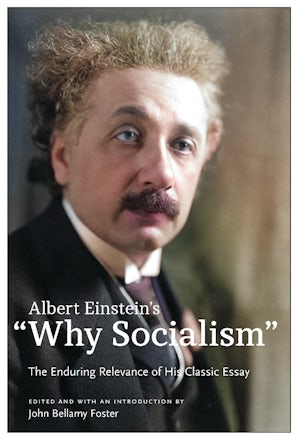
In the public eye: “Albert Einstein’s ‘Why Socialism?'”
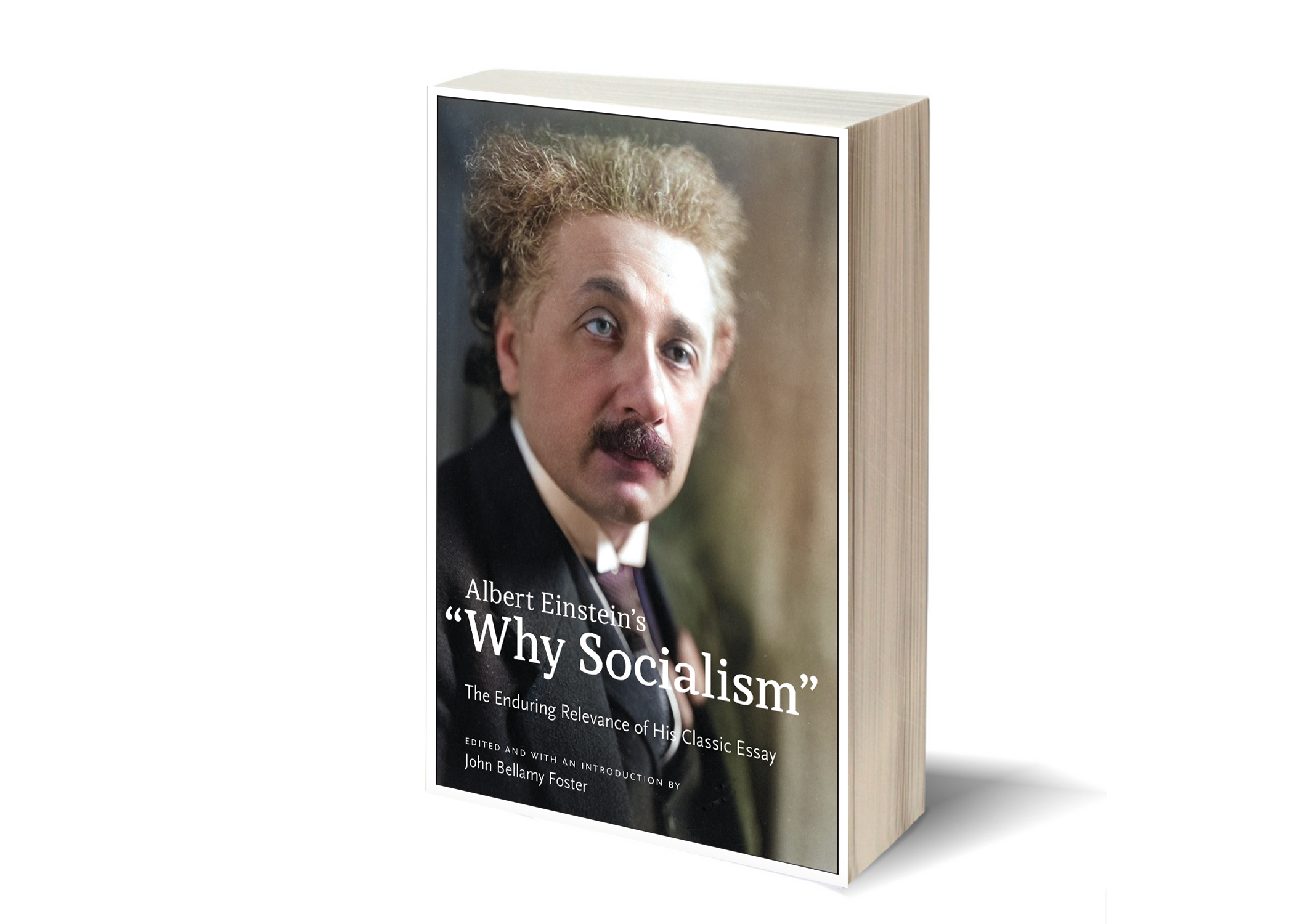
Einstein’s prescient article “Why Socialism?”, first published by Monthly Review in its inaugural 1949 issue, has to say the least, been circulating for some time. Yet it has never been more relevant than today. In defiance of those who would like to, not only re-write history, but erase the future, please help us get this book out to as wide an audience as possible.
Monthly Review Magazine republished the article online in 2009, making the article even more widely available. Monthly Review Press‘ recent reprint, ‘Albert Einstein’s “Why Socialism?”‘ stands out, however, for the extremely enlightening and thorough introduction written by magazine editor, John Bellamy Foster.
Einstein’s perspective links alienation and nuclear annihilation, capitalism to the devastating possibility of omnicide — the destruction of all human life on earth. As the U.S. approaches its 250th anniversary and the current US President imprisons and kills the heads of Venezuela and Iran in a clear attempt to control access to their oil supplies, we already find ourselves mired in another imperialist war in the Middle East that is very likely to veer towards World War III.
EINSTEIN IN THE ART WORLD
In October, not so long after the book’s release, the NYC/Mexico City gallery Kurimanzutto convened a show curated by Gabriel Orozco, featuring Ariel Schlesinger of Forensic Architecture, Minerva Cuevas, Petrit Halilaj, Robert Longo, Roman Ondak, Wilfredo Prieto, Zoe Leonard, and special guests. The prompt to which the artists responded, Einstein’s article, “Why Socialism?” The show was listed as a “Must See” in ARTFORUM magazine. Kurimanzutto excerpted the article in full, and e-flux Agenda excerpted the same portion of the article that we excerpted in the animated short above.
In Autre: “While visitors are left with political thoughts ruminating, they enter the almost all black-and-white main room of the exhibition and approach large grayscale flags of United Nations members, made by Wilfredo Prieto in a piece called “Apolitico.” Their loss of color strips away any signs of allegiance or patriotism and presents these flags as interchangeable. Other works, such as Ariel Schlesinger’s “Burnt Newspapers,” show the fragility of historical records, which is brought up again in the final and most shocking part of the exhibition, “The Pegasus Stories” by Forensic Architecture….” Read more….
REVIEWS
By David C. Perlman, for Marx & Philosophy review of Books
In the current era in which anti-science ideology, disinformation and ‘the destruction of reason’ are again increasingly being utilized as key components of a broader anti-materialism which reinforces a transition from neoliberalism to neofascism in response to crises of capitalism, Albert Einstein’s ‘Why Socialism?’: The Enduring Relevance of His Classic Essay is timely. It brings to the fore the links between science and the struggle for justice, a rich meaningful life, and environmental sustainability of humanity and other species.
On Open Culture: ‘Einstein saw a public role for scientists in matters social, political, and even economic. In 1949, he published an article in the Monthly Review titled “Why Socialism?” Anticipating his critics, he begins by asking “is it advisable for one who is not an expert on economic and social issues to express views on the subject of socialism?” To which he replies, “I believe for a number of reasons that it is.”
Einstein goes on, sounding something like a combination of Karl Marx and E.O. Wilson, to elaborate the theoretical basis for socialism as he sees it, first describing what Marx called “primitive accumulation” and what the socialist economist Thorstein Veblen called “’the predatory phase’ of human development.”
…most of the major states of history owed their existence to conquest. The conquering peoples established themselves, legally and economically, as the privileged class of the conquered country. They seized for themselves a monopoly of the land ownership and appointed a priesthood from among their own ranks. The priests, in control of education, made the class division of society into a permanent institution and created a system of values by which the people were thenceforth, to a large extent unconsciously, guided in their social behavior.
The science of economics, as it stands, writes Einstein, still belongs “to that phase.” Such “laws as we can derive” from “the observable economic facts… are not applicable to other phases.”
ACCLAIM
As seen listed as one of Book Culture‘s “top titles from university presses”: