
Recently reissued: The Rainbow Challenge (Excerpt)
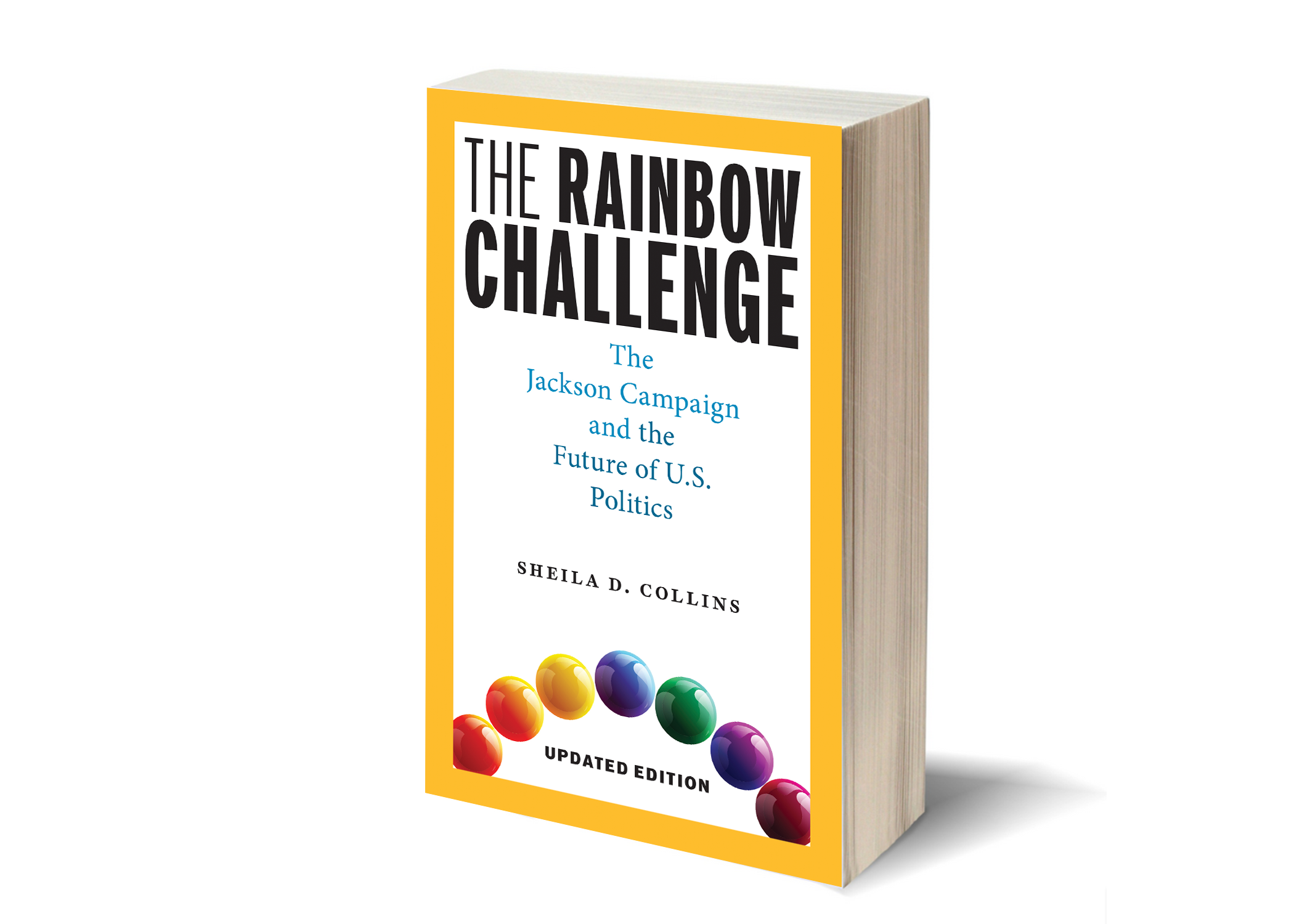
From the Preface to the new edition of The Rainbow Challenge:
“Jesse Jackson’s first presidential primary race in 1984 should have been a wakeup call for the Democratic Party. Without a large campaign chest, money for advertising, or seasoned political consultants he amassed 3.5 million votes (winning nearly the entire popular vote in the Deep South states of Mississippi and South Carolina, registering 2 million new voters, and winning 21 percent of the total votes cast). The press, the pundits, the pollsters, and the Democratic Party elites could not believe that the American people would vote for a Black man, let alone a man with such a progressive message, so they characterized him at first as a charlatan, then as a spoiler, and finally as a candidate who spoke only for African Americans. They had accepted the idea that Ronald Reagan’s election in 1980 meant that the New Deal reforms were over, that the growing polarization of the electorate could not be overcome, and that the Great Society had been defeated. Their marginalization of Jackson’s message of economic and social justice and international peace through cooperation, and their failure to imagine that anything else could be different, ceded the playing field to the Republican right. Walter Mondale’s tepid, neoliberal message could not compete with Reagan’s sunny, simplistic optimism; Reagan won by a landslide.[i]
When Jackson ran again in 1988, laying out a coherent, progressive, populist agenda he was hailed for his soaring rhetoric, but his message was still dismissed as being too “radical” for him to win. It was a social democratic message with a moral underpinning and was consonant with most of the values and issues that public opinion polling showed Americans supported. Jackson drew the largest crowds of any of the candidates, but after he won the Michigan caucuses in March 1988, with the largest number of committed delegates, the media coverage turned toward alarm. Despite having apologized numerous times for having used the term “Hymietown” to characterize New York City in a private, overheard conversation during the 1984 election, that term was trotted out again to undermine his appeal to Jewish Americans. And although he was drawing white voters against all expectations, it is likely that the fear of the residual racism of the white population played a role in the belief held by Democratic elites that he was unelectable. This led to a “stop-Jackson” narrative in many mainstream editorial circles.
Thanks to Jackson’s race in 1984, Democrats had won back both the House and the Senate in the 1986 midterms and thus could have capitalized on their majorities by putting forward a progressive charismatic candidate like Jackson. Instead, after a crowded and messy primary fight, Massachusetts governor Michael Dukakis, a moderate, centrist technocrat, emerged as the Democratic Party’s choice. Dukakis’s lack of passion did not inspire the Democratic base, and it is likely that Jackson’s dismissal by the party convinced many African Americans to stay home. In at least twelve states the number of unregistered and non-voting African Americans exceeded the number of votes by which Dukakis lost.[ii] Moreover, Dukakis was never able to overcome Republican accusations that he was weak on crime after a convicted murderer, Willie Horton, absconded from a weekend furlough program in Massachusetts and went on to commit kidnapping, rape and attempted murder in Maryland. On election day only half of those eligible to vote turned out. George H.W. Bush won with the votes of only 26 percent of all Americans of voting age.[iii]
If Jesse Jackson was dismissed in 1984 and 1988, in death he finally received his due appreciation. At the announcement of his passing on February 17, 2026, a blizzard of articles written with a whiff of nostalgia for lost opportunity appeared in the major media and all over the Internet, lauding his moral and political vision. The New York Times hailed his gospel of “seeking common ground, his pleas to ‘keep hope alive’ and his demands for respect for those seldom accorded it . . .” Mr. Jackson, they said, enunciated in his 1984 and 1988 speeches at the Democratic conventions “a progressive vision that defined the soul of the Democratic Party, if not necessarily its political policies in the last decades of the 20th century.”[iv] “Quite simply,” Michael Eric Dyson wrote, “Jesse Jackson led one of the most consequential American lives. He was a genuine populist who stood in stark contrast to the ersatz populists of today.”[v] Historians Clayborne Carson and Jon Meacham called Jackson the most significant political figure between Martin Luther King and Barack Obama. Said Carson, “Jesse Jackson played as central a role in his era as King did in his era. But it was not the kind of heroic struggle as in the 1960s. You’re not going to get a Nobel Prize for what Jesse Jackson did, but it took a lot of talent, initiative, energy, imagination and charisma, and he had those in full supply.”[vi] Jackson’s campaigns, said another New York Times journalist, “created a path for scores of Black democrats to run for office while demonstrating for the first time that white Americans would vote for a Black presidential candidate.”[vii] Without him Barack Obama could never have won. Read more
What accounts for this revisionist version of history? Perhaps the realization of what this failure to take Jackson seriously has finally dawned on at least a segment of the center left establishment. Perhaps Donald Trump’s blatantly racist, misogynistic, and antisemitic language and policies, perhaps the wrecking ball he has taken to all the institutions of democracy has finally led them to see the light. Perhaps the rise of Alexandria Ocasio-Cortez, affectionately known as AOC, and the stunning electoral victory of democratic socialist Zohran Mamdani to the mayoralty of New York City, or the courageous resistance of the people of Minneapolis to the fascist thuggery of ICE and Border Patrol agents has given these elites a picture of how far removed they have been from their core constituencies.
It is far past time to reassess what we lost when the Democratic Party and even some of the left marginalized Jesse Jackson’s candidacies. In 1988, he increased his share to nearly 7 million votes, beating out future Vice President Al Gore, future President Joe Biden, and Dick Gephardt, coming in second against Michael Dukakis, and forcing a change in the delegate selection process to enable more minorities to run and win. The failure to recognize what the two Jackson campaigns could have done for the country has led to the increasing polarization of the electorate, the neoliberal capture of the Democratic Party under Bill Clinton, and eventually to the election of Donald Trump. Even Barack Obama could not escape the racist backlash this rejection of the Rainbow Coalition portended nor the neoliberal pull of economic elites.
While many, in retrospect, have lauded Jackson’s charisma and his populist message, this book should be re-read for the specific lessons it can teach us about the nuts and bolts of running a progressive populist campaign. It contains positive lessons and points to some of the errors that were made. To be sure, we live in very different times. We are faced not with an encrusted political establishment that at least still played by rules established by the Constitution, but with a neo-fascist movement that has captured the presidency, the Republican Party, and the Supreme Court. Moreover, we face a media landscape dramatically altered by social media controlled by tech billionaires in which conspiracy theories run rampant; and we now have Artificial Intelligence beginning to zap our brains and eliminate our jobs, not to mention its potential for mass surveillance and for starting wars without the consent of humans. And Christian Nationalism, with its frightful messianic ideology, appears to have become the new public religion.
All of these new dangers will have to be addressed if we are to survive as a civilization.
Thus, the stakes today are monumental and the time frame for action is both short and long term—short term because we have only a few months, in the face of Republican states imposing voter identification laws, making registration more difficult, aggressively purging voter rolls, and gerrymandering districts to mount a political campaign that can put a brake on the Trump administration’s worst impulses. The next two national elections are critical. The time frame is also long term because it will take decades of careful organizing to build the structures of a revised political system and economy that can work for all.
Some have lamented the lack of a visible charismatic leader like Dr. King or Reverend Jackson to mount a counteroffensive to the Trump administration. “The Black church isn’t as important as it was. It’s harder to have a figure come out of that tradition and command the power and respect that Jesse Jackson did,” Claflin University historian Robert Greene II said. “It’s hard to imagine someone today being able to enter the political realm already seen as a moral authority.” Institutional religion just doesn’t have the authority or power it once did in the in the United States, experts have said.[ix]
But that may be changing. The moral clarity in the Minneapolis resistance movement was largely fueled by churches. Reverend William Barber’s Moral Monday and Repairers of the Breach movements have taken the ethical teachings of Jesus into the public square with multiracial marches, rallies and sermons. In his reverential post-mortem Substack on Jesse Jackson’s legacy, Reverend Barber vowed to carry on building the Rainbow Coalition for the new age. Jewish Voice for Peace seeks to apply the ethical teachings of the Prophets to matters of war, peace and social justice. In February 2026, 700 people of various faiths carrying signs that said, “Respect our Humanity” and “ICE Out “marched and sang as they surrounded the Federal building in lower Manhattan where immigrants are processed; and in that same month, over 2,000 United Methodists gathered in the nation’s capitol to witness on behalf of undocumented immigrants and make visits to their congressional representatives.
Precisely because we are living in such fraught times, we may now have the constituency that is needed for this work. When he ran for president in 1984, Jackson had to build the Rainbow Coalition from the many identity movements that existed in those days (for example, the civil rights and Black nationalist movements, the Arab-American Anti-Discrimination Committee, the Latino movement, the Native American movement, the peace movement, the environmental movement, rank and file labor, the low-income tenants’ movement, the women’s movement, the LGBTQ movement, the disabled movement, and so on). In the intervening years, the right-wing assault on identity movements has left many of them weaker than they were in the 1980s. But Trump’s attacks on just about everything we hold dear, the blatant cruelty and immorality of his administration, have inadvertently created what amounts to a new Rainbow Coalition. When, in 1984, Jackson spoke for “the desperate, the damned, the disinherited, the disrespected, and the despised,”[x] we knew whom he meant. It was the largely brown and Black underclass. In 1988, he had a related but somewhat different message.
“We meet tonight at the crossroads, a point of decision. Shall we expand, be inclusive, find unity and power; or suffer division and impotence? . . . Tonight, there is a sense of celebration, because we are moved, fundamentally moved from racial battlegrounds by law, to economic common ground. Tomorrow we will challenge to move to higher ground. . . . Common ground! Think of Jerusalem, the intersection where many trails met. A small village that became the birthplace for three religions—Judaism, Christianity and Islam. Why was this village so blessed? Because it provided a crossroads where different people met, different cultures, different civilizations could meet and find common ground. When people come together, flowers always flourish – the air is rich with the aroma of a new spring. Take New York, the dynamic metropolis. What makes New York so special? It’s the invitation of the Statue of Liberty,” Give me your tired, your poor, your huddled masses who yearn to breathe free.” Not restricted to English only. Many people, many cultures, many languages—with one thing in common, they yearn to breathe free. Common ground!“
Tragically, that call for common ground was not heeded. The country became even more polarized and the calls for social and economic justice went unanswered. But today the great majority of us are the “desperate, the damned, the disinherited, the disrespected, the despised and the locked-out.” Think of Renee Good and Alex Pretti, executed by ICE; but think also of the Black and brown people who have routinely been killed by police. Think of the people who have lived and worked here for years, started families, and paid their taxes being dragged out of their cars and homes and sent to American style concentration camps awaiting deportation to countries from whose violence many of them had fled. Think of the single mothers who must decide whether to pay the rent or put food on their tables, or the young couples starting out in life who cannot afford to buy their own home. Think of the displaced industrial workers whose desperation leads them to fentanyl addiction or the professional federal government workers who have lost their jobs. Think of the young people just graduating from college whose once secure job prospects are being taken over by Artificial Intelligence, or the low-income families without Medicaid and the middle-class families who will be bankrupted by soaring health care costs. Think of the home care workers who are losing their livelihoods and their elderly and disabled patients who will lose their care. Think of the gay, lesbian, and trans community whose very identities are threatened. Think of all of us facing a rapidly warming climate.
Jesse Jackson’s concept of the Rainbow Coalition was not new, but he elevated it into a powerful symbol of unity. He made concrete the phrase imprinted on the Great Seal of the United States, e pluribus unum.
‘Our flag is red, white and blue, but our nation is a rainbow —red, yellow, brown, black and white—and we’re all precious in God’s sight. America is not like a blanket—one piece of unbroken cloth, the same color, the same texture, the same size. America is more like a quilt—many patches, many pieces, many colors, many sizes, all woven and held together by a common thread.‘….”