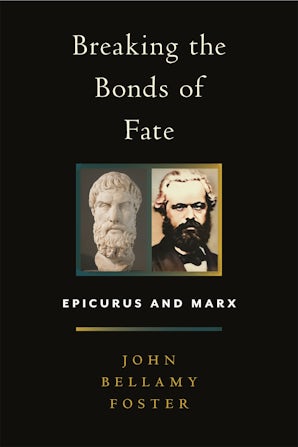
John Bellamy Foster’s “Breaking the Bonds of Fate”
In the Public Eye
GPEnewsdocs, with Lynn Fries:
In the 1st segment of an interview series on ecology and materialism conducted by journalist Lynn Fries, John Bellamy Foster explains how Marx, who was not a natural scientist learned from chemists, physicists, biologists and the ancient Greek philosopher Epicurus. Marx then garnered a unique theoretical approach that identifies the causes of the societal and ecological crises we face today. In Part 2, Foster debunks the misconception that socialism and materialism had no role in the development of ecological analysis. His research shows that socialist transformation involves the transformation of human relations with nature, and that the modern ecological movement grew out of Marx’s analysis of the dialectics of society and nature. And there again, the Epicurean strand carries right through. In the 3rd segment, Foster concludes that across different societies starting from ancient China, the Hellenistic world and India, there is a parallelism of class struggles. They involve notions of self-consciousness through production in relation with nature, human freedom, solidarity and substantive equality. Common to them is a praxis that combines Epicurus’s philosophy of enough and reciprocity with Marx’s emphasis on production and transformation. Says Foster in Part 1: “….Epicurus for Marx was a plus because he was very critical of religion or teleology – the notion that the gods or God determined things on earth. He rejected that without rejecting religion completely. And he emphasized that the basis of human life was community, friendship; building a society based on friendship. He was the first to bring women into philosophy – allowing them to emerge as major philosophers within the Epicurean school – and also slaves. He couldn’t do anything about slavery itself, but he brought slaves into Epicurean philosophy. They were given a high status. The whole society was organized around a garden. And emphasized sustainable living, and very ecological in orientation. Epicurus criticized those who thought that, “enough was too little”. The idea is that everyone needs enough but no one needs more than that….” Read more here and watch here.
Emancipations with Daniel Tutt
In late May, Helena Sheehan, Katarina Kolozova, Thomas Nail joined John Bellamy Foster in discussing his latest book, Breaking the Bonds of Fate: Epicurus and Marx, in a symposium hosted by Daniel Tutt. We encourage you to support Emancipations with Daniel Tutt, a series of public discussions on seminal works in the history of Marxist thought and philosophy. Watch below….
The Critical Theory Workshop
The Critical Theory Workshop was first to launch John Bellamy Foster’s excellent new work. Speakers alongside Foster included Boris Hennig and Paul Schafer, with Jennifer Ponce de León of The Critical Theory Workshop serving as the moderator: https://www.youtube.com/live/1PrDLsHiKkk
REVIEWS
Socialism and Democracy, by Mat Callahan
“The title of John Bellamy Foster’s latest book, Breaking the Bonds of Fate, derives from Lucretius’s famed De Rerum Natura, usually translated as On the Nature of Things. Lucretius wrote:
“Again, if all movement is always interconnected, the new arising from the old in a determinate order – if the atoms never swerve so as to originate some new movement that will break the bonds of fate, the everlasting sequence of cause and effect – what is the source of the free [will] … .” ([On the Nature of Things,] Book II, 251ff)
This exact quotation, moreover, was one made by Karl Marx in his Epicurean Notebooks, compiled in preparation for his doctoral thesis: “The Difference Between the Democritean and Epicurean Philosophy of Nature” of 1841. From this point of departure, Foster initiates the reappraisal of two thousand years of philosophical controversy…
…Breaking the Bonds of Fate is a major contribution to our understanding of the history of philosophy. Furthermore, it demonstrates the continued relevance of philosophy today. Especially at a time like ours, when social disintegration, irrationalism and reaction are rampant, the praxis and enduring influence of Epicurus and the Garden is an inspiration. By reaffirming basic principles of materialism, dialectics, and the work of Marx and Engels, Foster has provided persuasive arguments for their propagation. It is to be hoped that this wonderful book will be read and discussed by many. We will be better equipped for the struggle to emancipate humanity.” Read more…
Theory and Struggle, by Richard Clarke
Foster’s latest blockbuster Breaking the Bonds of Fate though the most recent, fits logically as the first of the trilogy. It dismantles another myth: that Marx’s own doctoral thesis ‘The Difference Between the Democritean and Epicurean Philosophy of Nature’5 (completed in 1841 and dedicated to Ludwig von Westphalen, his friend, mentor and future father-in-law) was merely an aberration or youthful enthusiasm soon surpassed by his developing political awareness and activity. On the contrary, it was central to the development of Marx’s world view….Often presented as a private retreat into tranquillity, Foster emphasises that Epicureanism was a materialist challenge – not limited to the elite – to the ideological forces that told ordinary people their suffering was predestined and divinely ordained. Epicurean communities (the Garden) sought friendship and liberation from fear in a world where political agency had been eroded. Foster highlights Epicurus as the pinnacle of ancient materialism, who introduced the idea of the clinamen (swerve), a spontaneous slight, unpredictable deviation in the motion of atoms, acknowledging causality but allowing for chance, emergence, responsibility and human volition. The ‘original constitution’ of humans had itself become modified including development of new mental powers and (non-metaphysical) ‘free will’, based on an objective understanding of the world, rejecting inevitability or ‘fate’ within a thoroughly material universe….”
Socialist.ca, reviewed by Brian Champ:
“Foster starts by situating Epicurus in his time. He was the son of colonists of the island of Samos in the Aegean Sea, which had been seized by Athenian forces from the Persian empire. Shortly after his birth, Alexander the Great of Macedonia incorporated Athens into his empire, though allowing relative autonomy for the city-state. At about the time of Epicurus’s mandatory military service, Alexander died, leading to “an ‘empire of chaos’ during the Wars of the Diadochi (or Successors) of the Macedonian Empire”.
After studying the philosophy of the Pre-Socratics, Plato and Aristotle, Epicurus set up schools, first in Lampsacus (in modern day Turkey), then later in Athens.
Other philosophical schools in the city used public space for lectures and attracted young, well educated, aristocratic Greek men. His critique of the ruling classes that dominated these schools that “Nothing is enough for those for whom enough is too little” is as applicable today as in his age…. Read more
Marx & Philosophy Review of Books, reviewed by Alex Adamson:
“…Living in the fallout following the death of Alexander that threw the Hellenistic world into chaos, the wars of the Diadochi created a situation of precarity and uncertainty. Within these uncertain times and famines caused by war, Epicurus’s school was called ‘the Garden,’ in part because of the necessity for planting vegetables to sustain their community. Food was grown both for self-sufficiency as well as to provide for those in need- one could say Epicurus was one of the first to perfect the anarchist bean-stew for his comrades. Given current climate crises and devastation of the earth by imperialist wars and capitalist agriculture, this grounding of Marxism within the soil of Epicurus’s garden is a welcome contribution to the history of ecological philosophy….” Read more
Morning Star, “New light on the origins of Marx’s thought”, by Richard Clarke:
“Epicurean is commonly understood as a reference to gourmet food and drink, or more generally to a hedonistic lifestyle. Google a little deeper and you’ll find that Epicurus was a Greek philosopher who tells us that pleasure is the highest good; not wild indulgence but a tranquil state (ataraxia) achieved by removing pain (aponia) through simple living, friendship, limiting desires to natural and necessary ones (food, shelter, safety), and working collectively to secure true, lasting happiness.
And if you’ve read up on the origin of Karl Marx’s world view you’ll have come across the argument that his doctoral thesis, The Difference Between the Democritean and Epicurean Philosophy of Nature (completed in 1841 and dedicated to Ludwig von Westphalen, his friend, mentor and future father-in-law), was merely an aberration or youthful enthusiasm soon overtaken by his developing political awareness and activity.
In reality, argues John Bellamy Foster, the opposite is the case. Marx’s study of Epicurus and his relation to it was central to the development of Marx’s world view.
Foster is one of the most prominent of today’s Marxist academics who have “rescued” the ecological Marx (and Engels), and promoted the notion of a “second foundation” of Marxism; extending our understanding of Marxism beyond human society (historical materialism and the critique of political economy) to encompass the whole of nature.
For Foster, Epicurus and Marx are individuals of equivalent stature: even Marx couldn’t “make bricks without straw”. One example: Marx’s well known statement about standing Hegel on his feet seems to have come from Epicurus’ Roman populariser, Lucretius, who said of the idealist philosophers of his day that they stood with their heads where their feet belong….” Read more
EXCERPT
(Excerpted From the Introduction) Praxis: Ancient and Modern
“In terms of praxis, or the dialectic of theory and practice, the contribution of Epicurus’s philosophy was affected by the fact that he was writing at a time of an “empire of chaos” that ensued during the Wars of the Diadochi (or Successors) over Alexander’s Empire, and the related demise of the polis.9 Nevertheless, his emphasis on contingent freedom was an important break from the fatalism of his time. Although he advised his followers to avoid where possible any serious engagement in the political life of the time, he also supported taking direct actions on behalf of friends who were victims of injustice. In a famous case, Epicurus, and his follower Metrodorus, intervened in support of their friend the Syrian Mithres when he was imprisoned in Piraeus, reflecting the fact that in Epicurean philosophy the distinction between Greek and “barbarian” had been dissolved. Epicurus was well known for providing aid, in the form of bushels of food, from his limited means, to those in distress.10 In general, the social praxis promoted by Epicurus in the Hellenistic Age was one of defiance of the state (astral) religion, accompanied by a relatively distant relation to the polis itself, focusing instead on creating self-sufficient communities rooted in friendship, the reconciliation of humanity and nature, egalitarianism, and ataraxia, or contentment. The emphasis was on internal human development, cultivation of philosophy, and an atmosphere of reciprocity and “mutual exchange.”11 “Nothing is enough,” Epicurus wrote, “for those for whom enough is too little.”12
The significance of Epicurus and Epicureanism for an understanding of classical historical materialism and for the renewal of Marxism today should be readily apparent. The one-sided Western Marxist philosophical tradition, for all of its immense contributions, was based from its beginning in the 1920s on a rejection of materialist dialectics, or the dialectics of nature, and thus of natural science. This translated into the negation of any meaningful materialist conception of nature. Yet, without a thoroughgoing materialist perspective it is impossible to perceive the relation of humanity to nature, of which we are a part. In terms of Marx’s later analysis, this requires recognizing how the labor and production process constitutes the specific human “social metabolism” within the “universal metabolism of nature.” The relation of freedom to necessity, peculiar to our time, demands a dialectical perspective, one that refuses to divide nature from society, while recognizing the contradictions imposed by capitalism in that respect.13
In any attempt to address Marx’s materialism, his “genetic exposition” of Epicurus’s philosophy, exploring its “objective logic,” is of decisive importance given its genetic relation to his own materialism and dialectical method.14 Reduction of historical materialism to a purely social dialectic, excluding the natural-material realm, has robbed Marxian theory of its earthly basis, including any understanding of the relation of freedom and necessity. The result is to negate the whole larger conception of revolutionary struggle as aimed at the creation of a society of sustainable human development…”
To read more, get your copy here.