Monthly Review Press

Michael Heinrich interviewed by Xiaoping Wei

Michael Heinrich interviewed by Xiaoping Wei

Michael Heinrich is the author of An Introduction to the Three Volumes of Marx's Capital, published last year by Monthly Review Press. Here, he discusses his work and his interpretation of Capital with Xiaoping Wei, director of History of Marxism Philosophy in the Philosophy Institute of the Chinese Academy of Social Sciences, vice-director of History of Marxism Philosophy Society of China, and vice-director of Western Marxism Society of China.

Hell’s Kitchen and the Battle for Urban Space reviewed by Resolute Reader

Hell’s Kitchen and the Battle for Urban Space reviewed by Resolute Reader

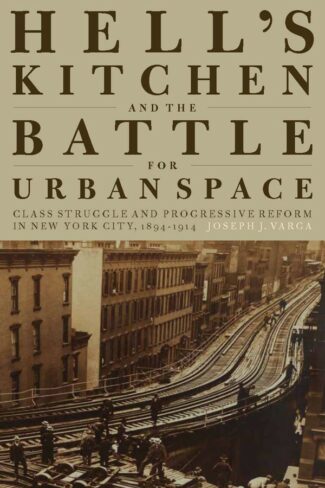
In the period this book considered, Hell's Kitchen, or "Manhattan's Middle West Side" was considered by many commentators to be an area of poverty, corruption, crime and unsavoury types. In reality of course it was a home to thousands of working class people who carved their own lives out of the limited opportunities that they had ... Subtitled, Class Struggle and Progressive Reform in New York City, 1894-1914, Joseph J. Varga's new book is a detailed examination of the development of this district in New York, but more importantly, an attempt to understand, using the concept of the "production of space" how that urban space was shaped and, in turn, shaped those who inhabited it.

Ruth First and Joe Slovo in the War against Apartheid reviewed in Z Magazine

Ruth First and Joe Slovo in the War against Apartheid reviewed in Z Magazine

Ruth and Joe, white secular Jews in apartheid South Africa, did not have to fight against that society of skin-color privilege. Yet they did because that social system doomed scores of people to lives of misery and poverty. We discover the complexities of place, space, and time in Ruth and Joe's lives among those with and without name recognition to overthrow white-minority rule in South Africa.

Alan Wieder on South Africa in CounterPunch

Alan Wieder on South Africa in CounterPunch

(Alan Wieder is the author of Ruth First and Joe Slovo in the War against Apartheid, new from MR Press.) There were five South African launches for my new book on freedom fighters Ruth First and Joe Slovo – Bloemfontein, Johannesburg, two in Cape Town, and finally Port Elizabeth. It was the latter that provided a political education for the present. Earlier in our day in Port Elizabeth our host, Allan Zinn, had taken us to the northern campus of Nelson Mandela Metropolitan University in the Missionvale Township. We witnessed over 500 high school students participating in a Nelson Mandela day workshop on conflict resolution and the difference between debate and dialogue.

The Endless Crisis reviewed in Socialism & Democracy

The Endless Crisis reviewed in Socialism & Democracy

In mainstream economics capitalism as a theoretical construct has been replaced by the free market economy, which has been declared the ultimate arbiter of public policy. It is little wonder that the very academic and business economists charged with developing a practical understanding of the economy went into shock when the Great Recession hit. In their world such an event was simply not theoretically possible. Into this breach step Foster and McChesney, continuing the tradition of Monthly Review, with their analysis of the contradictions of monopoly-finance capital. This book provides a clear explanation of why the Great Recession occurred and how the crash constituted a wide-scale failure that was entirely predictable.

Read an excerpt from Hell’s Kitchen and the Battle for Urban Space on the Gotham Center's History Blotter

Read an excerpt from Hell’s Kitchen and the Battle for Urban Space on the Gotham Center's History Blotter

What does it mean to live in a "bad neighborhood"? How do urban dwellers themselves produce urban space as history, in the changing modes of perception, in the shifting conceptual ideas that are literally the result of the numerous encounters with the everyday physical paths, nodes, and routes. Here in urban laboratories like New York's Hells Kitchen, we see the actual creation of the Progressive Era reformer, forged in the encounter with the space of tenement life. We see the emergence of a new politics, of an urban working class aware of its role as object of study, performing the routine of urban "problem" by insisting that their collective voice be heard. We see the space itself being produced in everyday use, and altered by the demands of economy, of culture, of politics, spaces that then act themselves, framing the new conceptual ideas that would drive future restructurings.

NEW! A Freedom Budget for All Americans: Recapturing the Promise of the Civil Rights Movement in the Struggle for Economic Justice Today by Paul Le Blanc and Michael D. Yates

NEW! A Freedom Budget for All Americans: Recapturing the Promise of the Civil Rights Movement in the Struggle for Economic Justice Today by Paul Le Blanc and Michael D. Yates

Just in time for the 50th anniversary of the March on Washington for Jobs and Freedom, Paul Le Blanc and Michael D. Yates explain the origins of the Freedom Budget, how it sought to achieve "freedom from want" for all people, and how it might be re-imagined for our current moment. Combining historical perspective with clear-sighted economic proposals, the authors make a concrete case for reviving the spirit of the Civil Rights Movement and building the society of economic security and democratic control envisioned by the movement's leaders—a struggle that continues to this day.

Hell’s Kitchen and the Battle for Urban Space reviewed in Antipode

Hell’s Kitchen and the Battle for Urban Space reviewed in Antipode

Despite recent efforts to efface its history through the practice of renaming, the area of mid-west Manhattan that real estate agents now call the Clinton Historic District (or even 'Clinton Heights') remains – to many existing residents and to the popular imagination at large – Hell's Kitchen. Just how and why this moniker and all that it conjures have stuck is part of the story that Joseph Varga tells in Hell's Kitchen and the Battle for Urban Space, a nuanced and theoretically-sophisticated history of the social relations and spatial imaginaries that produced this area in the turbulent decades from 1894 to 1914. Though this period of American urban history – the era of Progressive reform – has received considerable attention from historians, Varga adds a much-needed dimension to the discussion by engaging directly with critical spatial theory. The result is not just an eminently readable history of Hell's Kitchen, but a fascinating example of how 'taking space seriously' can alter our historical understandings and perspectives in powerful ways.