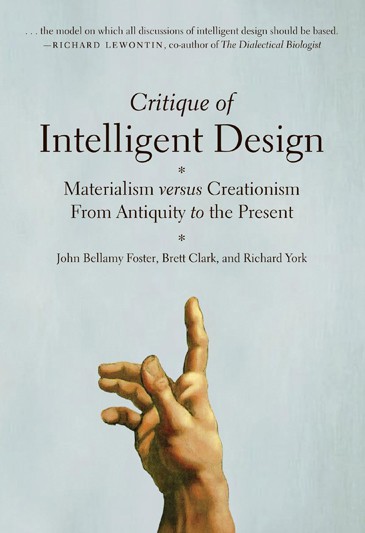
Critique of Intelligent Design: Materialism versus Creationism from Antiquity to the Present
$15.95
Paperback, 240 pages
ISBN-13: 978-1-58367-173-3
Released: November 2008
Is the Teaching of Evolution to Be Banned in U.S. Public Schools? Is Science Once More to be Burned on the Cross? Will Creationism Win the 2,500 Year War with Materialism and Reason?
A critique of religious dogma historically provides the basis for rational inquiry into the physical and social world. Critique of Intelligent Design is a key to understanding the forces of irrationalism challenging the teaching of evolution in U.S. public schools and seeking to undermine the natural and social sciences. It illuminates the 2,500 year evolution of the materialist critique the explanation of the world in terms of itself from antiquity to the present through engaging the work of Socrates, Plato, Aristotle, Epicurus, Lucretius, Francis Bacon, Isaac Newton, David Hume, William Paley, Charles Darwin, Karl Marx, Sigmund Freud, Stephen Jay Gould, and numerous others (including contemporary advocates of ‘intelligent design’).
Proponents of intelligent design creationism in a more subtle guise have recently reignited the age-old war between materialism and creationism, in which they claim to elevate their doctrine to empirical truth and thus incorporate it into science curricula. They attack modern science, advancing a pseudo-scientific view and a reactionary political culture in line with their theology and what they perceive as a knowable moral order. They single out for criticism the greatest modern representatives of materialist-scientific thought: Darwin, Marx, and Freud.
Critique of Intelligent Design is a direct reply to the criticisms of intelligent design proponents and a compelling account of the long debate between materialism and religion in the West. It provides an overview of the contemporary fight concerning nature, science, history, morality, and knowledge. Separate chapters are devoted to the design debate in antiquity, the Enlightenment and natural theology, Marx, Darwin, and Freud, and to current scientific debates over evolution and design. It offers empowering tools to understand and defend critical and scientific reasoning in both the natural and social sciences and society as a whole.
Finally we have a book on so-called ‘intelligent design’ that gets to the heart of the matter rather than devoting all its energies to a point by point refutation of that doctrine. While providing a sophisticated modern understanding of the complexities of organisms and the biological processes that have resulted in life as it has evolved, the authors of Critique of Intelligent Design never lose sight of the real issue which is the struggle between materialism and supernaturalism as an explanation for the world of phenomena. Theirs is the model on which all discussions of intelligent design should be based.
This superb history of philosophical materialism argues for its indispensability as the answer to the ideology of ‘intelligent design’: its authors make the point that the latter is not merely a local tactic in the service of political reaction, but that religion itself is fundamentally incompatible with progressive politics. At a time when all kinds of religious assertions are allowed to pass unchallenged, this book is an invigorating blast of fresh air.
The intelligent design creationist movement’s attack on the natural sciences has been thoroughly critiqued and rightly rejected. However, the movement’s attempt to undermine the social sciences as well has been largely overlooked. This book fills that void by offering a thoughtful, well-researched discussion of the major figuresbesides Darwin himselfwhom ID creationists demonize: Epicurus, Marx, and Freud. Moreover, by analyzing C. S. Lewis’s influence on the ID movement’s leaders, the authors further expose ID as essentially an exercise in Christian apologetics. This is an excellent book. It adds to the growing body of critical writing about intelligent design creationism.
. . . this is an admirable little book. It is well written; it is punchy and forthright; and by and large it gets the facts right and makes some good points. . . . Critique of Intelligent Design does a good job of picking up on the work of Forrest and Gross, using it to set the background for the overall history of what John Bellamy Foster, Brett Clark, and Richard York see as a clash between materialism and Christianity as represented by design arguments, of which IDT is only the latest manifestation.
A discerning historical reconstruction, which succeeds in illuminating the broad anti-materialist agenda underlying the intelligent design movement.
A scholarly and compelling book showing intelligent design to be an anti-Enlightenment projectand one full of illusion, superstition, and hidden reactionary agendas. Anyone interested in science and reason rather than fairy tales about a Celestial Designer should get hold of a copy. So too should educators intending to force intelligent design onto their pupils.
A fascinating history of the long struggle between scientific and materialist thought on the one hand and religion and various forms of idealism on the otherprobably the most significant issues over which humans have been arguing throughout their recorded history.
With Epicurus and Darwin among its heroes, this book is a timely exposure of the creationist dogmatism that the intelligent design movement seeks to disguise as science.
What can a Marxist critique of ‘intelligent design’ do that the flood of non-Marxist atheist works on this subject cannot? The short answer is that it can show how this new/old form of ideology functions inside our modern capitalist society (systemic critique), and it can show how it has developed over time as part of the debate between materialist and idealist views of the world (historical critique). The long answer can be found in the detailed and scholarly manner in which this project has been carried out in the volume before us. Without this double contextualization, you may be able to judge whether ‘intelligent design’ is true or false, but you will never know its ‘meaning.’ A brilliant scholarly achievement that no one interested in the subject or in how to analyze this kind of subject can afford to miss.
In combating the new creationism repackaged as intelligent design, it is not enough to refute particular misunderstandings about chance, complexity, or natural selection. ID is part of an offensive against materialism and humanism aimed at imposing a Christian fundamentalist culture congruent with the needs of a declining empire. Critique of Intelligent Design places the debate in its broadest context and historical roots from Epicurus on up, in a vigorous defense of a materialist view of nature that rejects the tepid compromise that would simply divide the turf into domains of science and religion.
Publication Date: November 2008
Number of Pages: 240
Paperback ISBN: 9781583671733
Related products
-
![Monthly Review Volume 2, Number 8 (December 1950) [PDF]](data:image/svg+xml,%3Csvg%20xmlns='http://www.w3.org/2000/svg'%20viewBox='0%200%20150%20232'%3E%3C/svg%3E)
Monthly Review Volume 2, Number 8 (December 1950) [PDF]
$10.00 Add to cart -
Monthly Review Volume 2, Number 6 (October 1950) [PDF]
$10.00 Add to cart -
![Monthly Review Volume 2, Number 3 (July 1950) [PDF]](data:image/svg+xml,%3Csvg%20xmlns='http://www.w3.org/2000/svg'%20viewBox='0%200%20150%20239'%3E%3C/svg%3E)
Monthly Review Volume 2, Number 3 (July 1950) [PDF]
$10.00 Add to cart -
Monthly Review Volume 2, Number 1 (May 1950) [PDF]
$10.00 Add to cart -
Monthly Review Volume 1, Number 6 (October 1949) [PDF]
$10.00 Add to cart -
Monthly Review Volume 1, Number 5 (September 1949) [PDF]
$10.00 Add to cart
![Monthly Review Volume 2, Number 8 (December 1950) [PDF]](https://monthlyreview.org/wp-content/uploads/2015/09/Monthly Review Volume 2, Number 8 (December 1950) [PDF].jpg)
![Monthly Review Volume 2, Number 6 (October 1950) [PDF]](https://monthlyreview.org/wp-content/uploads/2015/09/Monthly Review Volume 2, Number 6 (October 1950) [PDF].jpg)
![Monthly Review Volume 2, Number 3 (July 1950) [PDF]](https://monthlyreview.org/wp-content/uploads/2015/09/Monthly Review Volume 2, Number 3 (July 1950) [PDF].jpg)
![Monthly Review Volume 2, Number 1 (May 1950) [PDF]](https://monthlyreview.org/wp-content/uploads/2015/09/Monthly Review Volume 2, Number 1 (May 1950) [PDF].jpg)
![Monthly Review Volume 1, Number 6 (October 1949) [PDF]](https://monthlyreview.org/wp-content/uploads/2015/09/Monthly Review Volume 1, Number 6 (October 1949) [PDF].jpg)
![Monthly Review Volume 1, Number 5 (September 1949) [PDF]](https://monthlyreview.org/wp-content/uploads/2015/09/Monthly Review Volume 1, Number 5 (September 1949) [PDF].jpg)