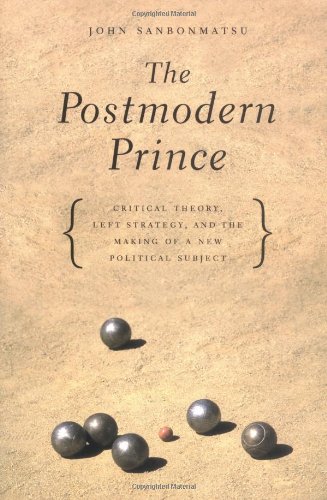
The Postmodern Prince: Critical Theory, Left Strategy, and the Making of a New Political Subject
$29.00
Paperback, 272 pages
ISBN: 1-58367-090-4
Released: June 2003
John Sanbonmatsu’s Postmodern Prince is an work of political theory with a focus on questions of strategy. At the same time it provides an original and illuminating intellectual history of the Left from the 1960s to the present. It examines the politics of the New Left in the 1960s, showing how its expressivism led to political division and also prepared the ground for postmodernism. It shows also how the political economy of academic life in an increasingly commodified society strengthened the basis of postmodernism.
The Postmodern Prince provides a historically-grounded critique of postmodernism, and a history of how the socialist Left has helped to create its ideas. In the course of this two-sided critique, it develops a brilliant account of a Marxism that sets itself the task of building a collective political subject—a successor to Machiavelli’s Prince and Gramsci’s Modern Prince—capable of challenging capitalism in its moment of global crisis.
Sanbonmatsu demonstrates the limitations of the work of Michel Foucault, and more recently, Hardt and Negri’s much-acclaimed Empire. In the process he validates for Marxism the classical idea of politics as hegemonic in scope, revolutionary in aspiration, and dependent on the capacity of leadership to rise to unforeseen challenges. He draws on an extraordinary range of historical, political and philosophical analyses to set out the preconditions for a renewal of strategic and theoretical vision for the Left.
In a well-argued, often insightful book, Sanbonmatsu traces the rise of postmodern theory to the ‘expressivist’ politics of the New Left; he shows that the postmodern attempt to promote differences and question notions of universality has undercut the possibility of a unified radical movement. Going back to the work of Antonio Gramsci, the author argues for the need to develop a theory of a ‘postmodern prince,’ one that assumes unity and difference by squarely lodging its analysis in the experiential realm where solidarity can arise. In the process of such an argument, Sanbonmatsu admirably explicates the problems associated with postmodern theory, particularly the work of Michel Foucault, and clearly lays out the relevant arguments associated with Gramsci’s theory … Highly recommended.
A wide-ranging and well-researched book. As a welcome change, it also happens to be a deeply-felt work.
Possesses an admirable urgency, unity of purpose, and clarity, as an intervention around strategy and as a critique of postmodern theory.
Combines a devastatingly precise critique of postmodernism with a visionary and realistic account of the necessity for ethical and political unity among progressive movements. This brilliant and provocative book is in the best tradition of Marx, Gramsci, and Marcuse—and should be read by anyone who still believes that the task of left theory is to help create a better world.
Fascinating and provocative from beginning to end, this book weaves together a compelling study of how the language of politics has evolved through its various complex and difficult encounters with such traditions as Gramscian Marxism, existentialism, postmodernism, feminism, radical ecology, and religion.
This is a stunning survey and critique of left practice and theory … Sanbonmatsu argues that the Left has undermined itself in pursuit of difference and expressiveness at the expense of unity and strategic action, and that postmodernist theory has deepened these problems by associating its campaign against coherence with the Left. He calls for a new radical ethos based on empathy for all living creatures. This book should be taken seriously by anyone who wants a revitalized Left.
Contents
INTRODUCTION
Chapter One: ROMANCING THE LEFT
- A Romantic Structure of Feeling
- Faith vs. Works
- The Pentecostal Mysticism of Norman O. Brown
- Morbid Symptoms Appear
- The Expressivist Legacy
Chapter Two: SPEAKING IN TONGUES
- The Cyborg Speaks in Tongues
- “Breaking the Silence”: Postmodernist Identity Politics
- La Lingua Continua
- Expressivism as Reification
Chapter Three: BAROQUE THEORY
- “Use Value” and the Baroque Arsenal of Theory
- Commodity Aesthetics
- Trend Innovation in Theory
- Against the Autonomy of Theory
- Theory as Practice
Chapter Four: THE FRENCH IDEOLOGY
- Althusser, Foucault, and the Liquidation of Experience
- “Two, Three . . . Many Geists”: Reification and the Automaton Empire
- The Catechism of Praxis
Chapter Five: THE PRINCE AND THE ARCHAEOLOGIST
- Exemplary Lives
- The Virtú of the Modern Prince
- Strategy and the Modern Prince
- Foucault’s Great Refusal of Strategy
- Teaching Literacies of Power
- Against Pedagogy
- Reversal of Fortune
Chapter Six: THE POSTMODERN PRINCE
- Form in Modern Political Thought
- Lenin’s Leviathan
- Enter, stage left: The Modern Prince
- Unity and Difference: The Challenge of Translation
- The Postmodern Prince
- Totality and Perception
- Toward a New Theory of the Whole
Chapter Seven: METAHUMANISM
- Empathy and Attentiveness to Others
- Humanism, Suffering, and Love
- New Gnosis
- The Fight for Eros
EPILOGUE
NOTES
INDEX
Publication Date: August 2003
Number of Pages: 272
Paperback ISBN: 9781583670903
Related products
-
![Monthly Review Volume 2, Number 5 (September 1950) [PDF]](data:image/svg+xml,%3Csvg%20xmlns='http://www.w3.org/2000/svg'%20viewBox='0%200%20150%20239'%3E%3C/svg%3E)
Monthly Review Volume 2, Number 5 (September 1950) [PDF]
$10.00 Add to cart -
Monthly Review Volume 1, Number 12 (April 1950) [PDF]
$10.00 Add to cart -
Monthly Review Volume 1, Number 10 (February 1950) [PDF]
$10.00 Add to cart -
![Monthly Review Volume 1, Number 5 (September 1949) [PDF]](data:image/svg+xml,%3Csvg%20xmlns='http://www.w3.org/2000/svg'%20viewBox='0%200%20150%20232'%3E%3C/svg%3E)
Monthly Review Volume 1, Number 5 (September 1949) [PDF]
$10.00 Add to cart -
Monthly Review Volume 1, Number 2 (June 1949) [PDF]
$10.00 Add to cart -

We, the People: The Drama of America
$15.00 – $18.00 Select options This product has multiple variants. The options may be chosen on the product page
![Monthly Review Volume 2, Number 5 (September 1950) [PDF]](https://monthlyreview.org/wp-content/uploads/2015/09/Monthly Review Volume 2, Number 5 (September 1950) [PDF].jpg)
![Monthly Review Volume 1, Number 12 (April 1950) [PDF]](https://monthlyreview.org/wp-content/uploads/2015/09/Monthly Review Volume 1, Number 12 (April 1950) [PDF].jpg)
![Monthly Review Volume 1, Number 10 (February 1950) [PDF]](https://monthlyreview.org/wp-content/uploads/2015/09/Monthly Review Volume 1, Number 10 (February 1950) [PDF].jpg)
![Monthly Review Volume 1, Number 5 (September 1949) [PDF]](https://monthlyreview.org/wp-content/uploads/2015/09/Monthly Review Volume 1, Number 5 (September 1949) [PDF].jpg)
![Monthly Review Volume 1, Number 2 (June 1949) [PDF]](https://monthlyreview.org/wp-content/uploads/2015/09/Monthly Review Volume 1, Number 2 (June 1949) [PDF].jpg)