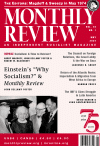
May 2024 (Volume 76, Number 1)
The MR editors revisit the words of Monthly Review editors Harry Magdoff and Paul M. Sweezy, writing in the twenty-fifth-year anniversary issue. Writing on the innate contradictions plaguing the capitalist system, the editors in 1974 noted that the ecological limitations of capital accumulation was “unsolvable” under capitalism, thus setting the stage for the magazine’s continued exploration of ecosocialism as humanity’s future. | more…

Einstein’s “Why Socialism?” and ‘Monthly Review’: A Historical Introduction
For our seventy-fifth anniversary issue, John Bellamy Foster revisits the legacy of Albert Einstein and his deep connections to Monthly Review, including his authorship of the article “Why Socialism?,” published in our first-ever issue in May 1949. Through historical documents and the famed physicist’s own words, Foster rediscovers Einstein’s commitment to socialism in both word and deed, and his collegial ties to MR‘s founding editors. | more…

The Council on Foreign Relations, the Israel Lobby, and the War on Gaza
Over six months into to Israel’s atrocity-filled assault on Gaza, Laurence Shoup digs deep to reveal a rarely discussed—but enormously influential—force within the Israel Lobby: the Council on Foreign Relations. The CFR, he writes, is more than just Wall Street’s think tank; it is an elite network of Zionist politicians and donors who comprise a significant part of the Israel lobby and the continuing U.S. commitment to funding Israel’s genocidal actions in Palestine. | more…

Return of the Atlantic Route from West Africa to Europe: Imperialism and Regional (De-)Integration
As dangerous trans-Atlantic crossings between Africa and Europe continue to rise, Hannah Cross examines the roots of the ongoing crisis. The discussion around migration, she notes, “overlooks the imperial role of Europe and the United States over borders, migration regimes, regional (de-)integration, and national development projects within Africa.” The solution, therefore, can only be found through genuine liberation and autonomy across the continent, rather than internationally imposed mechanisms benefitting the powerful in the Global North. | more…

The IMF and Class Struggle in Latin America: Unveiling the Role of the IMF
This article will be released in full online May 20, 2023.
The International Monetary Fund, part of the Bretton Woods Agreement that helped establish the current rules of the U.S.-dominated international capitalist system, claims to aim for a world of prosperity through so-called free trade. In Latin America, David Barkin and Juan Santarcángelo write, the IMF has contributed to the impoverishment of the working class and destruction of these countries’ ecological legacies. But what does the future hold for the IMF in Latin America? | more…
![Monthly Review Volume 52, Number 4 (September 2000) [PDF]](https://p4r4f7y4.rocketcdn.me/wp-content/uploads/2015/08/MR-052-04-2000-08-100x146.jpg)
Socialism—A Time to Retreat?
The Perspective of 'Monthly Review' at the Opening of the Twenty-First Century
This article will be released in full online May 27, 2023.
In this reprise from September 2000, Harry Magdoff, John Bellamy Foster, and Robert W. McChesney look forward to the future of Monthly Review in the twenty-first century: “Despite mistakes, setbacks, and recognition that the road is long and arduous, we must not waver as we continue to study, educate, and be missionaries for the transcendence of the social system of capitalism and the development…of a society of equals.” | more…
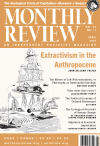
April 2024 (Volume 75, Number 11)
In a December 2023 interview with the Wall Street Journal, Richard Haass, former special assistant to H. W. Bush, declared that the world has descended into a “new world disorder,” lamenting the long-lost dream of unending U.S. hegemony. This month’s “Notes from the Editors” reflects on not only Haass’s recent statements, but his longstanding advocacy of an “Imperial America” designed to ensure U.S. domination on the world stage. | more…
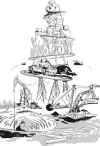
Extractivism in the Anthropocene
This month’s Review of the Month by John Bellamy Foster illuminates the idea of extractivism, a key concept in understanding our current planetary crisis. The accelerated extraction of Earth’s resources since the mid-twentieth century, Foster notes, threatens not only the natural world, but the means of life for the entire planet. | more…

On the Misery of Left Nietzscheanism, or Philosophy as Irrationalist Ideology
Matthew Sharpe discusses Aymeric Monville’s Misère du nietzschéisme de gauche (The Misery of Left Nietzscheanism), an exploration of how Nietzsche’s popularity on the left co-opts truly radical energy in favor of authoritarianism and elitism. “If Monville is right,” Sharpe concludes, “Nietzcheanism has acted as a kind of ideological ‘useful idiot.’” | more…

Old Age but No Rest: A Political-Economic Reflection on Delayed Retirement Policy
As populations worldwide grow older, politicians are clamoring to raise the retirement age, thus extending people’s working lives at their own expense. Using the lens of political economy, Cai Chao examines the false narratives behind capitalists’ claims that delayed retirement is necessary to maintain society’s productive capacity, and proposes solutions to promote human development at all life stages. | more…

The Necessity of System Change: An Ecological and Marxian Synthesis
In a world of convergent crises, leading voices have called for radical changes to food, financial, and energy systems. However, these fail to account for a deeper systemic crisis: unfettered and accelerating of capital accumulation. In this article, M. Graziano Ceddia and Jacopo Nicola Bergamo provide a more comprehensive narrative, one which emphasizes capital as a social relation—and the potential of the environmental proletariat to dismantle its dominance. | more…

Who owns this ‘country’?
A new poem by Marge Piercy. | more…

The Ecological Crisis of Capitalism and Human Survival
In this remarkable reprise reprinted from Monthly Review‘s October 1992 issue, Harry Magdoff and Paul Sweezy look ahead to the ecological crisis that has continued to unfold into the twenty-first century. Presaging the critical juncture at which we find ourselves today, they write that “only a change in the in the nature of power structures on a global scale could bring a realistic hope for the long-term continuation of human civilization…. If you think that is true, what do you think are the implications?” | more…