From Classic Labor to the Labor of the ‘General Intellect’: The Impact of the Digital Intelligence Era on Socialist Labor Theory Article
New This Week

From Classic Labor to the Labor of the ‘General Intellect’: The Impact of the Digital Intelligence Era on Socialist Labor Theory

Applying Marxist labor theory to the rise of artificial intelligence and its effects on workers, Te Li presents an understanding of labor in the age of increasing reliance on algorithms and digital technologies. As Li argues: "In the civilization of general intellect labor, where the knowledge economy dominates, knowledge-intensive labor such as scientific research, technological innovation, artistic creation, and education and training will become primary forms of labor."
+ read more
read our latest issue

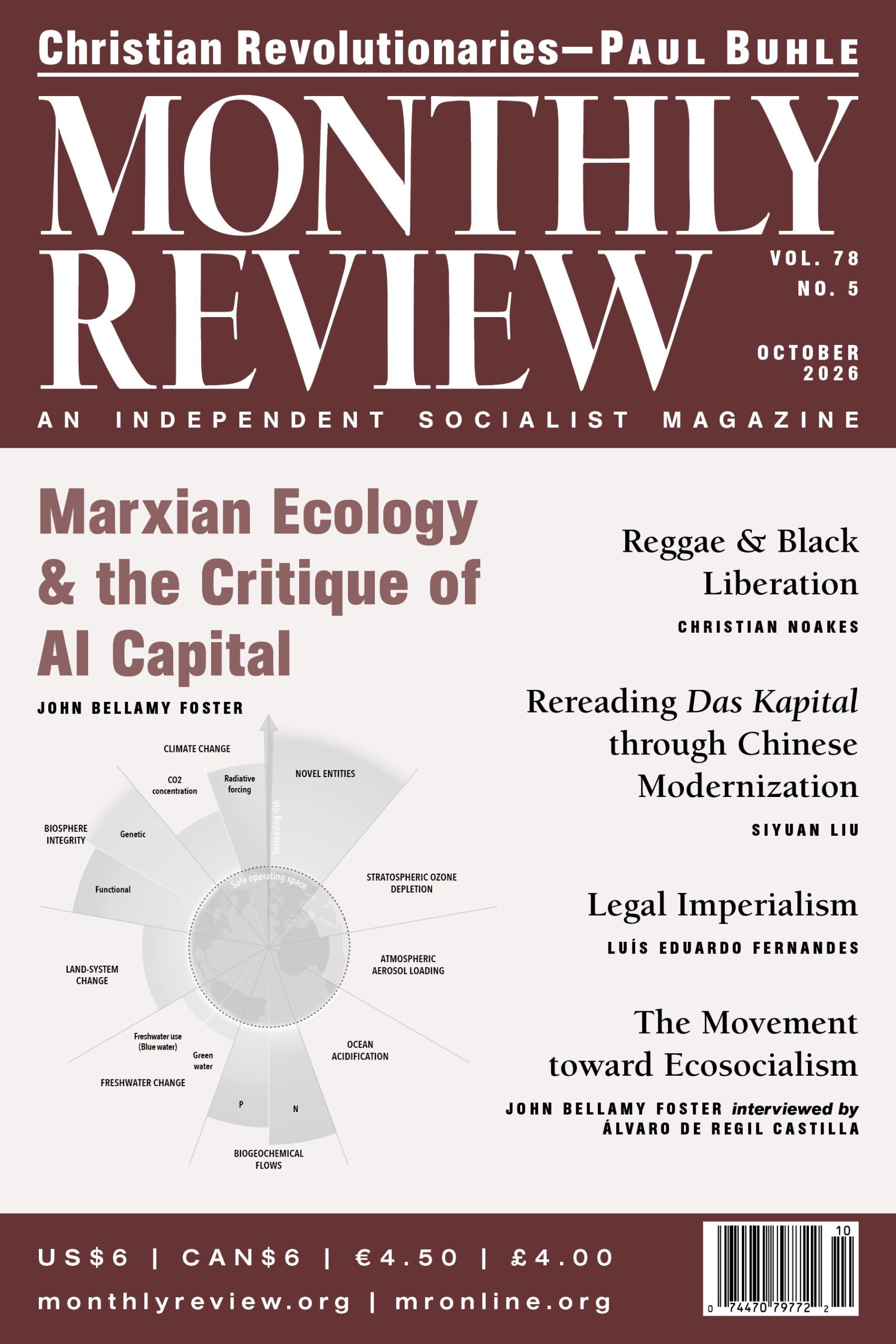
May 2026 (Volume 78, Number 1)

May 2026 (Volume 78, Number 1)
Notes from the Editors buy this issue Subscribe Articles
May 2026 (Volume 78, Number 1) Notes from the Editors

May 2026 (Volume 78, Number 1)

This month's "Notes from the Editors" dissects recent attacks on historical materialism from so-called social materialism. This way of thinking, the editors write, is profoundly divorced from Marxism, in that it lacks a dialectical foundation and eliminates the ethical domain that is critical to building a revolutionary praxis.
+ read more
The Fetishism of AI Review of the Month

The Fetishism of AI

John Bellamy Foster takes on sweeping questions of artificial intelligence and its role in today's capitalist society. "The Great Houses of AI are divided against themselves and cannot stand," he writes, "If humanity is to flourish, the forces and relations of production must be revolutionized together…creating a world of sustainable human development."
+ read more
Engels’s Dialectics of Nature and Marxist Ecology Article

Engels’s Dialectics of Nature and Marxist Ecology

Yiwen Chen dives deep into Frederick Engels's Dialectics of Nature in order to give context to present-day debates surrounding the juxtaposition of the dialectics of nature Marxist ecology. "It is hardly surprising that Engels's and Marx's ecological ideas are not entirely identical," Chen writes. "Nevertheless, their ideas do possess an inherent consistency."
+ read more
Marx on the Circular Economy Article

Marx on the Circular Economy

Today, many use the term "circular economy" to describe a shift in the use of industrial waste products in a way that does not challenge the present mode of production. Returning to Marx, Benjamin Selwyn is able to show that this usage of the term is designed to facilitate the acquisitive demands of a capitalist economy, rather than a fundamental shift in resource use.
+ read more
Slipping into Gogol’s “Overcoat”: A Winter’s Tale Article

Slipping into Gogol’s “Overcoat”: A Winter’s Tale

Andy Merrifield reflects on Nikolai Gogol's short story "The Overcoat," tying it to "a distinctively Marxist problematic." In the protagonist of the tale, a Russian counsellor whose life is forever changed by the acquisition of a new overcoat, Merrifield finds a character who, like Marx, knows firsthand what a single coat can tell us about the structures of society.
+ read more
They are killing us off Poetry

They are killing us off

A new poem by Marge Piercy.
+ read more
Vulnerable Israel Review

Vulnerable Israel

In this review of Ilan Pappé's Israel on the Brink, Tom Mayer considers the famed historian's assessment of the increasingly precarious Zionist state. In the book, Mayer writes, readers will find a thoughtful consideration of the past, present, and potential events that could shape a new vision for Palestine.
+ read more
The Idea of the ‘Uyghur Genocide’ and the Realities of Xinjiang Review of the Month

The Idea of the ‘Uyghur Genocide’ and the Realities of Xinjiang

What is really happening in Xinjiang? Vijay Prashad and Tings Chak write: "There is no evidence of a policy of physical annihilation of the Uyghur peoples by the Chinese government, unlike say, direct evidence of extermination by the Israeli government against the occupied Palestinian people. There are no mass graves and no accusations of systematic killing—the hallmarks of a genocide."
+ read more
The Material Basis of a Spectre: Why China’s Youth Are Rediscovering Mao Article

The Material Basis of a Spectre: Why China’s Youth Are Rediscovering Mao

This article examines the resurgence of interest in Mao Zedong among China's youth, particularly at elite universities. This "Mao fever" reflects a complex mindset: indignation toward social inequality, uncertainty within a brutal job market, and a firm anti-imperialist and patriotic stance amidst the "New Cold War." In Mao’s legacy, a new generation is finding the guidance to navigate the sharpening contradictions of the present day.
+ read more
Yellow Shades upon a Global Color Line: Historicizing Filipino America and the “Deadliest Phase of U.S. Imperialism” Article

Yellow Shades upon a Global Color Line: Historicizing Filipino America and the “Deadliest Phase of U.S. Imperialism”

Michael Viola explores the building of the Filipino identity in the context of U.S. imperialism. The broad-reaching effects of this "deadliest phase of imperialism," combined with pervasive anti-Asian racism in the United States, fuels the idea of a collective political project that "comes with the praxis, the power, and the price of a unique lineage" extending across an ocean and intimately connected to the dark history of U.S. militarism abroad.
+ read more
The daily, nightly news Poetry

The daily, nightly news

A new poem by Marge Piercy.
+ read more
French Theory in the Intellectual Cold War Review of the Month

French Theory in the Intellectual Cold War

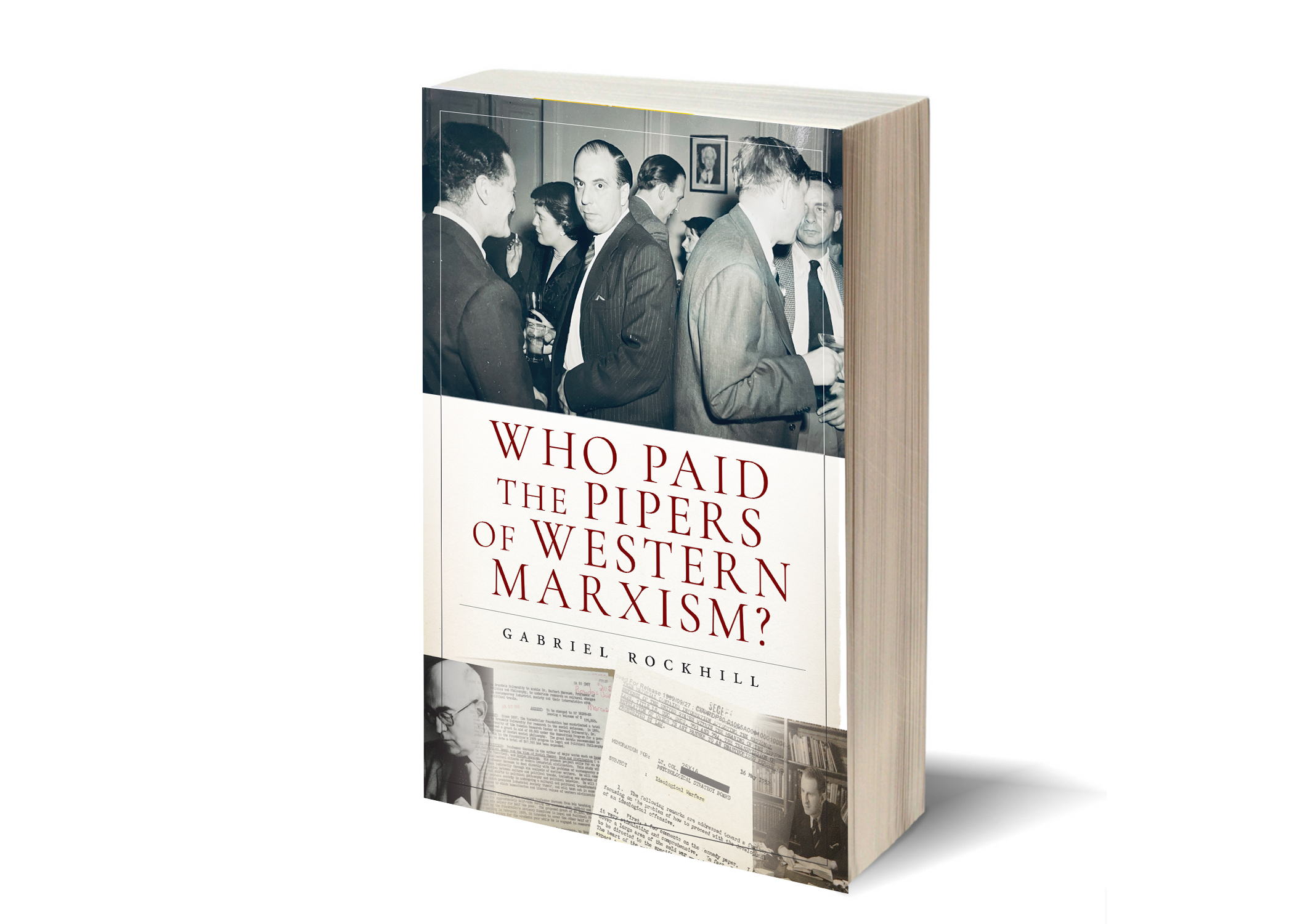
In 1966, Johns Hopkins hosted a seemingly innocuous international conference titled "The Languages of Criticism and the Sciences of Man," featuring leading figures of what would later be known as "French Theory." However, John Bellamy Foster writes, far from a simple meeting of intellectuals, this represented a "politically motivated attempt to create a beachhead for French structuralism in the United States that would counter the radicalization then taking place."
+ read more
Could Capitalism Have Thrived Without Colonialism? Article

Could Capitalism Have Thrived Without Colonialism?

Vijay Prashad critiques the argument that colonialism was, at most, ancillary to the transition between capitalism and feudalism in Western Europe. Instead, Prashad argues, "capitalism as it historically emerged—industrial, global, racialized, and imperial—was inseparable from colonial expropriation." This reality must fuel a Marxist conception of the global struggle for reparations for those who have been oppressed and exploited at the hands of empires past and present.
+ read more
More Articles from Monthly Review