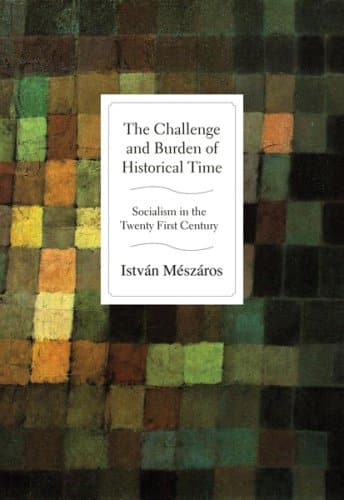
The Challenge and Burden of Historical Time: Socialism in the Twenty First Century
$29.95
Paperback, 480 pages
ISBN-13: 978-1-58367-169-6
sReleased: August 2008
A breakthrough in the development of socialist thought, The Challenge and Burden of Historical Time is both a companion volume to Mészáros’s seminal Beyond Capital and a major theoretical contribution in its own right. Mészáros, one of the foremost Marxist thinkers of our age, focuses on the tyranny of capital’s time imperative and the necessity of a new socialist time accountancy, and provides a strong refutation of the popular view that there is no alternative to the current neoliberal order.
Mészáros offers masterful analysis of the forces behind the expansion of inequality and unemployment, the return of imperial intervention across the globe, the growing structural crisis of the capitalist state, and the widening ecological crisis along with the hope offered by the reemergence of concrete socialist alternatives. This powerful and provocative new collection defines the challenges and burdens facing all who are committed to a more rational and egalitarian future.
Today Mészáros’s theoretical insights are becoming a material force, gripping the masses through various world-historical developments, including the ‘Bolivarian Revolution’ of Venezuela’s President Hugo Chávez.
István Mészáros illuminates the path ahead. He points to the central argument we must make in order… to take to the offensive throughout the world in moving toward socialism.
If everyone had the spirit of István Mészáros, that is, if everyone were… so mindful of the totality and the future, so fierce in opposition, so faithful to the exploited and oppressed, and so hopeful for a better world, then such a world would be in closer reach.
István Mészáros has produced what might yet prove a manifesto for the new socialism, 21st century socialism.
Publication Date: August 2008
Number of Pages: 480
Paperback ISBN: 9781583671696
Related products
-
![Monthly Review Volume 2, Number 9 (January 1951) [PDF]](data:image/svg+xml,%3Csvg%20xmlns='http://www.w3.org/2000/svg'%20viewBox='0%200%20150%20239'%3E%3C/svg%3E)
Monthly Review Volume 2, Number 9 (January 1951) [PDF]
$10.00 Add to cart -
![Monthly Review Volume 2, Number 7 (November 1950) [PDF]](data:image/svg+xml,%3Csvg%20xmlns='http://www.w3.org/2000/svg'%20viewBox='0%200%20150%20228'%3E%3C/svg%3E)
Monthly Review Volume 2, Number 7 (November 1950) [PDF]
$10.00 Add to cart -
Monthly Review Volume 2, Number 3 (July 1950) [PDF]
$10.00 Add to cart -
Monthly Review Volume 2, Number 2 (June 1950) [PDF]
$10.00 Add to cart -

Monthly Review Volume 1, Number 3 (July 1949) [PDF]
$10.00 Add to cart -
Monthly Review Volume 1, Number 1 (May 1949) [PDF]
$10.00 Add to cart
![Monthly Review Volume 2, Number 9 (January 1951) [PDF]](https://monthlyreview.org/wp-content/uploads/2015/09/Monthly Review Volume 2, Number 9 (January 1951) [PDF].jpg)
![Monthly Review Volume 2, Number 7 (November 1950) [PDF]](https://monthlyreview.org/wp-content/uploads/2015/09/Monthly Review Volume 2, Number 7 (November 1950) [PDF].jpg)
![Monthly Review Volume 2, Number 3 (July 1950) [PDF]](https://monthlyreview.org/wp-content/uploads/2015/09/Monthly Review Volume 2, Number 3 (July 1950) [PDF].jpg)
![Monthly Review Volume 2, Number 2 (June 1950) [PDF]](https://monthlyreview.org/wp-content/uploads/2015/09/Monthly Review Volume 2, Number 2 (June 1950) [PDF].jpg)