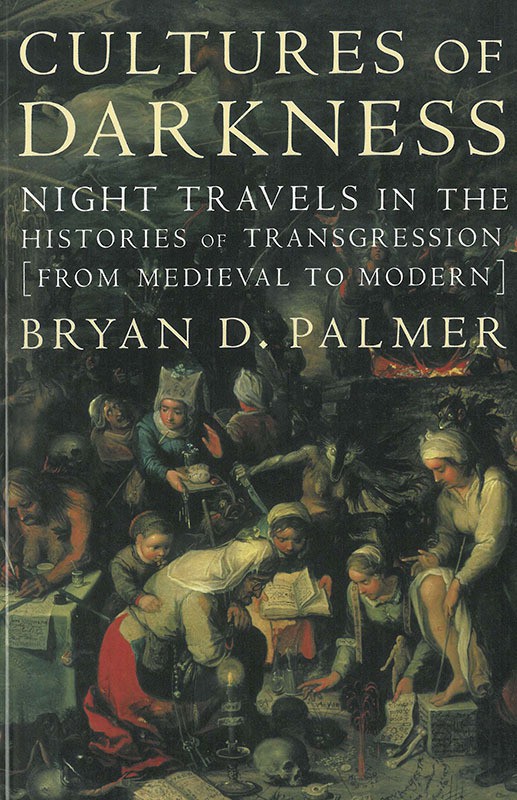
Cultures of Darkness: Night Travels in the Histories of Transgression
$15.00 – $28.00
Constructing a rich tapestry of example and experience spanning eight centuries, Palmer’s fascinating account details lives of exclusion and challenge, as the night travels of the transgressors clash repeatedly with the powerful conventions of their times. Nights of liberation and exhilarating desire are at the heart of this study but so, too, are the dangers cloaked in darkness. Palmer reveals those hidden spaces where darkness concealed acts of brutalizing terror or alternately provided refuge, solace, or freedom. Using the night as metaphor and unifying theme Palmer takes an unflinching look at those dissident or oppositional cultures and movements and shows how they were fueled and shaped by the rise and transformation of capitalism.
[An] enthralling and important trans-historical study… Palmer’s canvas is huge…it ranges from an analysis of early modern witch culture (which he connects to the later development of Puritanism) to the emergence of 19th-century semisecret fraternal orders such as the Oddfellows, the vibrant 20th-century gay male cultures of drag and sadomasochism, and the emergence of a U.S. jazz and blues culture…yet he manages to bring these diverse topics together in a cohesive and astute analysis. Integrating unusual details and artful nuances (from the specifics of 18th-century pirate executions to the links between the Rosenberg trial and the novels of Micky Spillane), Palmer creates a multilayered but seamless portrait of four centuries of Western culture. The underlying theme here is not simply that night offers the occasional transgressive respite from the orderly civilization of day, but that these alternative social, political and artistic spaces are often where the impetus for social change begins. Palmer’s bold theme is sustained by his ability to communicate his in-depth, far-ranging scholarship with a broad political vision… and by his accessible and highly entertaining writing style.
An unusual work of historical scholarship, a highly readable yet deeply learned history…
A truly breathtaking book, whose richness of interpretation as well as documentation is nothing short of remarkable.
A rare achievement, a triumph of engaged left scholarship, truly a book of our times…
Publication Date: November 2000
Number of Pages: 624
Paperback ISBN: 9781583670279
Related products
-
![Monthly Review Volume 2, Number 10 (February 1951) [PDF]](data:image/svg+xml,%3Csvg%20xmlns='http://www.w3.org/2000/svg'%20viewBox='0%200%20150%20232'%3E%3C/svg%3E)
Monthly Review Volume 2, Number 10 (February 1951) [PDF]
$10.00 Add to cart -
Monthly Review Volume 2, Number 6 (October 1950) [PDF]
$10.00 Add to cart -
![Monthly Review Volume 2, Number 1 (May 1950) [PDF]](data:image/svg+xml,%3Csvg%20xmlns='http://www.w3.org/2000/svg'%20viewBox='0%200%20150%20239'%3E%3C/svg%3E)
Monthly Review Volume 2, Number 1 (May 1950) [PDF]
$10.00 Add to cart -
Monthly Review Volume 1, Number 12 (April 1950) [PDF]
$10.00 Add to cart -
Monthly Review Volume 1, Number 10 (February 1950) [PDF]
$10.00 Add to cart -
Monthly Review Volume 1, Number 8 (December 1949) [PDF]
$10.00 Add to cart
![Monthly Review Volume 2, Number 10 (February 1951) [PDF]](https://monthlyreview.org/wp-content/uploads/2015/09/Monthly Review Volume 2, Number 10 (February 1951) [PDF].jpg)
![Monthly Review Volume 2, Number 6 (October 1950) [PDF]](https://monthlyreview.org/wp-content/uploads/2015/09/Monthly Review Volume 2, Number 6 (October 1950) [PDF].jpg)
![Monthly Review Volume 2, Number 1 (May 1950) [PDF]](https://monthlyreview.org/wp-content/uploads/2015/09/Monthly Review Volume 2, Number 1 (May 1950) [PDF].jpg)
![Monthly Review Volume 1, Number 12 (April 1950) [PDF]](https://monthlyreview.org/wp-content/uploads/2015/09/Monthly Review Volume 1, Number 12 (April 1950) [PDF].jpg)
![Monthly Review Volume 1, Number 10 (February 1950) [PDF]](https://monthlyreview.org/wp-content/uploads/2015/09/Monthly Review Volume 1, Number 10 (February 1950) [PDF].jpg)
![Monthly Review Volume 1, Number 8 (December 1949) [PDF]](https://monthlyreview.org/wp-content/uploads/2015/09/Monthly Review Volume 1, Number 8 (December 1949) [PDF].jpg)