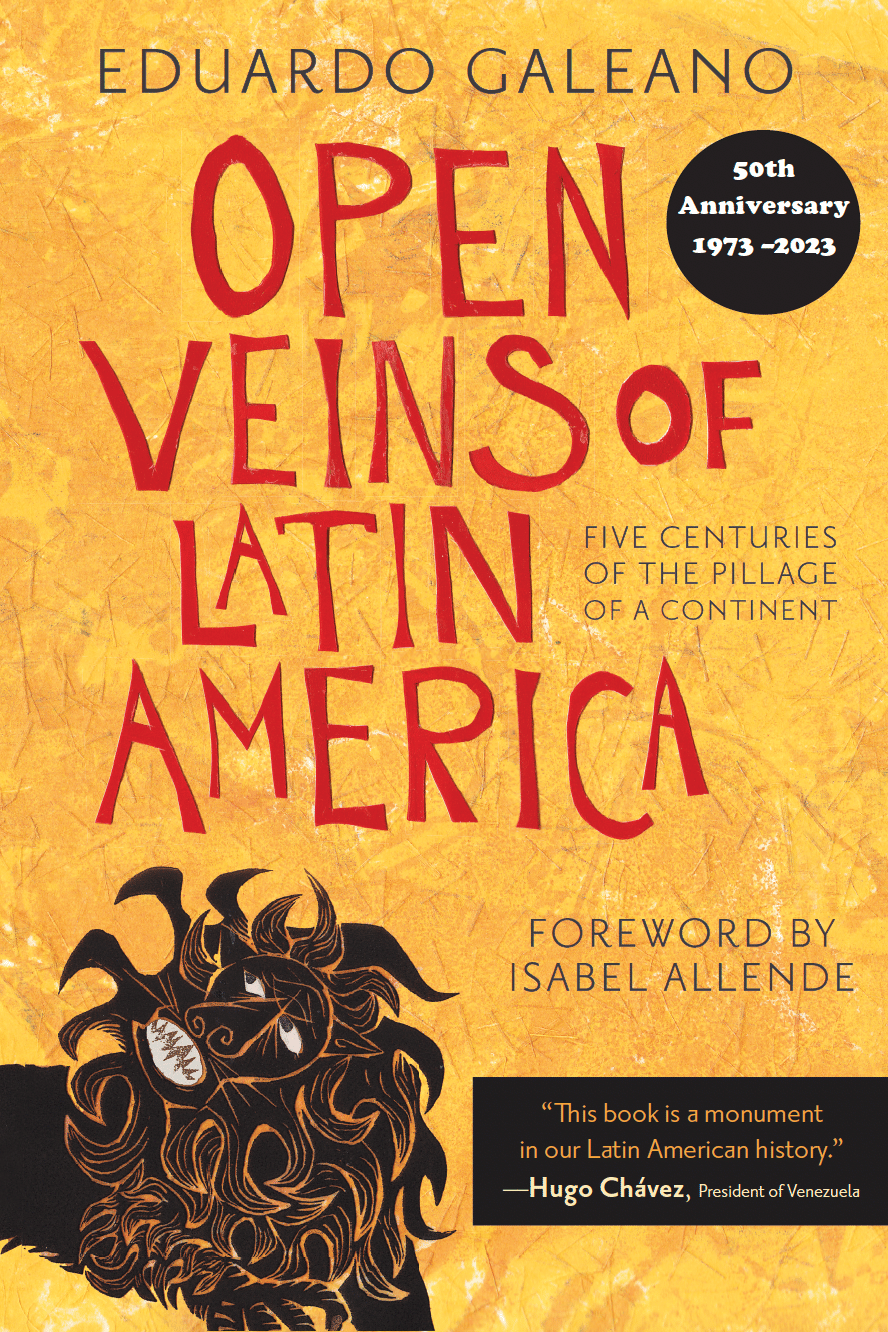
Open Veins of Latin America: Five Centuries of the Pillage of a Continent
$15.20 – $22.00
50th Anniversary edition!
Honored by an inspiring introduction by one of the most important writers of our time, Isabel Allende
With its U.S. debut fifty years ago, this brilliant classic set the standard for historical scholarship on Latin America. Rather than charting the continent according to more traditional geographic or chronological delineations, Eduardo Galeano told the story of Latin America by uncovering the patterns of five centuries of exploitation. Thus he was concerned with gold and silver, cacao and cotton, rubber and coffee, fruit, hides and wool, petroleum, iron, nickel, manganese, copper, aluminum ore, nitrates, and tin. These are the veins which he traced through the body of the entire continent, up to the Rio Grande and throughout the Caribbean, and all the way to their open ends where to this day they empty continuously into the coffers of wealth in the United States and Europe.
Weaving fact and imagery into a rich tapestry, Galeano never faltered as he fused scientific analysis of an immense vault of historical material, with the impassioned perspective of plundered peoples. Readers in all manner of great historical, economic, political, and social writing have found in Open Veins of Latin America a singularly rigorous analytical achievement which never lost vigor, an overwhelming narrative that makes history speak, unforgettably.
To publish Eduardo Galeano is to publish the enemy: the enemy of lies, indifference, above all of forgetfulness. Thanks to him our crimes will be remembered. His tenderness is devastating, his truthfulness, furious.
This book is a monument in our Latin American history. It allows us to learn history, and we have to build on this history.
A superbly written, excellently translated, and powerfully persuasive expose which all students of Latin American and U.S. history must read.
I cannot recommend this book highly enough. Galeano’s vision is unswerving, surgical and yet immensely generous and humane. This book, written more than thirty years ago, contains profound lessons for contemporary India. Eduardo Galeano ought to be a household name in this country.
Publication Date: January 1997
Number of Pages: 360
Paperback ISBN: 9780853459910
eBook ISBN: 9781583673119
Related products
-
![Monthly Review Volume 2, Number 8 (December 1950) [PDF]](data:image/svg+xml,%3Csvg%20xmlns='http://www.w3.org/2000/svg'%20viewBox='0%200%20150%20232'%3E%3C/svg%3E)
Monthly Review Volume 2, Number 8 (December 1950) [PDF]
$10.00 Add to cart -
Monthly Review Volume 2, Number 6 (October 1950) [PDF]
$10.00 Add to cart -
![Monthly Review Volume 2, Number 3 (July 1950) [PDF]](data:image/svg+xml,%3Csvg%20xmlns='http://www.w3.org/2000/svg'%20viewBox='0%200%20150%20239'%3E%3C/svg%3E)
Monthly Review Volume 2, Number 3 (July 1950) [PDF]
$10.00 Add to cart -
Monthly Review Volume 2, Number 1 (May 1950) [PDF]
$10.00 Add to cart -
![Monthly Review Volume 1, Number 7 (November 1949) [PDF]](data:image/svg+xml,%3Csvg%20xmlns='http://www.w3.org/2000/svg'%20viewBox='0%200%20150%20229'%3E%3C/svg%3E)
Monthly Review Volume 1, Number 7 (November 1949) [PDF]
$10.00 Add to cart -
Monthly Review Volume 1, Number 2 (June 1949) [PDF]
$10.00 Add to cart
![Monthly Review Volume 2, Number 8 (December 1950) [PDF]](https://monthlyreview.org/wp-content/uploads/2015/09/Monthly Review Volume 2, Number 8 (December 1950) [PDF].jpg)
![Monthly Review Volume 2, Number 6 (October 1950) [PDF]](https://monthlyreview.org/wp-content/uploads/2015/09/Monthly Review Volume 2, Number 6 (October 1950) [PDF].jpg)
![Monthly Review Volume 2, Number 3 (July 1950) [PDF]](https://monthlyreview.org/wp-content/uploads/2015/09/Monthly Review Volume 2, Number 3 (July 1950) [PDF].jpg)
![Monthly Review Volume 2, Number 1 (May 1950) [PDF]](https://monthlyreview.org/wp-content/uploads/2015/09/Monthly Review Volume 2, Number 1 (May 1950) [PDF].jpg)
![Monthly Review Volume 1, Number 7 (November 1949) [PDF]](https://monthlyreview.org/wp-content/uploads/2015/09/Monthly Review Volume 1, Number 7 (November 1949) [PDF].jpg)
![Monthly Review Volume 1, Number 2 (June 1949) [PDF]](https://monthlyreview.org/wp-content/uploads/2015/09/Monthly Review Volume 1, Number 2 (June 1949) [PDF].jpg)