Monthly Review Press

The World We Wish to See reviewed by ANTI-IMPERIALISM.ORG

The World We Wish to See reviewed by ANTI-IMPERIALISM.ORG

“What to do?" A short question with a very complex answer. In The World We Wish to See, Samir Amin delves into the contemporary political conjuncture with a succinctness and ease that belies the monuments scope of the topic he addresses—how do counter-hegemonic movements find convergence in diversity, in an age when political lines are being redrawn and new issues are being raised, daily, hourly?

Revolutionary African Perspectives presents Gerald Horne in a 5-part radio WRFG interview

Revolutionary African Perspectives presents Gerald Horne in a 5-part radio WRFG interview

Nyeusi U. Jami, host of Revolutionary African Perspectives (WRFG 89.3 FM, Atlanta), talks with Gerald Horne in a four-part interview, about his recent book, The Apocalypse of Settler Colonialism: The Roots of Slavery, White Supremacy, and Capitalism in Seventeenth-Century North America and the Caribbean. In part five, the conversation turns to matters involving Dr. Horne’s 2014 book, Race to Revolution: The U.S. and Cuba during Slavery and Jim Crow

Rethinking Democracy, SR 2018 reviewed by Counterfire

Rethinking Democracy, SR 2018 reviewed by Counterfire

This latest addition to one of the most prestigious journals on the left is a timely examination of the relationship between socialism and democracy. Decades of Stalinist distortion in Eastern Europe still leave a residual notion in the minds of many that these two concepts are, in fact, antithetical. Throughout the era of the cold war, the Western states propagated the related idea that only capitalism was capable of securing the individual freedoms that are synonymous with the idea of democracy….

“The Wire and the World”: Helena Sheehan and Sheamus Sweeney via Jacobin

“The Wire and the World”: Helena Sheehan and Sheamus Sweeney via Jacobin

Helena Sheehan, author of the recent The Syriza Wave: Surging and Crashing with the Greek Left, and Seamus Sweeney, a “recovering academic,” who has written about the representation of Baltimore in the work of David Simon, recently collaborated on an article for Jacobin about how the decade-old TV series, The Wire, was a Marxist’s idea of what TV drama should be...

Gerald Horne on the Centrality of Race, via WORT Community Radio

Gerald Horne on the Centrality of Race, via WORT Community Radio

Allen Ruff, a host of A Public Affair on radio station WORT (89.9FM, Madison, WI), interviews the irrepressible African-American historian Gerald Horne, author of numerous titles exploring the centrality of race and class for understanding the contemporary world. His most recent book is The Apocalypse of Settler Colonialism: The Roots of Slavery, White Supremacy, and Capitalism in Seventeenth-Century North America and the Caribbean

Socialist Review considers Karl Marx’s Ecosocialism

Socialist Review considers Karl Marx’s Ecosocialism

This fascinating book builds on the work of Marxists such as John Bellamy Foster to argue that Karl Marx’s thought is central to understanding that humanity’s destruction of the planet is due to the capitalist mode of production. It is a further blow against the perception that Marx was a naive Promethean—someone who believed that simply increasing production will solve all humanity’s ills and that therefore Marxism has nothing to say about ecological crisis....

“The militarized identity politics that was ‘whiteness’”: Marxism-Leninism Today on The Apocalypse of Settler Colonialism

“The militarized identity politics that was ‘whiteness’”: Marxism-Leninism Today on The Apocalypse of Settler Colonialism

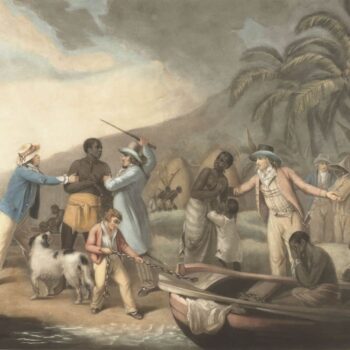
Gerald Horne introduces his book about 17th century English colonial aggression in the Caribbean and North America by mentioning a three-part ‘Apocalypse.’ He indicates that its ‘three horsemen’—slavery, capitalism, and white supremacy—were present and sowing grief at the formation of the United States. But the first two play only supporting roles in his narrative. They give rise to conflicts and crises that provoke white supremacy, his third protagonist, into existence….