June 1, 2026
MR associate editor Brett Clark and editor John Bellamy Foster explore "the death drive of late imperialism" and its manifestations in an ecological crisis that is not parallel to, but inseparable from, increasingly open ecofascism in the United States. Drawing from Luckács's
Destruction of Reason and István Mészáros's work on imperialism, Clark and Foster present a materialist analysis that illuminates the cult of unreason so pervasive under capitalism and imperialism while pointing to a path forward that is grounded in the historical-materialist Marxist tradition.
January 1, 2026
In this Introduction to the updated edition of
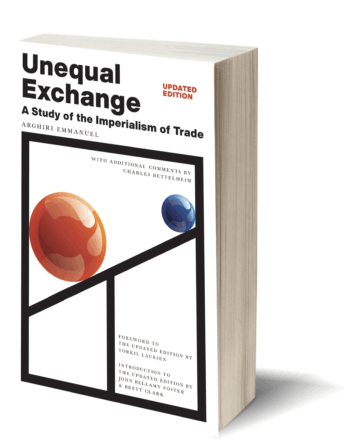
Unequal Exchange by Arghiri Emmanuel, published by Monthly Review Press, John Bellamy Foster and Brett Clark offer readers insight into the continuing influence of Emmanuel's seminal work. Through both deep understanding thoughtful critique, the authors deftly situate Emmanuel's text as an indispensable part of an enduring tradition of Marxist analysis of the global dynamics of labor.
January 1, 2025
In January's Review of the Month, John Bellamy Foster and Brett Clark revisit the legacy of scientist and
MR author Richard Levins, from his "red diaper" infancy to his agroecological work in Cuba and his contributions to Marxian ecological thinking as a whole. "As a dialectical ecologist," they write, "Levins proposed that we ask the big questions, as part of understanding why the world came to be organized in a particular way, and how it might be different."
July 1, 2024
John Bellamy Foster and Brett Clark introduce this summer's special issue on "Imperialism in the Indo-Pacific," exploring how the super-region came to be conceptualized among geopolitical strategists and its present-day role in U.S military strategy. "The United States," they write, "facing the demise of its global hegemonic imperialism, is not only preparing for a Third World War; it is actively provoking it."
July 1, 2022
Time is running out for humanity to avoid a catastrophic planetary tipping point. Widespread mass mobilizations of populations worldwide must fight to bring about revolutionary societal changes and dismantle neoliberal monopoly capitalism, with its reliance on extractive exploitation of our planet's resources and communities.
September 1, 2021
Assuming that the Anthropocene will soon be officially designated as the earth's current epoch, there remains the question of the geological age with which the Anthropocene begins. Adopting the standard nomenclature for the naming of geological ages, the term Capitalinian is proposed as the most appropriate name for the new geological age, conforming to the historical period that environmental historians see as commencing around 1950, in the wake of the Second World War, the rise of multinational corporations, and the unleashing of the process of decolonization and global development.
June 1, 2021
The death of Salvador Allende in 1973 marked, simultaneously, not only the demise of one of the great socialist experiments, and the launching of neoliberalism; it also represented the loss in Allende of one of the great figures in social medicine. Nowhere has neoliberalism had more devastating effects than in the destruction of public health and social medicine initiatives throughout the world.
January 1, 2021
Although the current crisis of production associated with the COVID-19 pandemic has sharpened disparities, the overall problem is much longer and more deep-seated, a manifestation of the inner contradictions of monopoly-finance capital. Comprehending the basic parameters of today's financialized capitalist system is the key to understanding the contemporary contagion of capital, a corrupting and corrosive cash nexus that is spreading to all corners of the U.S. economy, the globe, and every aspect of human existence.
July 1, 2020
The rise to prominence of analyses of racial capitalism represents a breakthrough in Marxian theory. This has necessarily been accompanied by a critique of previous Marxian analyses, which all too often ignored or minimized the relation of slavery to capitalism. In recent years, however, these criticisms of orthodox Marxist treatments of slavery have been extended, much more problematically, to the work of Karl Marx himself. Although Marx never wrote a treatise on slavery, the issue of slave labor was woven into his analysis of social formations, both ancient and modern, and was inextricably intertwined with his treatment of wage labor.
April 1, 2020
Karl Marx's (and Frederick Engels's) analysis of nineteenth-century Irish history revealed what is referred to as "the rift of Éire" in the colonial period. Indeed, it is in relation to the analysis of the systematic disruption of the Irish environment that Marx's ecological inquiries can be seen as taking on a concrete and developed form, encompassing the ecological as well as economic robbery that characterized the Irish colonial regime.