March 2008, Volume 59, Number 10
This month marks the fifth year of the U.S. war and occupation in Iraq, which commenced on March 19, 2003. Despite setbacks for the U.S. empire, including unexpected losses in lives and money as a result of the continuing resistance of the Iraqi population, this war has succeeded in the U.S. imperial objective of eliminating Iraq, once a powerful force in the Middle East, as a nation to be reckoned with. Much of its population is dead, displaced, and divided. Its infrastructure is in tatters. The country is occupied on a seemingly permanent basis by U.S. military forces, allowing Washington to project its power more fully in the region, and making it easier to threaten Iraq’s neighbor Iran. Iraqi oil, designated as a vital strategic asset by Washington, is now largely in the grip of the U.S. empire.… | more |
In March 2003, Khalid Sheikh Mohammed, alleged mastermind of the 9/11 attacks, was captured in Pakistan. Much of the information on his movements and whereabouts is believed to have come from interrogations of his two children, aged six and eight. The children are known to have been held in an adult detention facility for at least four months while they were interrogated. During this time, according to one witness, “the boys were kept in a separate area upstairs, and were denied food and water by other guards. They were also mentally tortured by having ants or other creatures put on their legs to scare them and get them to say where their father was hiding.” After that, they disappeared into the system and nothing more was heard about them. Their current whereabouts and condition are unknown. The United States has sunk to kidnapping, imprisoning, torturing, and then “disappearing” children in order to get at their parents. What were once dark and unlikely rumors have gradually proven to be true: many men, women, and yes, children have been abducted around the world and fed into the maw of the American system.… | more |
Who Really Won the Space Race?
Last October’s anniversary of the launch of the Sputnik artificial satellite has led to much discussion as to who won the space race. Usually it is argued that the United States unproblematically “won.” But this is a very simplistic picture and one that should be challenged. Above all, the focus on nations “winning” or “losing” needs to be rejected. It is the rich and powerful who are doing the winning. And they can come from any country.… | more |
The War for Control of the Periphery
Just before John Perkins, author of the bestselling Confessions of an Economic Hit Man, decided it was no longer possible to remain silent about his intimate involvement in the economic warfare waged against the Global South, he sat despondently before the ruins of Ground Zero, totally incapable of visualizing the tragedy: all he could see was a U.S. contractor delivering millions of dollars of weapons to the mujahadeen in Afghanistan. Perkins understood himself—a former economic advisor for a multinational utilities contractor, similar to Bechtel—and others like him, to be products of a “system that promotes the most subtle and effective form of imperialism the world has ever witnessed.” Mainstream commentators addressing Perkins’s book ignored the vivid recounting of his own personal involvement as an economic hit man. This is undoubtedly because Perkins used this experience to emphasize the substantial connections between U.S. intelligence agencies, multinational corporations, and political elites of the Global South, laying bare the true motives of “development.” As an “economic hit man,” Perkins fabricated nearly every economic forecast he was asked to produce—as his bosses clearly expected him to do. This led him to repeatedly attack U.S. economic dogma in Confessions… | more |
Political Islam in the Service of Imperialism
All the currents that claim adherence to political Islam proclaim the “specificity of Islam.” According to them, Islam knows nothing of the separation between politics and religion, something supposedly distinctive of Christianity. It would accomplish nothing to remind them, as I have done, that their remarks reproduce, almost word for word, what European reactionaries at the beginning of the nineteenth century (such as Bonald and de Maistre) said to condemn the rupture that the Enlightenment and the French Revolution had produced in the history of the Christian West… | more |
The issues that I will cover in this article and the cases I would like to describe make for uncomfortable reading. But I believe that it is important to record the torture at Abu Ghraib prison and elsewhere in Iraq and to deconstruct the culture that accommodated and legitimated it, because what happened cannot be relegated to a mere footnote in the history of the region. I feel the same about Halabja and the chemical warfare employed by Saddam Hussein with the sponsorship of the “international community,” which is why I covered it in my other writings.1 I do not want to be misunderstood as arguing that the cultural context I will explain here is all-encompassing, that the U.S. presence in international society is singularly destructive, and that the “West” as an idea is nothing but “intoxicating.”2 What I say is much more confined. I am arguing that Abu Ghraib could not have happened without a particular racist current in the United States, that the individuals who committed the atrocities against the detainees were not isolated, and that they were part of a larger constellation with its own signifying ideational attitudes toward Muslims and Arabs. Those are the general claims that I would like to qualify in the following paragraphs… | more |
On the History of Imperialism Theory
In his illuminating survey, “The Imperialist World System: Paul Baran’s Political Economy of Growth After Fifty Years” (Monthly Review, May 2007), John Bellamy Foster remarks that “The concept of the imperialist world system in today’s predominant sense of the extreme economic exploitation of periphery by center, creating a widening gap between rich and poor countries….had its genesis in the 1950s, especially with the publication fifty years ago of Paul Baran’s Political Economy of Growth.” While acknowledging that traces of such a concept could be found in Marx and Lenin, he feels that “The classical Marxist approach to the worldwide spread of capitalist relations has often been characterized as a crude theory of linear stages of development” whereby the less developed countries would necessarily traverse the same path as the more developed ones. Among the adherents to this view Foster includes Marxists in the Second and Third Internationals… | more |
Rediscovering the History of Imperialism: A Reply
The Research Unit for Political Economy’s (RUPE’s) brief historical account here of the origins of the Marxist theory of imperialism constitutes a crucial corrective to common errors regarding that history. In my article, “The Imperialist World System: Paul Baran’s Political Economy of Growth After Fifty Years” (Monthly Review, May 2007), I began by pointing out that Baran’s book was an outgrowth of classical Marxist thought—the ideas of Marx, Lenin, and Luxemburg. At the same time it represented a sharp departure from the rigid orthodoxy of linear development that had come to characterize so much of socialist (as well as bourgeois) thought—often presented in terms of Horace’s phrase, quoted by Marx, “the tale is told of you.” Baran’s treatment of the imperialist world system was a startling contribution at the time that his book appeared, challenging the conventional assumptions of both the right and an increasingly calcified left… | more |
November 2007, Volume 59, Number 6
Former Federal Reserve Board Chairman Alan Greenspan’s new book The Age of Turbulence (Penguin 2007)set off a firestorm in mid-September with its dramatic statement on the Iraq War: “I am saddened that it is politically inconvenient to acknowledge what everyone knows: that the Iraq war is largely about oil” (p. 463). The fact that someone of Greenspan’s stature in the establishment—one of the figures at the very apex of monopoly-finance capital—should issue such a twenty word statement, going against the official truths on the war, and openly voicing what “everyone knows,” was remarkable enough. Yet, his actual argument was far more significant, and since this has been almost completely ignored it deserves extended treatment here. … | more |
October 2007, Volume 59, Number 5
It is almost unheard of for a whole issue of MR (other than occasionally one of our special July-August issues) to be devoted to a single contribution. The typical MR issue consists of a lot of short articles. We have no intention of changing that. Nevertheless, we are making a rare exception in the case of Edward S. Herman and David Peterson’s “The Dismantling of Yugoslavia,” which we regard as the definitive critique at this stage both of the U.S./NATO role in the exploitation and exacerbation of the Yugoslavian tragedy and of the “Western Liberal-Left Intellectual and Moral Collapse” that made this possible. So effective has been the media propaganda system at presenting the imperialist wars in Yugoslavia in the 1990s as “humanitarian interventions” that this not only bolstered support for the invasions and occupations in Afghanistan and Iraq (in defiance of international law), but is now being offered as a justification for further possible “humanitarian interventions” elsewhere, such as Iran, the Sudan (Darfur), Nigeria, and even Venezuela… | more |
The Dismantling of Yugoslavia (Part I)
A Study in Inhumanitarian Intervention (and a Western Liberal-Left Intellectual and Moral Collapse)
The breakup of Yugoslavia provided the fodder for what may have been the most misrepresented series of major events over the past twenty years. The journalistic and historical narratives that were imposed upon these wars have systematically distorted their nature, and were deeply prejudicial, downplaying the external factors that drove Yugoslavia’s breakup while selectively exaggerating and misrepresenting the internal factors. Perhaps no civil wars—and Yugoslavia suffered multiple civil wars across several theaters, at least two of which remain unresolved—have ever been harvested as cynically by foreign powers to establish legal precedents and new categories of international duties and norms. Nor have any other civil wars been turned into such a proving ground for the related notions of “humanitarian intervention” and the “right [or responsibility] to protect.” Yugoslavia’s conflicts were not so much mediated by foreign powers as they were inflamed and exploited by them to advance policy goals. The result was a tsunami of lies and misrepresentations in whose wake the world is still reeling.… | more |
The Dismantling of Yugoslavia (Part II)
Jump to Part: I, III, IV | Glossary | Timeline 3. The UN in NATO’s Service A striking feature of U.S. policy since the collapse of the Soviet deterrent is the frequency with which it relies on the Security Council and the Secretariat for its execution—before the fact when it can (Iraq 1990–91), but after [...]… | more |
The Dismantling of Yugoslavia (Part III)
Jump to Part: I, II, IV | Glossary | Timeline 7. The Milosevic Trial The four-year trial of Slobodan Milosevic was the culmination of ICTY service to the NATO program in the Balkans. It was designed to show the world by an elaborate procedure leading ultimately to the conviction of the top Serb leader—the first [...]… | more |
The Dismantling of Yugoslavia (Part IV)
Jump to Part: I, II, III | Glossary | Timeline 10. The Role of the Media and Intellectuals in the Dismantlement Media coverage of the Yugoslav wars ranks among the classic cases in which early demonization as well as an underlying strong political interest led quickly to closure, with a developing narrative of good and [...]… | more |
The Dismantling of Yugoslavia (Part V)
Glossary & Timeline
Jump to Part: I, II, III | IV | Timeline Glossary Badinter (or Arbitration) Commission: Appointed by the European Commission in September 1991 for the purpose of arbitrating legal disputes related to the crisis in the SFRY, with representatives from France (Robert Badinter), Belgium, Germany, Italy, and Spain. But the commission’s ten opinions were deeply [...]… | more |
“Enemy Combatant” or Enemy of the Government?
By introducing the concept of war into national law, the latest U.S. anti- terrorist law, the Military Commissions Act of 2006 (MCA), produces a turning point in the legal and political organization of the Western world. It puts an end to a form of state that succeeded in “establishing peace internally and excluding hostility as a concept of law.”1 It is the constituent act of a new form of state that establishes war as a political relation between constituted authorities and national populations.… | more |
A System of Wholesale Denial of Rights
As in the past, Americans owe Jean-Claude Paye a debt of gratitude. From his position, as a sociologist in Brussels, he has proven that he can see what is happening in George Bush’s and Dick Cheney’s America, more clearly perhaps than many who live in the United States.…As Paye notes, there are two important aspects to the regime created by the Detainee Treatment Act of 2005 (DTA) and the Military Commissions Act of 2006 (MCA). The MCA recognizes a distinction between “enemy combatants” who are citizens of the United States and those who are aliens. Alien enemy combatants are, as Paye notes, subjected entirely to the regime of military commissions and denied access to civil courts except under limited circumstances. Citizen enemy combatants have access to civil courts, but find their rights constricted in other ways. The alien-citizen distinction in the MCA is a congressional response to the Supreme Court’s decision in Hamdan v. Rumsfeld, in which a five-justice majority held that the president did not have the power to strip citizens and aliens alike of their right of access to civil courts and to the writ of habeas corpus. The Court invited the president to return to Congress to validate his claims of power, and Congress obligingly did so, thus proving that there are few persons in the elected leadership willing to raise a voice against the imperial powers of which Paye writes.… | more |
July-August 2007, Volume 59, Number 3
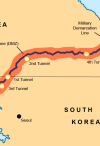
At the end of May the Bush administration announced that the United States is planning on maintaining permanent military bases in Iraq on a model like that of South Korea, where U.S. troops have been deployed in massive numbers for more than fifty years. Despite the failures associated with the U.S. invasion of Iraq, Washington is openly proclaiming to the world that it intends to do everything it can to maintain a lasting military presence in that country. By doing so it hopes to retain the main spoils won in the war and to declare it a partial victory. The strategic objectives are obvious: to control Iraq and Iraqi oil, threaten Iran, and dominate the geopolitically vital Middle East. Thus Secretary of Defense Robert Gates declared on May 31 that he did not expect the United States to withdraw from Iraq as from Vietnam “lock, stock and barrel” and invoked the example of South Korea. Earlier that week White House Press Secretary Tony Snow, conveying the views of President Bush, said U.S. troops would remain but would be in an “over-the-horizon support” role to maintain security in Iraq—with permanent bases on the South Korean model. Lt. Gen. Raymond Odierno, in charge of daily military operations in Iraq, stated on May 31 that he supported the creation of a South Korean type U.S. military presence in Iraq. The message could not be clearer and can be summed up as: Naked Imperialism: The U.S. Pursuit of Global Dominance (see John Bellamy Foster’s book with this title for an analysis of the larger forces at work).… | more |
Imminent Crises: Threats and Opportunities
egrettably, there are all too many candidates that qualify as imminent and very serious crises. Several should be high on everyone’s agenda of concern, because they pose literal threats to human survival: the increasing likelihood of a terminal nuclear war, and environmental disaster, which may not be too far removed. However, I would like to focus on narrower issues, those that are of greatest concern in the West right now. I will be speaking primarily of the United States, which I know best, and it is the most important case because of its enormous power. But as far as I can ascertain, Europe is not very different… | more |
The South has already repaid its external debt to the North. Since the onset of the global debt crisis, precipitated in 1979 by a sharp increase in the Federal Reserve’s interest rates by Paul Volcker, the developing/ emerging market economies as a whole have paid in current dollars a cumulative $7.673 trillion in external debt service.1 However, during the same period their debt has increased from $618 billion in 1980 to $3.150 trillion in 2006, according to figures published by the International Monetary Fund (IMF). The external debt of this group of countries, comprising 145 member states, will continue to grow throughout 2007, according to the IMF, to more than $3.350 trillion. The debt of the Asian developing countries alone could rise to $955 billion. Although they have already repaid, in interest and capital, far more than the original amount due in 1980, these countries are now carrying a burden of debt much larger than they faced at the beginning of the period… | more |