Category: Monthly Review Press /

Hell’s Kitchen and the Battle for Urban Space reviewed by Resolute Reader

Hell’s Kitchen and the Battle for Urban Space reviewed by Resolute Reader

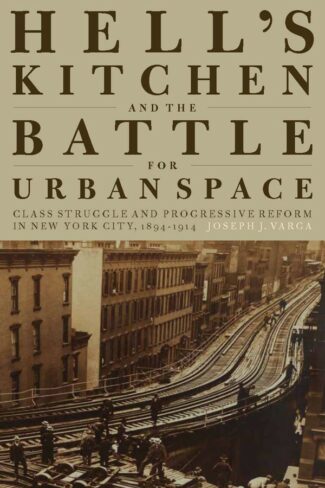
In the period this book considered, Hell's Kitchen, or "Manhattan's Middle West Side" was considered by many commentators to be an area of poverty, corruption, crime and unsavoury types. In reality of course it was a home to thousands of working class people who carved their own lives out of the limited opportunities that they had ... Subtitled, Class Struggle and Progressive Reform in New York City, 1894-1914, Joseph J. Varga's new book is a detailed examination of the development of this district in New York, but more importantly, an attempt to understand, using the concept of the "production of space" how that urban space was shaped and, in turn, shaped those who inhabited it.

Paul Le Blanc and Michael D. Yates on "Black America and A New Freedom Budget" in Truthout

Paul Le Blanc and Michael D. Yates on "Black America and A New Freedom Budget" in Truthout

"A Freedom Budget for All Americans," published in 1966 by the A. Philip Randolph Institute, demanded that the federal government put in place policies and programs that would eliminate poverty within ten years. Its authors demonstrated with clear and realistic assumptions about government taxes and revenues that this could be accomplished easily. The "Freedom Budget" was a direct descendant of the historic 1963 March on Washington for Jobs and Freedom. The organizers of the march and the architects of the "Freedom Budget"—people like A. Philip Randolph, Bayard Rustin and Martin Luther King Jr.—understood that ending poverty, achieving full employment, guaranteeing incomes, winning higher wages and providing good schools, national health care and decent housing would not happen without tremendous struggle, one that challenged not only the federal government but the basic structure of a capitalist economy. Their sensibility was democratic and socialist; it envisioned a society both egalitarian and controlled by the people themselves

Michael A. Lebowitz on "Contested Reproduction and the Contradictions of Socialism" in The Bullet

Michael A. Lebowitz on "Contested Reproduction and the Contradictions of Socialism" in The Bullet

(Michael Lebowitz is the author of The Contradictions of "Real Socialism".) Why did 'real socialism' and, in particular the Soviet Union, fall? Let me note a few explanations that have been offered. With respect to the Soviet Union, one very interesting explanation that has been suggested is that it's all the fault of Mikhail Gorbachev. And not simply the errors of Gorbachev but the treachery. Those who offer this explanation rely in particular upon a document which is sometimes described as his confession.

Ruth First and Joe Slovo in the War against Apartheid reviewed in Z Magazine

Ruth First and Joe Slovo in the War against Apartheid reviewed in Z Magazine

Ruth and Joe, white secular Jews in apartheid South Africa, did not have to fight against that society of skin-color privilege. Yet they did because that social system doomed scores of people to lives of misery and poverty. We discover the complexities of place, space, and time in Ruth and Joe's lives among those with and without name recognition to overthrow white-minority rule in South Africa.

A Freedom Budget for All Americans reviewed in Library Journal

A Freedom Budget for All Americans reviewed in Library Journal

Socialist intellectuals (e.g., Bayard Rustin) and radical labor leaders (e.g., A. Philip Randolph) were trusted advisers and allies of Martin Luther King Jr. Their social-democratic economic ideas ... embodied in the "Freedom Budget" ... called for the elimination of poverty by 1976 through programs to create full employment, eliminate slums, and ensure a minimum standard of living for all. The book ends with a proposed updated version of the Freedom Budget; the budget includes federal programs for full employment, a restructuring of education and job-training systems, and more. ... Invaluable for restating the influence of the American left on King's views and enriching the historical record.

Paramilitarism and the Assault on Democracy in Haiti reviewed in WorkingUSA

Paramilitarism and the Assault on Democracy in Haiti reviewed in WorkingUSA

A sense of the arguments and perspective that drive Jeb Sprague's detailed study of paramilitarism in Haiti from the early 1990s to 2004 is given in the following quote, which comes in a closing chapter: "As with all historical processes, Haiti's recent history cannot be reduced to pure good versus pure evil—the popular Lavalas movement had its own contradictions and failures. Even so, right-wing paramilitarism and its backers have produced, by far, the most victims of political violence in Haiti in recent history" (p. 281). Sprague supports this point—and at the same time aims to expose layers of political complexity—with an intriguing assessment of the role of paramilitary organizations in ensuring that popular movements in the Caribbean republic are kept hobbled.