Category: Monthly Review Press /

Read an excerpt from Hell’s Kitchen and the Battle for Urban Space on the Gotham Center's History Blotter

Read an excerpt from Hell’s Kitchen and the Battle for Urban Space on the Gotham Center's History Blotter

What does it mean to live in a "bad neighborhood"? How do urban dwellers themselves produce urban space as history, in the changing modes of perception, in the shifting conceptual ideas that are literally the result of the numerous encounters with the everyday physical paths, nodes, and routes. Here in urban laboratories like New York's Hells Kitchen, we see the actual creation of the Progressive Era reformer, forged in the encounter with the space of tenement life. We see the emergence of a new politics, of an urban working class aware of its role as object of study, performing the routine of urban "problem" by insisting that their collective voice be heard. We see the space itself being produced in everyday use, and altered by the demands of economy, of culture, of politics, spaces that then act themselves, framing the new conceptual ideas that would drive future restructurings.

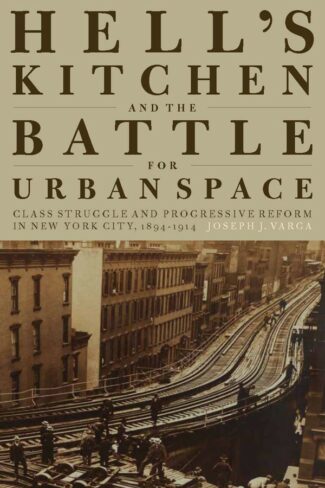
NEW! Hell’s Kitchen and the Battle for Urban Space by Joseph J. Varga

NEW! Hell’s Kitchen and the Battle for Urban Space by Joseph J. Varga

Hell's Kitchen is among Manhattan's most storied and studied neighborhoods. A working-class district situated next to the West Side's middle- and upper-class residential districts, it has long attracted the focus of artists and urban planners, writers and reformers. Now, Joseph Varga takes us on a tour of Hell's Kitchen with an eye toward what we usually take for granted: space, and, particularly, how urban spaces are produced, controlled, and contested by different class and political forces.

NEW! A Freedom Budget for All Americans: Recapturing the Promise of the Civil Rights Movement in the Struggle for Economic Justice Today by Paul Le Blanc and Michael D. Yates

NEW! A Freedom Budget for All Americans: Recapturing the Promise of the Civil Rights Movement in the Struggle for Economic Justice Today by Paul Le Blanc and Michael D. Yates

Just in time for the 50th anniversary of the March on Washington for Jobs and Freedom, Paul Le Blanc and Michael D. Yates explain the origins of the Freedom Budget, how it sought to achieve "freedom from want" for all people, and how it might be re-imagined for our current moment. Combining historical perspective with clear-sighted economic proposals, the authors make a concrete case for reviving the spirit of the Civil Rights Movement and building the society of economic security and democratic control envisioned by the movement's leaders—a struggle that continues to this day.

The Endless Crisis reviewed in The Spokesman

The Endless Crisis reviewed in The Spokesman

This is another book from the Monthly Review stable defending and extending the theoretical work of Baran and Sweezy, two redoubtable Marxist economists who along with Harry Magdoff kept the flame of Marxist economics alive in the United States through some pretty arduous domestic and international times. Readers may recall another title reviewed in Spokesman 111, The Great Financial Crisis: Causes and Consequences, in which the idea of capitalist stagnation was explained with particular reference to the present crisis. This new book takes on the task of defending and extending the same thesis on a broader theoretical basis, with additional material including substantial pieces on the international division of labour and China's political economy.

Hell’s Kitchen and the Battle for Urban Space reviewed in Antipode

Hell’s Kitchen and the Battle for Urban Space reviewed in Antipode

Despite recent efforts to efface its history through the practice of renaming, the area of mid-west Manhattan that real estate agents now call the Clinton Historic District (or even 'Clinton Heights') remains – to many existing residents and to the popular imagination at large – Hell's Kitchen. Just how and why this moniker and all that it conjures have stuck is part of the story that Joseph Varga tells in Hell's Kitchen and the Battle for Urban Space, a nuanced and theoretically-sophisticated history of the social relations and spatial imaginaries that produced this area in the turbulent decades from 1894 to 1914. Though this period of American urban history – the era of Progressive reform – has received considerable attention from historians, Varga adds a much-needed dimension to the discussion by engaging directly with critical spatial theory. The result is not just an eminently readable history of Hell's Kitchen, but a fascinating example of how 'taking space seriously' can alter our historical understandings and perspectives in powerful ways.

Lettuce Wars reviewed by Resolute Reader

Lettuce Wars reviewed by Resolute Reader

While in part biography, Bruce Neuburger's Lettuce Wars is really a history of life and work for agricultural labourers in California in the early 1970s. At its heart is the day to day struggle to make ends meet for tens of thousands of workers, mostly immigrant labour. But this is also a celebration of the struggle of those workers to get organised, and their victories against the bosses. Sometimes, this is in spite of their trade union leaders, and often it was because of a few individuals like Neuburger, prepared to stand up and be counted.

Paul Le Blanc discusses A Freedom Budget for All Americans with Scott McLemee for Inside Higher Ed

Paul Le Blanc discusses A Freedom Budget for All Americans with Scott McLemee for Inside Higher Ed

Three years after the March on Washington for Jobs and Freedom, a number of its core organizers projected a new stage of the struggle for equality -- expanding and deepening it, creating the economic and social foundations needed to realize Martin Luther King's dream. Their program, "A Freedom Budget for All Americans," was issued by the A. Philip Randolph Institute in fall 1966. In his foreword, King called the document "a moral commitment to the fundamental principles on which this nation was founded." Chances are you've never heard of it.

Chip Smith on Monthly Review and Economics

Chip Smith on Monthly Review and Economics

Chip Smith is an economist and author of The Cost of Privilege. He was interviewed on Cumberland County Progressives TV (North Carolina) by host Nancy Shakir on the topic "Growing a Sustainable Economy." In this video, Chip discusses the contributions made by Monthly Review authors and publications toward an understanding of monopoly capitalism, particularly The Endless Crisis by John Bellamy Foster and Robert W. McChesney, The Great Financial Crisis by Foster and Fred Magdoff, and Monopoly Capital by Paul Baran and Paul Sweezy.

One Day in December: Celia Sánchez and the Cuban Revolution reviewed by Helen Yaffe

One Day in December: Celia Sánchez and the Cuban Revolution reviewed by Helen Yaffe

Nancy Stout has treated the reader to an exhilarating biography of Celia Sanchez, recording her vital contribution to the revolutionary struggle and the socialist state in Cuba. This is long overdue. While many supporters of the Cuban Revolution will have heard about Celia and her close relationship with Fidel Castro, few will have understood or appreciated the role she played ... With the captivating power of a good novel, but based on ten years of archival research and interviews, Stout first introduces us to Celia's comfortable life in Pilón, a small rural town in sugar-plantation country.

Read Nadine Gordimer's foreword to Ruth First and Joe Slovo in the War against Apartheid in Guernica Magazine

Read Nadine Gordimer's foreword to Ruth First and Joe Slovo in the War against Apartheid in Guernica Magazine

Joe Slovo and Ruth First. We are entering their paths. Both grew up unbelievers in Jewish or any religious faith. They met when Ruth was at the University of the Witwatersrand, Joe just returned from the South African Army in the war against Nazi Germany. His motivation for volunteering, eighteen years old, unemployed, lying about being underage for military call-up—his early alliance with communism, and so to the Soviet Union under attack—was decisive in the act. But there remained the devastating racial dilemma in South Africa. He wrote: "How do you tell a black man to make his peace with General Smuts—butcher of Bulhoek and the Bondelswarts?"