Category: Monthly Review Press /

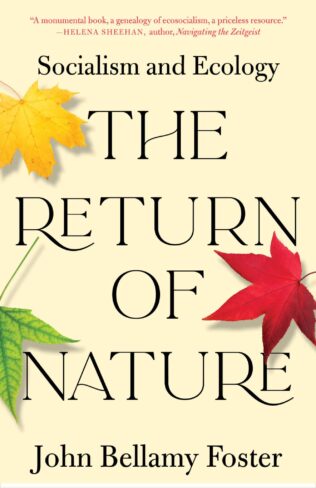
New! “The Return of Nature: Socialism and Ecology”

New! “The Return of Nature: Socialism and Ecology”

Twenty years ago, John Bellamy Foster’s Marx’s Ecology: Materialism and Nature introduced a new understanding of Karl Marx’s revolutionary ecological materialism. More than simply a study of Marx, it commenced an intellectual and social history, encompassing thinkers from Epicurus to Darwin, who developed materialist and ecological ideas. Now, with The Return of Nature, Foster continues this narrative. In so doing, he uncovers a long history of efforts to unite issues of social justice and environmental sustainability that will help us comprehend and counter today’s unprecedented planetary emergencies....

Did the Good Guys Win in 1776? Gerald Horne talks with Historic.ly

Did the Good Guys Win in 1776? Gerald Horne talks with Historic.ly

Historian Gerald Horne, author of several books, including the forthcoming The Dawning of the Apocalypse: The Roots of Slavery, White Supremacy, Settler Colonialism, and Capitalism in the Long Sixteenth Century, talks to Esha, host of Historic.ly, the web program that “decolonizes history and debunks myths and misinformation taught to you in school and on corporate media.” Much of Dr. Horne's work, it turns out, is based on his question, “Why is there not a stronger left movement in the USA, the leading imperialist country?”

A retrospective view of Ireland from the far Left: The Irish Catholic considers “Navigating the Zeitgeist”

A retrospective view of Ireland from the far Left: The Irish Catholic considers “Navigating the Zeitgeist”

Dr Helena Sheehan is a well-known left-wing intellectual. Her book, Marxism and the Philosophy of Science: Critical History, published in 1985, became a classic work on its subject. ¶ She has now written her autobiography, and this is the first volume, covering her life from the 1940s to the 1980s, a book which is full of interest for a particular view of Ireland and the world today....

Work is Inevitable But Its Organization Is Not: CounterPunch considers “How the World Works”

Work is Inevitable But Its Organization Is Not: CounterPunch considers “How the World Works”

All human societies, from the most primitive to the most modern, have an important commonality—the need to work. Water, food, shelter and other basics of life don’t arrive as gifts. Work is required to secure them and to raise the next generation. ¶ So fundamental is this basic principal of human life that generations of Marxist theorists have based analyses of social societies and structures on the economic base of a given society….

How the Coronavirus Unmasked Capitalism: Gerald Horne Talks to WBAI’s “Building Bridges”

Historian and prolific author Gerald Horne--whose latest book The Dawning of the Apocalypse will be published in July--recently talked to Mimi Rosenberg and Ken Nash, hosts of WBAI's Building Bridges, the longest running labor and community affairs radio program in the New York Metropolitan area, about the history of inequality behind the current horrific impact of the coronavirus....

New! “Tell the Bosses We’re Coming: A New Action Plan for Workers in the Twenty-First Century”

New! “Tell the Bosses We’re Coming: A New Action Plan for Workers in the Twenty-First Century”

Lengthening hours, lessening pay, no parental leave, scant job security… Never have so many workers needed so much support. Yet the very labor unions that could garner us protections and help us speak up for ourselves are growing weaker every day. In an age of rampant inequality, of increasing social protest and strikes—and when a majority of workers say they want to be union members—why does union density continue to decline? Shaun Richman offers some answers in his book, Tell the Bosses We’re Coming

“From Commune to Capitalism” reviewed by Science & Society

“From Commune to Capitalism” reviewed by Science & Society

This book is expressive of a new wave of scholarly reassessments of China’s transition from its socialist past to capitalist present. From a Chinese perspective, it has not much in common with the canonical CCP narratives widely circulated in printed media and Party phone apps, as Zhun Xu employs a “betrayal of the revolution” rhetoric that pinpoints ruptures between a socialist China under Mao Zedong’s leadership and a capitalist China headed by Deng Xiaoping and afterwards ...

Why the presidential debates aren’t about imperialism: The Progressive Populist looks at Intan Suwandi’s “Value Chains”

Why the presidential debates aren’t about imperialism: The Progressive Populist looks at Intan Suwandi’s “Value Chains”

Imperialism does not play out much in the 2020 presidential race. That says more about US corporate power over the two political parties and other institutions such as the new media, e.g., Comcast owning MSNBC. ¶ Meanwhile, as the US has deindustrialized, 79 percent of the globe’s industrial workers toiled in the Global South in 2010, over double the figure in 1950. The fruits of their exploited labor sell in the Global North

Action Guide for Green New Deal Advocates: Science for the People reviews “Creating an Ecological Society”

Action Guide for Green New Deal Advocates: Science for the People reviews “Creating an Ecological Society”

Creating an Ecological Society is an important and timely book for two reasons. First, the authors merge two rich areas of discourse—environmental conservation and anti-capitalism—in a seamless narrative that underscores both the urgency of our times and the opportunity of the moment. Second, authors Fred Magdoff and Chris Williams describe how creating an ecological society based on a set of shared values can directly improve the lived experience of individuals across the globe...