Category: Monthly Review Press /

FORUM reviews Howard Ryan’s “Educational Justice: Teaching and Organizing Against the Corporate Juggernaut”

FORUM reviews Howard Ryan’s “Educational Justice: Teaching and Organizing Against the Corporate Juggernaut”

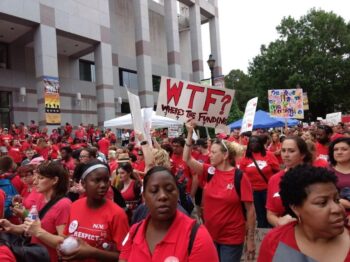
Preparation and militancy, though essential, don’t guarantee success. In Oklahoma and Kentucky, union leaders cut a poor settlement to end the dispute over the heads of those teachers who took action. Gains in one school, or in a city, or even across a state, can only be provisional absent wider changes in the political field. Hence the need for a vision of society which will consolidate and build from such gains, as Howard Ryan articulates…

UE News looks at Michael Yates’s new book–and how working people can still change the world

UE News looks at Michael Yates’s new book–and how working people can still change the world

If you have ever felt overwhelmed by the problems facing working people on seemingly every front, economist and labor educator Michael Yates has written a timely book. In Can the Working Class Change the World? he makes the case that the working class — and only the working class — can indeed overcome economic inequality, eliminate racism, sexism and other forms of discrimination, and meet the challenge of environmental degradation and climate change….

New! The World Turned Upside Down? | Socialist Register 2019

New! The World Turned Upside Down? | Socialist Register 2019

The World Turned Upside Down? poses overarching questions for the new period opened by the Trump election and the continued growth of right-wing nationalisms. These questions are addressed through a series of essays that carefully map the national, class, racial, and gender dimensions of the state, capitalism, and progressive forces today. Sober assessment is crucial for the left to gain its political bearings in this trying period and the uncertainties that lie ahead.

“Is This the Moment for the Working Class?” –Counterpunch reviews “Can the Working Class Change the World?”

“Is This the Moment for the Working Class?” –Counterpunch reviews “Can the Working Class Change the World?”

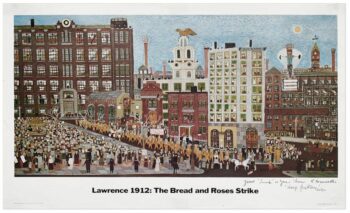
Fasanella’s father delivered ice to people in his Bronx neighborhood and his mother worked in a neighborhood dress shop drilling holes into buttons. In her spare time, she was an anti-fascist activist. The family’s experience informed his art just as Michael Yates’s working class roots and long career as a labor activist and educator shapes his latest book...

Capitalism: to be “rejected, root and branch”–Michael Yates via Counterpunch

Capitalism: to be “rejected, root and branch”–Michael Yates via Counterpunch

There is much discussion on the left about the connections and relative importance of class, race, gender, and the environment. Some, like political scientist Adolph Reed, take a class-first approach and criticize those who place an emphasis on race and gender as engaging in an identity politics that often shades into support for the neoliberalism that has wreaked havoc on working people for the past several decades....

A “definitive one-volume anthology”: Marxism & Philosophy reviews Samir Amin’s “Modern Imperialism, Monopoly Finance Capital, and Marx’s Law of Value”

A “definitive one-volume anthology”: Marxism & Philosophy reviews Samir Amin’s “Modern Imperialism, Monopoly Finance Capital, and Marx’s Law of Value”

Last August, the world lost a great Marxist theorist, Samir Amin. Amin was politically engaged throughout his life, worked in planning agencies in Mali and Senegal, and contributed to the theoretical elaboration of Marxist theory. Amin published dozens of books that cover a wide range of topics, including, amongst other topics...

New! Can the Working Class Change the World?

New! Can the Working Class Change the World?

In his timely and innovative book, Michael D. Yates asks if the working class can, indeed, change the world. Deftly factoring in such contemporary elements as sharp changes in the rise of identity politics and the nature of work, itself, Yates wonders if there can, in fact, be a thing called the working class. If so, how might it overcome inherent divisions of gender, race, ethnicity, religion, location—to become a cohesive and radical force for change? Forcefully and without illusions, Yates supports his arguments with relevant, clearly explained data, historical examples, and his own personal experiences.