Monthly Review Press

Politics of the Right “essential reading” —The Progressive Populist

Politics of the Right “essential reading” —The Progressive Populist

Far-right forces are on the move in and out of the US. Socialist Register 2016: The Politics of the Right, edited by Leo Panitch and Greg Albo, delivers crisp analyses of this trend.... A recurring theme in the book is the process of political centrism drifting to the right. This move enhances authoritarianism, a cultural feature of modern politics in the post Sept. 11 era.... Hard right politics dovetails with policing of national minorities. Lesley Wood outlines three related trends: “intelligence-led policing, community policing and strategic incapacitation protest policing,” which confront movements such as Black Lives Matter, pushing back for public control over this state function.

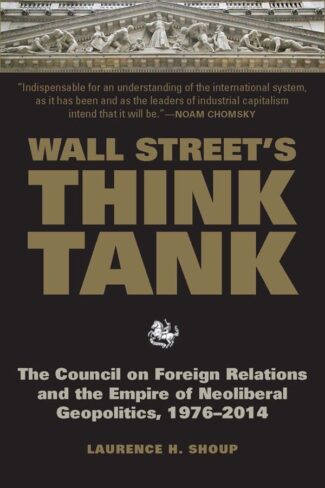
Laurence Shoup interviewed by Z Magazine

Laurence Shoup interviewed by Z Magazine

My interests cluster around understanding and exposing both global power structures and alternatives to the existing system. I approach this from the point of view of someone who wants to help create a socio-economic and political system worthy of humanity’s best inclinations. This would be a society and civilization without racial, class, sexual and gender divisions and conflicts, one based on authentic democracy, equality, civil freedoms, respect for the natural world, generous social arrangements, empathy, peace, social justice, and solidarity.

Save Our Unions reviewed in Journal of Sociology & Social Welfare

Save Our Unions reviewed in Journal of Sociology & Social Welfare

ave Our Unions is a sprawling collection of essays, covering everything from the Bread and Roses strike of 1912 to the current struggles of the British Labour Party. The text includes movie and book reviews, as well as journalistic accounts of many contemporary U.S. labor struggles, and even author Steve Early’s personal experience over many years of working for the Communication Workers of America (CWA). The book will offer practitioners a wealth of details with strategic implications for ongoing efforts. Academics will find hints of theory throughout, and a series of cases with implications for longstanding debates in labor and social movement studies.

The Socialist Imperative reviewed in CounterPunch

The Socialist Imperative reviewed in CounterPunch

When the serious work of building a better world starts, we will have no choice but to use some of the bricks of the current world as we begin that construction.... When ideas become rooted in masses of people, they become a natural force, argues Michael Lebowitz in his latest book, The Socialist Imperative: From Gotha to Now. He uses the example of the “socialist triangle” to explicate a structure for a better, democratic system.

NEW! America’s Addiction to Terrorism

NEW! America’s Addiction to Terrorism

By Henry A. Giroux Foreword by Michael D. Yates In the United States today, the term “terrorism” conjures up images of dangerous, outside threats: religious extremists and suicide bombers in... READ MORE
Railroading Economics reviewed in naked capitalism

Railroading Economics reviewed in naked capitalism

Continuing our series of book reviews in time for the holiday gift-giving season, here’s a quick look at Michael Perelman’s Railroading Economics, a title, and a subject, that intrigued me for two reasons. Trivially, as readers know, I’m by way of being a rail fan; more importantly, when I was a mere sprat, I read Matthew Josephson’s Robber Barons. Josephson’s tales of Jim Fisk watering the stock of the Erie Railroad — 'Gone where the woodbine twineth' was Fisk’s answer to where the money went — and his running buddy Jay Gould — 'I can hire one half of the working class to kill the other half' (attributed) — trying to corner the gold market would inoculate anyone from belief in the ideology of 'perfect competition.' They certainly did me.... This is a long and complicated story, and Perelman tells it well.

Laurence Shoup debunks the CFR on Redeye Radio, 100.5 FM

Laurence Shoup debunks the CFR on Redeye Radio, 100.5 FM

News stories and academic studies generally focus on the decisions made by presidents, prime ministers, and other world leaders. But where do those options decided upon come from in the first place? Why are some options never even considered? Behind the scenes, think tanks play a large part in what policies are considered by central governments. In the U.S., the most influential think tank of them all is the Council on Foreign Relations. From the 1920s right up until today, the CFR has been shaping policies, advising presidents, and helping ensure the U.S. remains the dominant superpower in the world.