Monthly Review Press

A Brief History of the KKK w/Gerald Horne, via The Real News Network

A Brief History of the KKK w/Gerald Horne, via The Real News Network

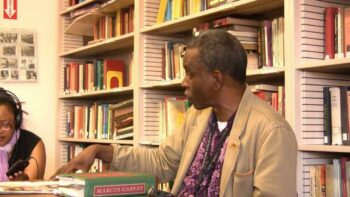
Gerald Horne, historian and author of several books, including the upcoming The Apocalypse of Settler Colonialism: The Roots of Slavery, White Supremacy, and Capitalism in Seventeenth-Century North America and the Caribbean, talks to Jaisal Noor of The Real News Network about July 8 KKK rally in Charlottesville, VA—and the origins of one of America’s oldest hate groups.

G20 is now G19 + 1: Gerald Horne on US isolation at Hamburg

G20 is now G19 + 1: Gerald Horne on US isolation at Hamburg

On July 7, 2017, a group of the world’s biggest economic powers, known as the G20, met in Hamburg, Germany. What happened at the event? What kinds of realignments happened among governments? How did the U.S. emerge the meetings? Margaret Prescod of SojournerTruthradio/KPFK discussed this on July 11 with Gerald Horne, Professor of African American Studies at the University of Houston and author of more than thirty books, including the forthcoming The Apocalypse of Settler Colonialism

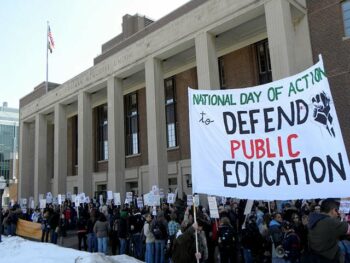
Howard Ryan’s Educational Justice reviewed by Teachers College Record

Howard Ryan’s Educational Justice reviewed by Teachers College Record

It is 2017 and the critique of corporate school reform has been around for some time. Beginning with Pauline Lipman’s critique of the Chicago Commercial Club’s role in remaking Chicago’s public schools (2004, 2011), Mike Fabricant and Michelle Fine’s critique of charter schools (2012), Ken Saltman’s critique of privatization (2007), and Sarah LeBlanc Goff’s exposé of the move of New Orleans from a public to a privatized school system (2009), they exposed the shortcomings of corporate or neoliberal reform efforts...

New! The Politics of Immigration: Questions and Answers

New! The Politics of Immigration: Questions and Answers

U.S. immigration has been the subject of furious debates for decades. On one side, politicians and the media talk about aliens and criminals, with calls to “deport them all.” On the other side, some advocates idealize immigrants and gloss over problems associated with immigration. Dialogue becomes possible when we dig deeper and ask tough questions: Why are people in other countries leaving their homes and coming here? What does it mean to be “illegal”? How do immigration raids, prisons, and border walls impact communities? Who suffers and who profits from our current system—and what would happen if we transformed it?

Aeon: “Who Names Diseases?” – in which Rob Wallace figures prominently

Aeon: “Who Names Diseases?” – in which Rob Wallace figures prominently

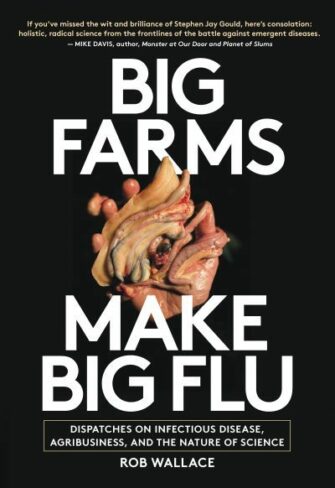
In his book Big Farms Make Big Flu, the evolutionary ecologist Rob Wallace draws a direct link between the growing threat of zoonotic diseases, and the agricultural practices that neoliberalism has encouraged—notably, the expansion and consolidation of agribusinesses, and the vertical integration of different stages of food production. The food we eat is produced by an ever-shrinking number of ever-growing mass-production units, in which vast herds or flocks of hybrid animals are packed into megabarns, forced to mature in a matter of months, and then slaughtered, processed and transported around the world.

Oakland, May 30: Against the Corporate Juggernaut – Howard Ryan on Educational Justice

Oakland, May 30: Against the Corporate Juggernaut – Howard Ryan on Educational Justice

Tuesday, May 30
5:00-7:00pm
2027 42nd Ave.
Oakland, CA 94601
With Donald Trump and Education Secretary Betsy DeVos at the helm, teachers, parents, and students have every reason to organize! But what exactly are we up against? Let’s talk about that with Howard Ryan, author of Educational Justice: Teaching and Organizing Against the Corporate Juggernaut, who will offer an analysis and organizing stories that can help our work.

Jim Young’s Union Power reviewed by Labor Notes

Jim Young’s Union Power reviewed by Labor Notes

For unions in corporate America, it’s always been hard times. Even in labor’s heyday—the 1940s, ’50s, and ’60s—unions had to struggle for everything. Plus, back then organizers risked being tarred as stooges for Moscow. ¶ Historian James Young makes those points clear in his readable new book Union Power: The United Electrical Workers in Erie, Pennsylvania. But the book offers more than history—it’s instructive, showing how a progressive union can survive in the incredibly hostile and toxic environment of corporate America.

“Ragpicking Through History,” we discover, via Salvage, Jimmy Boggs

“Ragpicking Through History,” we discover, via Salvage, Jimmy Boggs

Salvage, a startling new quarterly of revolutionary arts and letters, brings us “Ragpicking Through History: Class Memory, Class Struggle and its Archivists,” an article by Tithi Bhattacharya, in which James Boggs’s The American Revolution: Pages from a Negro Worker’s Notebook receives notice...

“E.P. Thompson’s Socialist Humanism” in Against the Current

“E.P. Thompson’s Socialist Humanism” in Against the Current

“The English working class ‘did not rise like the sun at an appointed time. It was present at its own making.’ In frequently quoted lines from the preface to The Making of the English Working Class (1780-1832), E.P. Thompson endeavored to ‘rescue the poor stockinger, the Luddite cropper, the “obsolete” hand-loom weaver, the “utopian” artisan, and even the deluded follower of Joanna Southcott, from the enormous condescension of posterity.’ ¶ More broadly, Thompson sought to elucidate class as a historical phenomenon that involved changing human relationships over time, rather than being a static structure or simple category of analysis….”