Monthly Review Press

Cal Winslow reflects on the Seattle General Strike of 1919

Cal Winslow reflects on the Seattle General Strike of 1919

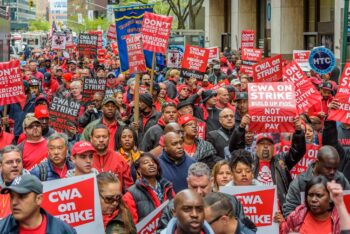
Cal Winslow, author of Radical Seattle: The General Strike of 1919, talks to Sasha Lilley, host of KPFA’s Against the Grain:
While the United States is in the throes of upheaval over police murders, we take a historical look back at another time of great social ferment: a century ago, when the workers of Seattle shut that city down. The first major general strike in the United States coincided with the last widespread pandemic — the Spanish influenza….

General Strike 100 Years Ago Shows Us Hope for Today: Labor Notes reviews “Radical Seattle”

General Strike 100 Years Ago Shows Us Hope for Today: Labor Notes reviews “Radical Seattle”

For five days in 1919, union members took control of the city of Seattle. They arguably ran it better, and certainly more justly, than it had ever been run before. ¶ The strike began when waitresses, laundry workers, streetcar workers, and more—65,000 union workers in all—walked off the job on February 6, 1919, to support striking shipyard workers. ¶ Thousands of workers volunteered to keep Seattle’s essential services operating. People were fed at 21 different locations; on February 9, volunteers served more than 30,000 meals....

When Solidarity Mattered: CounterPunch considers “Radical Seattle: The General Strike of 1919”

When Solidarity Mattered: CounterPunch considers “Radical Seattle: The General Strike of 1919”

This is a special book, bearing an almost sacred topic for all those interested in the history of the American labor and the Left. The vibrant, pre-1920 Socialist Party, waxing strong and confident until struck down for its resistance to the US entry into the First World War, stood for a larger and more diverse radicalism. including Wobblies, quasi-wobblies. labor and cultural radicals of no certain description and of several generations. They had in common the sense that dramatic change in society was possible, perhaps inevitable....

“From Commune to Capitalism” reviewed by Science & Society

“From Commune to Capitalism” reviewed by Science & Society

This book is expressive of a new wave of scholarly reassessments of China’s transition from its socialist past to capitalist present. From a Chinese perspective, it has not much in common with the canonical CCP narratives widely circulated in printed media and Party phone apps, as Zhun Xu employs a “betrayal of the revolution” rhetoric that pinpoints ruptures between a socialist China under Mao Zedong’s leadership and a capitalist China headed by Deng Xiaoping and afterwards ...

Delusions of the American Revolution: Science & Society looks at “The Apocalypse of Settler Colonialism”

Delusions of the American Revolution: Science & Society looks at “The Apocalypse of Settler Colonialism”

In this comprehensive study of the connections among capitalism, slavery and white supremacy, Gerald Horne, the Moores Professor of History and African American Studies at the University of Houston and the author of more than 30 scholarly books, takes a deep dive into the 17th century, revealing fallacies in what later ages have said about the earlier ones, showing the slow and steady consolidation of axes of differentiation in the service of capital, and ultimately connecting the choice in 2016 of “a vulgar billionaire” with the cross-class coalition that originated in the colonial settlements of the New World....