Monthly Review Press

“Guernica remains, alas, timeless”: Cal Winslow, via Jacobin

Guernica remains, alas, timeless”: Cal Winslow, via Jacobin

Pablo Picasso painted Guernica in just five weeks in the spring of 1937. ¶ Then living in Paris, Picasso, fifty-five, was already well-known. Born in Spain in 1881, he went to Paris in 1900; he had visited Spain in 1934 but would never return. ¶ Still, the insurgent Popular Front government appointed him director of the Prado Museum in Madrid, in absentia, and Picasso undertook several projects sympathetic to the Republic and to raise funds on its behalf. The government in turn asked him to produce a mural for the 1937 Paris World’s Fair, and he agreed, though progress at first was slow. It was the April 26 attack at Guernica that moved him. He threw himself into the painting and in less than five weeks, astonishingly, had completed Guernica...

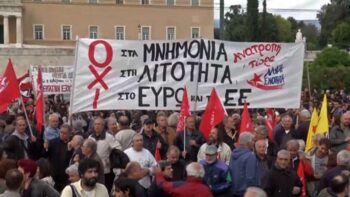
Helena Sheehan, Irish activist, author, coming to the U.S. for East Coast Book Tour!

Helena Sheehan, Irish activist, author, coming to the U.S. for East Coast Book Tour!

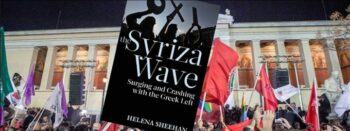
Helena Sheehan, Marxist scholar, activist, and author, will soon be leaving Dublin, Ireland for a U.S. book tour of her recently published The Syriza Wave: Surging and Crashing with the Greek Left. Her first appearance will be Thursday, May 25, 6:30pm, NYC, New York University, King Juan Carlos I of Spain Center at New York University, 53 Washington Square South, Manhattan

Anti-Imperialist U reviews Gerald Horne’s Confronting Black Jacobins

Anti-Imperialist U reviews Gerald Horne’s Confronting Black Jacobins

The Haitian Revolution, which ran from 1791-1804 was one of the most important events in modern history. It was the first successful anti-slavery revolution…. I dealt with this glorious moment in human history in my “Revolution in Haiti” based on C.L.R James classic The Black Jacobins…. Now I will deal with the part the Haitian revolution played in not only ending slavery on the island but throughout the americas relying on yet another masterpiece from Gerald Horne, Confronting Black Jacobins, which is both a sequel to The Counter-Revolution of 1776 and a companion to his excellent Negro Comrades of the Crown…

TORONTO, MAY 24-26: Marx’s Capital after 150 Years

TORONTO, MAY 24-26: Marx’s Capital after 150 Years

York University, 4700 Keele St, Toronto, ON M3J
Wednesday, May 24, 2017, 4:00pm – Friday, May 26, 2017, 7:30pm
Hear veteran scores of scholars and activists, including Immanuel Wallerstein, John Bellamy Foster, Leo Panitch, Ursula Huws, Kohei Saito …

New! Harbors Rich in Ships: The Selected Revolutionary Writings of Miroslav Krleža

New! Harbors Rich in Ships: The Selected Revolutionary Writings of Miroslav Krleža

Miroslav Krleža was a giant of Yugoslav literature, yet remarkably little of his writing has appeared in English. Harbors Rich in Ships gives English-speaking readers an unprecedented opportunity to appreciate the astonishing breadth of Krleža’s literary creations. Beautifully translated by Željko Cipriš, this collection of seven representative early texts introduces a new audience to three stories from Krleža’s renowned antimilitarist book, Croatian God Mars; an autobiographical sketch; a one-act play; a story from his collection of short stories, Thousand and One Deaths; and his signature drama, The Glembays, a satirical account of the crime-ridden origins of one of Zagreb’s most aristocratic families. This collection will help readers of all interests and ages see just why Krleža is considered among the best of the literary moderns.

Gerald Horne on Trump’s bombing Syria, via The Real News Network

Gerald Horne on Trump’s bombing Syria, via The Real News Network

PAUL JAY: So, what do you make of this moment? Trump is under attack for being pro-Russian, and just a few days ago he talks about over-throwing Assad is not the target. Which must have royally — excuse the language — pissed off a whole lot of the American foreign policy establishment.
GERALD HORNE: Well, I think you put your finger on a major issue, that this attack on Syria can be easily interpreted as a kind of wag the dog strategy by Mr. Trump. That is to say, the bloodhounds were on his trail, as a result of his pre-November 2016 contacts with Moscow.