Monthly Review Press

New! The Age of Monopoly Capital: Selected Correspondence of Paul A. Baran and Paul M. Sweezy, 1949-1964

New! The Age of Monopoly Capital: Selected Correspondence of Paul A. Baran and Paul M. Sweezy, 1949-1964

Paul A. Baran and Paul M. Sweezy were two of the leading Marxist economists of the twentieth century. Their seminal work, Monopoly Capital: An Essay on the American Economic and Social Order, published in 1966, two years after Baran’s death, was in many respects the culmination of fifteen years of correspondence between the two, from 1949 to 1964. Their surviving correspondence consists of some one thousand letters. Not since Marx and Engels carried on their epistolary correspondence has there has been a collection of letters offering such a detailed look at the making of a prescient critique of political economy—and at the historical conditions in which that critique was formed.

“The most important book…in years is John Smith’s Imperialism in the 21st Century”–OffGuardian review

“The most important book…in years is John Smith’s Imperialism in the 21st Century”–OffGuardian review

That first chapter goes on to consider two other products, iPhones and coffee. These too are produced in the global south for consumption in the north. Although very different products, Smith’s teasing out of the socioeconomic relations they embed shows their commonality. All are created under conditions of a super-exploitation which mainstream economics is at pains to conceal or obscure by a ‘value chain’ orthodoxy that would have us believe an iPhone made in China for $80 retails in the west for $800 not through exploitation but because the activities of shipping, advertising and packaging add $720 of value….

“A vital contribution to the ecosocialist argument”: Counterfire reviews Facing the Anthropocene

In August 2016, the International Geological Congress voted formally to recognise that the world has entered a new geological era, the Anthropocene. The effect of human activity on the planet has now become as significant as that of the comet that wiped out the dinosaurs and ended the Cretaceous era. In recognising this, it is important not to fall into a view of human effects on the Earth that idealises a separation between human society and a reified ‘Nature’….

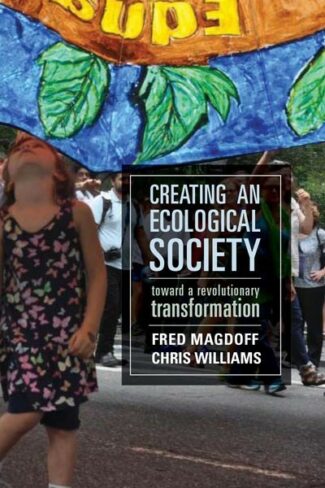
“Living Well is the Best Revolution”: The Progressive Populist reviews Creating an Ecological Society

“Living Well is the Best Revolution”: The Progressive Populist reviews Creating an Ecological Society

A book for a future society of buen vivir, or living well, with nature and other people? Yes, write Fred Magdoff and Chris Williams in Creating an Ecological Society. How to achieve sustainability with humanity and the planet? Start with context and vision to transcend the status quo of bio-sphere destruction. Reform is a part of the revolutionary process, according to the authors. It is not an either-or binary. The vision thing matters when it comes to the false consciousness of blaming other people for the system’s baked-in flaws. Dividing the working class to weaken it is elites’ go-to tactic. We see that now....

“Refreshing and timely”: Marx & Philosophy reviews Samir Amin’s Russia and the Long Transition from Capitalism to Socialism

“Refreshing and timely”: Marx & Philosophy reviews Samir Amin’s Russia and the Long Transition from Capitalism to Socialism

Samir Amin’s Russia and the Long Transition from Capitalism to Socialism is a collection of essays written between 1990 and 2015 on Soviet and Russian history…. ¶ At first glance, the title might appear to be backwards, as the socialist Soviet Union no longer exists and the capitalist Russian Federation has been deemed to be its successor on the world stage. However, it is from this juncture that Amin asks the reader to look towards the future as a way to analyse the present in comparison with the past, rather than looking back at the past to better understand the present and the possible future. In short, the author’s aim is to juxtapose the future of communism (as a higher mode of production) against the present in comparison with Russia’s past

Howard Ryan’s Educational Justice reviewed by Teachers College Record

Howard Ryan’s Educational Justice reviewed by Teachers College Record

It is 2017 and the critique of corporate school reform has been around for some time. Beginning with Pauline Lipman’s critique of the Chicago Commercial Club’s role in remaking Chicago’s public schools (2004, 2011), Mike Fabricant and Michelle Fine’s critique of charter schools (2012), Ken Saltman’s critique of privatization (2007), and Sarah LeBlanc Goff’s exposé of the move of New Orleans from a public to a privatized school system (2009), they exposed the shortcomings of corporate or neoliberal reform efforts...

G20 is now G19 + 1: Gerald Horne on US isolation at Hamburg

G20 is now G19 + 1: Gerald Horne on US isolation at Hamburg

On July 7, 2017, a group of the world’s biggest economic powers, known as the G20, met in Hamburg, Germany. What happened at the event? What kinds of realignments happened among governments? How did the U.S. emerge the meetings? Margaret Prescod of SojournerTruthradio/KPFK discussed this on July 11 with Gerald Horne, Professor of African American Studies at the University of Houston and author of more than thirty books, including the forthcoming The Apocalypse of Settler Colonialism