December 1, 2019
In The Killing Season: A History of the Indonesian Massacres, 1965–66, Geoffrey B. Robinson offers the most comprehensive history of Indonesia's mass killings to date, arguing that the army, foreign governments, and monopoly capital must all be jettisoned from the country's ruling coalition for meaningful justice to be achieved.
November 1, 2019
Ever since the United States divided the Korean peninsula in 1945, North Korea has had to cope with the existential challenge of U.S. hostility. Korea marks the western boundary of the empire, a border area where the sea power of the United States adjoins the land power of Russia and China. North Korea has been able to utilize this liminality to create a sovereign stateÑthe Democratic People's Republic of KoreaÑwhose independence is not welcomed by either Moscow or Beijing but tolerated because the alternatives, a client of the other or absorption into the U.S. empire, are considered worse. Washington, as global hegemon, has been less willing to tolerate this independence but has faced constraints. The result has been a policy of hostility, of unrelenting diplomatic and economic war of varying intensity, stopping short of actual kinetic war, though never far from it.
November 1, 2019
Monthly Review and Monthly Review Press author and celebrated world-systems theorist Immanuel Wallerstein died on August 31, 2019. In his memory, we republish an article that first appeared in Monthly Review 55, no. 3 (JulyÐAugust 2003).
October 1, 2019
Costas Lapavitsas's The Left Case Against the EU (Polity, 2019) is recognized as the leading work advocating Lexit, the left-wing case for Brexit, and for nations leaving the European Union more generally. In light of current Conservative British Prime Minister Boris Johnson's commitment to exit the European Union by October 31, even if it means a no-deal Brexit, the role of the left takes on growing importance. Moreover, this raises issues of the European Union generally, including the dominance of neoliberalism within it and the question of German hegemony. Here, Neil Davidson offers an assessment of Lapavitsas's book.
October 1, 2019
In this continuation of the exchange on the European Union, the United Kingdom, and the left, Andy Storey engages with Costas Lapavitsas's arguments in The Left Case Against the EU.
October 1, 2019
As part of the exchange on the European Union, the United Kingdom, and the left, Costas Lapavitsas provides an extensive response to Neil Davidson's and Andy Storey's contributions.
October 1, 2019
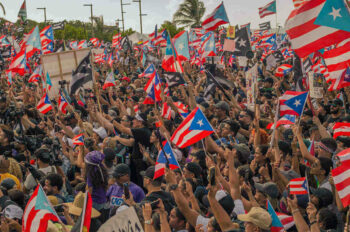
Naomi Klein's The Battle for Paradise (Haymarket, 2018) describes a duel of dreams for post-Hurricane Mar’a Puerto Rico. On the one hand, networks of resistance and resilience sprang up around the island in the wake of the collapse of not just trees and houses, but infrastructure and government. On the other, a small group of super rich speculators and futurists were poised to cash in on what Puerto Rico's then-Governor Ricardo Rossell—ó described as an opportunity to "sort of restart and upgrade" a nation he shamelessly called a "blank canvas." Rossell—ó— was forced out of office on July 24, 2019, by mass protests, in large part thanks to the networks of resistance and resilience that came to life when the government essentially disappeared after the 2017 hurricanes.
July 1, 2019
This special issue of Monthly Review is meant both to celebrate the fiftieth anniversary of Harry Magdoff's The Age of Imperialism: The Economics of U.S. Foreign Policy, which was devoted to the analysis of imperialism at the height of U.S. hegemony, and to carry this analysis forward to address the present era of late imperialism in the twenty-first century. In bringing together work on the political economy of imperialism in the current era of globalized production, we seek to transcend the now fashionable view within the Western academic left that the concept of imperialism is obsolete. The imperialist world system stands not only for capitalism at its most concrete historical level, but also for the entire dynamic structure of power constituting accumulation on a world scale, which can only be understood in terms of a developing global rift between center and periphery, global North and global South. Failure to attend to this fissure would be fatal for humanity.

July 1, 2019
The globalization of production (and finance)—which emerged along with neoliberalism out of the economic stagnation of the mid–1970s and then accelerated with the demise of Soviet-type societies and China's reintegration into the capitalist world system—has generated a more generalized monopoly capitalism, ushering in what can be called late imperialism. Late imperialism refers to the present period of monopoly-finance capital and stagnation, declining U.S. hegemony and rising world conflict, accompanied by growing threats to the ecological bases of civilization and life itself. It stands at its core for the extreme, hierarchical relations governing the capitalist world economy in the twenty-first century, which is increasingly dominated by mega-multinational corporations and a handful of states at the center of the world system. Just as it is now common to refer to late capitalism in recognition of the end times brought on by simultaneous economic and ecological dislocations, so it is necessary today to speak of late imperialism, reflecting the global dimensions and contradictions of that system, cutting across all other divisions, and posing a "global rift" in human historical development: an epochal crisis posing the question of "ruin or revolution."
July 1, 2019
Today, we not only have decades of neoliberalism behind us, but the neoliberal regime itself has reached a dead end. Contemporary imperialism has to be discussed within this setting. There are two main reasons why the regime of neoliberal globalization has run into a dead end. The first is an ex ante tendency toward global overproduction; the second is that the only possible counter to this tendency within the regime is the formation of asset-price bubbles, which cannot be conjured up at will and whose collapse, if they do appear, plunges the economy back into a crisis. In short, there are no "markets on tap," to use the words of British economic historian Samuel Berrick Saul, for contemporary metropolitan capitalism, such as had been provided by colonialism prior to the First World War and by state expenditure in the post-Second World War period of dirigisme.