October 1, 2026
Marking the sixtieth anniversary of Paul A. Baran and Paul M. Sweezy's
Monopoly Capital, the
MR editors situate this key work of political economy within the contemporary political-economic landscape. The tendency toward the overaccumulation capital, they explain, represents a shift from the "
generation of economic surplus…to one of its
absorption." In an age of financialization and market bubbles, the editors note, Baran and Sweezy's work stands as a testament to the continuing necessity of incisive political-economic analysis of capitalism, inequality, and the irrationality that pervading the entire system.
October 1, 2026
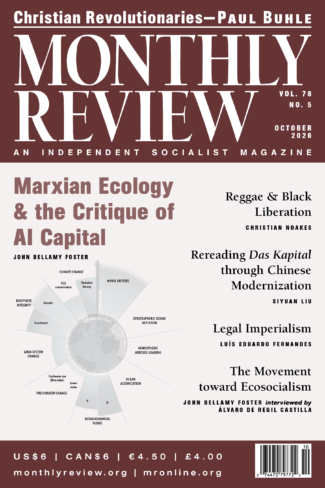
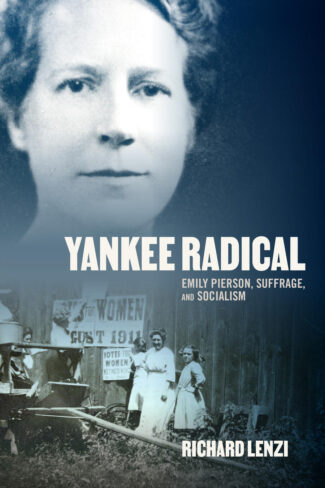
Paul Buhle reviews
Emily Pierson: A Yankee Radical, a new biography of the eponymous Christian radical and communist organizer. As a "strong willed" woman born at the nineteenth century and living well into the twentieth, Pierson is a figure whose work spanned the fight for women's suffrage, public health, the labor movement, and the Russian, Chinese, and Cuban Revolutions, traveling to the latter countries toward the end of her life. As a writer, teacher, churchgoer, and worker, Pierson, Buhle writes, was a presence to be reckoned with throughout her lifetime.
September 1, 2026
The relationship between Marxism and other revolutionary traditions is a key question for our time. If we approach the issue incorrectly, we risk Eurocentrism and underrecognizing Marxism's role in the Global South contexts where it is most vital and active. This article examines and extends José Carlos Mariátegui's dialectical approach to the issue, which demonstrates how Marxism is not diluted but strengthened through engagement with the thought and practice of existing struggles, while those struggles can, in turn, gain greater depth and groundedness through the same relationship.
June 1, 2026
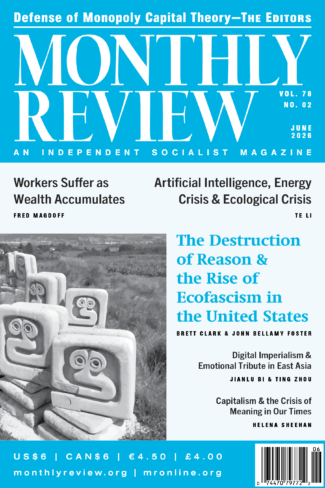
June's "Notes from the Editors" revisits the fundamental concept of monopoly capitalism as expounded by Paul A. Baran and Paul M. Sweezy in their pathbreaking
Monopoly Capital. The recent resurgence of the debate around Baran and Sweezy's work, the editors write, misses not only the enduring relevance of their analysis in an era of megacorporations and hyperscalers, but the revolutionary understanding of the economic system that arises from such an analysis.
May 1, 2026
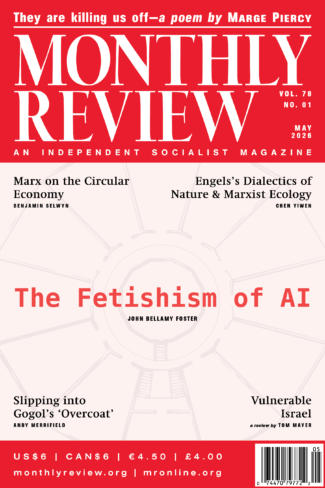
This month's "Notes from the Editors" dissects recent attacks on historical materialism from so-called social materialism. This way of thinking, the editors write, is profoundly divorced from Marxism, in that it lacks a dialectical foundation and eliminates the ethical domain that is critical to building a revolutionary praxis.
May 1, 2026
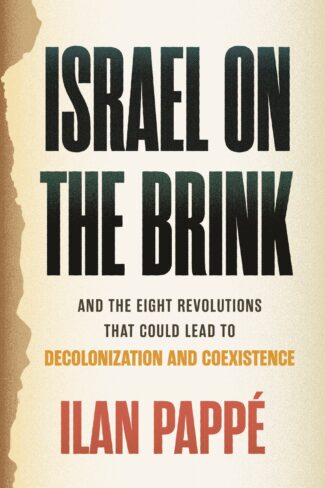
In this review of Ilan Pappé's
Israel on the Brink, Tom Mayer considers the famed historian's assessment of the increasingly precarious Zionist state. In the book, Mayer writes, readers will find a thoughtful consideration of the past, present, and potential events that could shape a new vision for Palestine.
April 1, 2026
What is really happening in Xinjiang? Vijay Prashad and Tings Chak write: "There is no evidence of a policy of physical annihilation of the Uyghur peoples by the Chinese government, unlike say, direct evidence of extermination by the Israeli government against the occupied Palestinian people. There are no mass graves and no accusations of systematic killing—the hallmarks of a genocide."
April 1, 2026
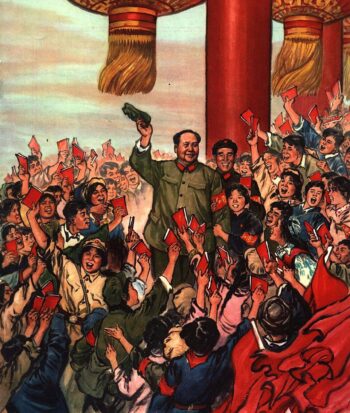
This article examines the resurgence of interest in Mao Zedong among China's youth, particularly at elite universities. This "Mao fever" reflects a complex mindset: indignation toward social inequality, uncertainty within a brutal job market, and a firm anti-imperialist and patriotic stance amidst the "New Cold War." In Mao’s legacy, a new generation is finding the guidance to navigate the sharpening contradictions of the present day.
April 1, 2026
Michael Viola explores the building of the Filipino identity in the context of U.S. imperialism. The broad-reaching effects of this "deadliest phase of imperialism," combined with pervasive anti-Asian racism in the United States, fuels the idea of a collective political project that "comes with the praxis, the power, and the price of a unique lineage" extending across an ocean and intimately connected to the dark history of U.S. militarism abroad.
March 1, 2026
Vijay Prashad critiques the argument that colonialism was, at most, ancillary to the transition between capitalism and feudalism in Western Europe. Instead, Prashad argues, "capitalism
as it historically emerged—industrial, global, racialized, and imperial—was inseparable from colonial expropriation." This reality must fuel a Marxist conception of the global struggle for reparations for those who have been oppressed and exploited at the hands of empires past and present.