June 1, 2026
June's "Notes from the Editors" revisits the fundamental concept of monopoly capitalism as expounded by Paul A. Baran and Paul M. Sweezy in their pathbreaking
Monopoly Capital. The recent resurgence of the debate around Baran and Sweezy's work, the editors write, misses not only the enduring relevance of their analysis in an era of megacorporations and hyperscalers, but the revolutionary understanding of the economic system that arises from such an analysis.
June 1, 2026
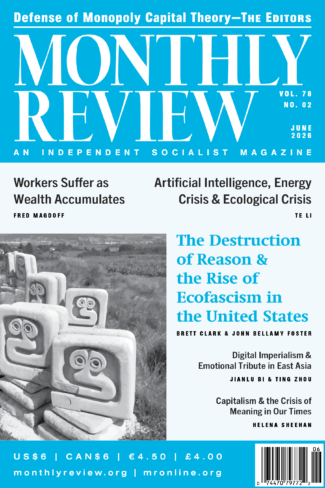
MR associate editor Brett Clark and editor John Bellamy Foster explore "the death drive of late imperialism" and its manifestations in an ecological crisis that is not parallel to, but inseparable from, increasingly open ecofascism in the United States. Drawing from Luckács's
Destruction of Reason and István Mészáros's work on imperialism, Clark and Foster present a materialist analysis that illuminates the cult of unreason so pervasive under capitalism and imperialism while pointing to a path forward that is grounded in the historical-materialist Marxist tradition.
June 1, 2026
Te Li unravels the myth of digital dematerialization so heavily promulgated by Silicon Valley and other AI boosters, which presents the technology as a phenomenon that has escaped the material realm and thus, entropy itself. In fact, Li shows that the material and energetic requirements of AI places it squarely in the physical realm, then situates the technology within the context of the metabolic rift under capitalism.
June 1, 2026
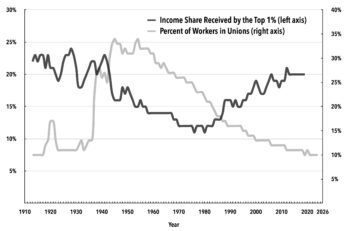
Fred Magdoff presents an incisive, data-driven analysis of the current state of the worker laboring under the domineering system of financialization and, in particular, private equity. In his conclusion, Magdoff asks: "Is there a way out of twenty-first-century 'normal' for labor?" "The key way out," he answers, "is an extraordinary growth of workers' power in order to combat the extraordinary power of capital"—one rooted in fully democratic socialist production and fundamental equality.
June 1, 2026
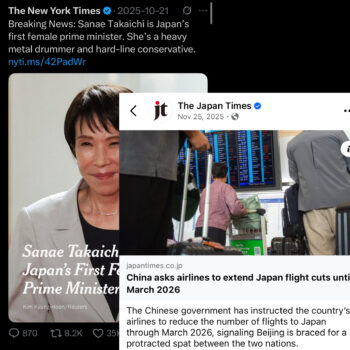
"In the contemporary era of stagnant monopoly-finance capital," Jianlu Bi and Ting Zhou begin, "the maintenance of global hegemony…necessitates the systemic colonization of digital consciousness. In examining the presentation of Sino-Japanese political tension across three media outlets, the authors describe digitally manufactured hatreds that "serve a vital imperialist function: the prevention of horizontal class solidarity" that may threaten U.S. hegemonic power in East Asia.
June 1, 2026
Philosopher and frequent
MR contributor Helena Sheehan considers the implications of living in a world in which a lack of meaning runs rampant, as well as how it is expressed in the literary world. If we lack coherent analysis, the varied crises of our times can seem disconnected and overpowering. A materially grounded Marxist worldview, she notes, allows us to clear away the fog of meaninglessness engulfing contemporary society and chart a path toward socialism.
May 1, 2026
This month's "Notes from the Editors" dissects recent attacks on historical materialism from so-called social materialism. This way of thinking, the editors write, is profoundly divorced from Marxism, in that it lacks a dialectical foundation and eliminates the ethical domain that is critical to building a revolutionary praxis.
May 1, 2026
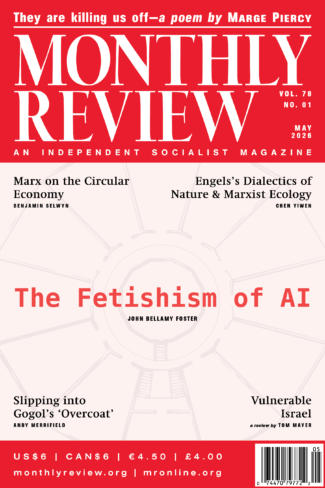
John Bellamy Foster takes on sweeping questions of artificial intelligence and its role in today's capitalist society. "The Great Houses of AI are divided against themselves and cannot stand," he writes, "If humanity is to flourish, the forces and relations of production must be revolutionized together…creating a world of sustainable human development."
May 1, 2026
Yiwen Chen dives deep into Frederick Engels's
Dialectics of Nature in order to give context to present-day debates surrounding the juxtaposition of the dialectics of nature and Marxist ecology. "It is hardly surprising that Engels's and Marx's ecological ideas are not entirely identical," Chen writes. "Nevertheless, their ideas do possess an inherent consistency."
May 1, 2026
Today, many use the term "circular economy" to describe a shift in the use of industrial waste products in a way that does not challenge the present mode of production. Returning to Marx, Benjamin Selwyn is able to show that this usage of the term is designed to facilitate the acquisitive demands of a capitalist economy, rather than a fundamental shift in resource use.