September 1, 2026
Taking as a starting point two classic works of the mid-nineteenth century—Benjamin Disraeli's
Sybil; or the Two Nations and Frederick Engels's
The Condition of the Working Class in England—this month's "Notes from the Editors" explores the way both authors articulated the plight of workers in their own era, drawing key parallels to our own time. The similarities are particularly conspicuous when examining the so-called affordability crisis, exposing the regime of social murder that accompanies the increasing polarization of economic life.
September 1, 2026
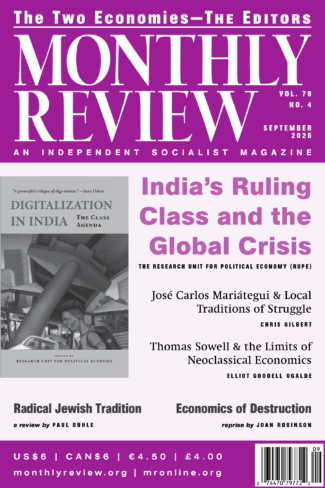
In September's Review of the Month, the Research Unit for Political Economy delves into how the crisis pervading the world system, on stark display in the tech sector, global finance, and the sphere of production, lays bare the longstanding vulnerabilities of the Indian economy. As the contradictions in the neoliberal phase become unmistakable, the authors write, it is necessary to take a class-based approach to resolving the questions of how to bring about key questions regarding the productive life and development of India.
July 1, 2026
Considering the "Structural Crisis of Capital" from the perspective of economics, Prabhat Patnaik sheds light on two major aspects that have risen to prominence in our current conjuncture. The first, rampant stagnation and unemployment, is clear and undeniable. The second, particular to the capitalism of the late twentieth century and the shedding of colonies on which imperial nations depended for wealth is particularly salient to Trump's economic strategy of economic recolonization not only through soft power, but direct military action.
July 1, 2026
In order to comprehend the environmental crisis that goes hand-in-hand with the "Structural Crisis of Capital," we must also understand the nature of global value chains and how they contribute to environmental degradation and worker exploitation on a global level. Benjamin Selwyn elucidates how global value chains and digitalization sit within a "conjoined dynamic of labor-exploitative accumulation and ecological expropriation."
June 1, 2026
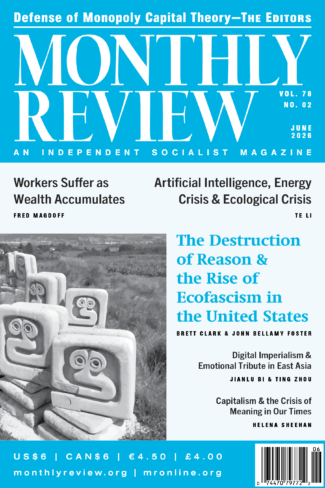
June's "Notes from the Editors" revisits the fundamental concept of monopoly capitalism as expounded by Paul A. Baran and Paul M. Sweezy in their pathbreaking
Monopoly Capital. The recent resurgence of the debate around Baran and Sweezy's work, the editors write, misses not only the enduring relevance of their analysis in an era of megacorporations and hyperscalers, but the revolutionary understanding of the economic system that arises from such an analysis.
June 1, 2026
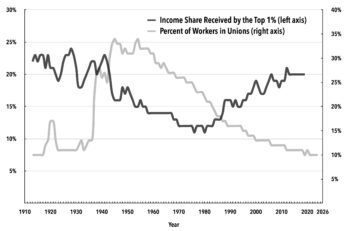
Fred Magdoff presents an incisive, data-driven analysis of the current state of the worker laboring under the domineering system of financialization and, in particular, private equity. In his conclusion, Magdoff asks: "Is there a way out of twenty-first-century 'normal' for labor?" "The key way out," he answers, "is an extraordinary growth of workers' power in order to combat the extraordinary power of capital"—one rooted in fully democratic socialist production and fundamental equality.
May 1, 2026
A new poem by Marge Piercy.
April 1, 2026
Applying Marxist labor theory to the rise of artificial intelligence and its effects on workers, Te Li presents an understanding of labor in the age of increasing reliance on algorithms and digital technologies. As Li argues: "In the civilization of general intellect labor, where the knowledge economy dominates, knowledge-intensive labor such as scientific research, technological innovation, artistic creation, and education and training will become primary forms of labor."
February 1, 2026
Despite its relatively small size, Mauritius increasingly is looming large in the geopolitical jostling in the Indian Ocean region. Tracing the country's often overlooked role in global affairs from the sixteenth century up until the present day, Stefan Gua provides readers with an insightful account of how politics both inside and outside of Mauritius reflect broader debates about colonialism, militarism, and self-determination.
January 1, 2026
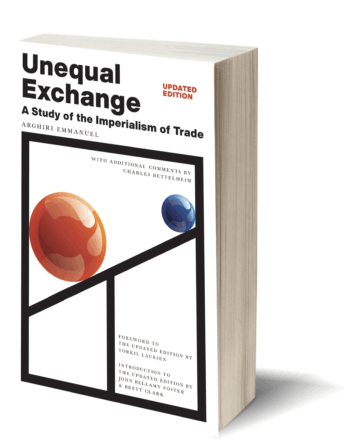
In this Introduction to the updated edition of
Unequal Exchange by Arghiri Emmanuel, published by Monthly Review Press, John Bellamy Foster and Brett Clark offer readers insight into the continuing influence of Emmanuel's seminal work. Through both deep understanding thoughtful critique, the authors deftly situate Emmanuel's text as an indispensable part of an enduring tradition of Marxist analysis of the global dynamics of labor.