October 1, 2026
Marking the sixtieth anniversary of Paul A. Baran and Paul M. Sweezy's
Monopoly Capital, the
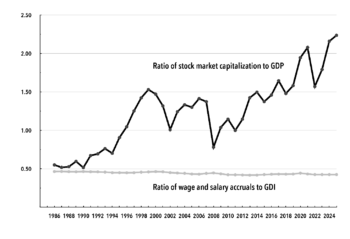
MR editors situate this key work of political economy within the contemporary political-economic landscape. The tendency toward the overaccumulation capital, they explain, represents a shift from the "
generation of economic surplus…to one of its
absorption." In an age of financialization and market bubbles, the editors note, Baran and Sweezy's work stands as a testament to the continuing necessity of incisive political-economic analysis of capitalism, inequality, and the irrationality that pervading the entire system.
October 1, 2026
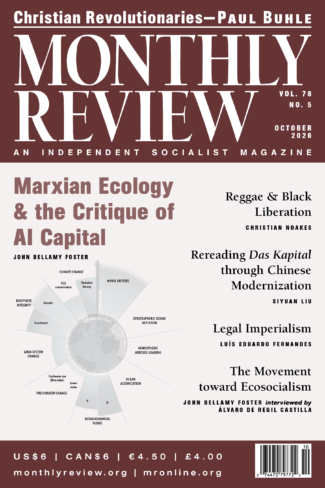
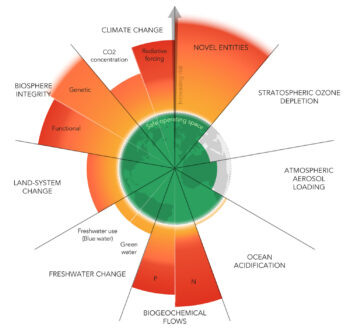
What is the rise of AI capital, and what does it mean for contemporary work, culture, and the ecological state of our planet? John Bellamy Foster dispels the myth of a "hyperorganized AI capitalism." As Foster writes: "We are not entering a stable new age…but rather a new, capitalist-engendered global disorder in which humanity, according to climate science, is headed ever more rapidly toward a planetary 'point of no return.'" The only way out—the only way, that is, to ensure the survival of humanity—is a radical shift away from the catastrophically destructive regime of capital accumulation and toward sustainable human development through socialism.
October 1, 2026
Álvaro de Regil Castilla interviews John Bellamy Foster. In the interview, de Regil Castilla and Foster discuss the existential risk to humanity presented by the ongoing planetary crisis wrought by capitalism and its endlessly destructive impacts on society and the earth. What would an ecosocialist movement look like? How do we pursue an equitable and sustainable path toward the development of all, rather than the privileged few? Do we still have time to organize to save the planet—and indeed, all of humanity?
September 1, 2026
Taking as a starting point two classic works of the mid-nineteenth century—Benjamin Disraeli's
Sybil; or the Two Nations and Frederick Engels's
The Condition of the Working Class in England—this month's "Notes from the Editors" explores the way both authors articulated the plight of workers in their own era, drawing key parallels to our own time. The similarities are particularly conspicuous when examining the so-called affordability crisis, exposing the regime of social murder that accompanies the increasing polarization of economic life.
September 1, 2026
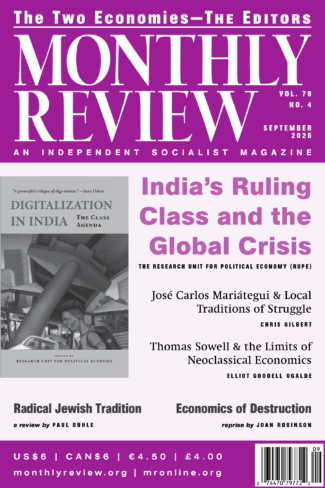
Through the work of neoclassical economist Thomas Sowell, Elliot Goodell Ugalde dissects the orthodox view that takes for granted that scarcity is at the center of economic life. In a world of various kinds of surpluses, Goodell argues, the idea that scarcity is the only organizing principle of our economic is inadequate to describe the complex interactions of institutions, history, and social power that make up economic organization under capitalism.
September 1, 2026
Paul Buhle reviews
The Radical Jewish Tradition by Donny Gluckstein and Janey Stone. The book, Buhle writes, is a window onto "the antinomies of nineteenth-century Jewish life"—including the growing movement against Zionism and for socialism among Eastern European Jews. This authors, Buhle notes, also tells the story of Jewish communists in Britain, the United States, and beyond, taking into account the wide sweep of Jewish left activity globally, situating the present struggles against genocide in Palestine squarely within the legacy of radical Jews everywhere.
July 1, 2026
John Bellamy Foster introduces our special summer issue on the "Structural Crisis of Capital," illuminating its four main characteristics as first outlined by István Mészáros in
Marx's Theory of Alienation. Capital, Foster says, has found itself in a position akin to Lucian's sorcerer's apprentice: futilely attempting to control a runaway system that he had himself created, accumulating not only contradictions but outright catastrophe—with globe-spanning consequences.
July 1, 2026
Jan Toporowski explains our contemporary age of "monetary policy dominance": the era in which the setting of short-term interest rates by the central banks is seen as the key instrument for regulating economic activity. This, however, does not reflect an ironclad law of the business cycle but, rather, a set of assumptions that underscores the dependence of capitalism on the accumulation of capital itself. This in turn obscures deeper truths about the effectiveness of monetary policy on the daily lives of the working class.
July 1, 2026
In order to comprehend the environmental crisis that goes hand-in-hand with the "Structural Crisis of Capital," we must also understand the nature of global value chains and how they contribute to environmental degradation and worker exploitation on a global level. Benjamin Selwyn elucidates how global value chains and digitalization sit within a "conjoined dynamic of labor-exploitative accumulation and ecological expropriation."
July 1, 2026
Martin Hart-Landsberg gives an in-depth account of the oligarchs of Silicon Valley and their embrace of transhumanist ideologies that celebrate individualism and technological advancement above all else. However, he asserts, all is not lost, as growing dissatisfaction with capitalism "is slowly but steadily helping to grow a movement of resistance"—a resistance that must recognize that it is not just tech billionaires but capitalism itself threatening humanity's chance at a better future.