October 1, 2026
Marking the sixtieth anniversary of Paul A. Baran and Paul M. Sweezy's
Monopoly Capital, the
MR editors situate this key work of political economy within the contemporary political-economic landscape. The tendency toward the overaccumulation capital, they explain, represents a shift from the "
generation of economic surplus…to one of its
absorption." In an age of financialization and market bubbles, the editors note, Baran and Sweezy's work stands as a testament to the continuing necessity of incisive political-economic analysis of capitalism, inequality, and the irrationality that pervading the entire system.
October 1, 2026
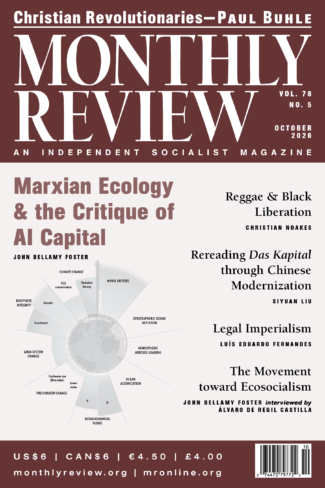
Christian Noakes explores the deep connections between the Jamaican Black Power movement and the political roots of its renowned indigenous musical genre, reggae. From the history of capitalist oppression in Jamaica and the indelible influence of Guyanese revolutionary Walter Rodney, Noakes provides essential context for incendiary political radicalism within reggae. Musically innovative and lyrically radical, reggae, he writes, was "instilled with a sense of militant determination that was at once a reflection of the culture it came from and a source of defiant resilience in the face of rampant inequality."
October 1, 2026
Álvaro de Regil Castilla interviews John Bellamy Foster. In the interview, de Regil Castilla and Foster discuss the existential risk to humanity presented by the ongoing planetary crisis wrought by capitalism and its endlessly destructive impacts on society and the earth. What would an ecosocialist movement look like? How do we pursue an equitable and sustainable path toward the development of all, rather than the privileged few? Do we still have time to organize to save the planet—and indeed, all of humanity?
September 1, 2026
In September's Review of the Month, the Research Unit for Political Economy delves into how the crisis pervading the world system, on stark display in the tech sector, global finance, and the sphere of production, lays bare the longstanding vulnerabilities of the Indian economy. As the contradictions in the neoliberal phase become unmistakable, the authors write, it is necessary to take a class-based approach to resolving the questions of how to bring about key questions regarding the productive life and development of India.
September 1, 2026
Through the work of neoclassical economist Thomas Sowell, Elliot Goodell Ugalde dissects the orthodox view that takes for granted that scarcity is at the center of economic life. In a world of various kinds of surpluses, Goodell argues, the idea that scarcity is the only organizing principle of our economic is inadequate to describe the complex interactions of institutions, history, and social power that make up economic organization under capitalism.
September 1, 2026
In this 1980 talk by Joan Robinson, first published in
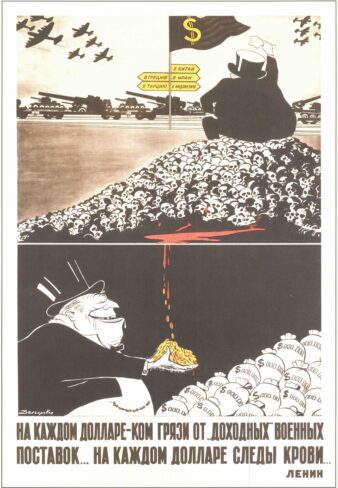
MR in 1983, the economist painted a stark picture of global arms race fueled by military capitalism and imperialism. "The important question," she urged, "is not whether the rate of inflation is high or low or can be brought under control but whether our generation will succeed in destroying the world…. Economics should begin to address the important issue of our impending doom."
July 1, 2026
John Bellamy Foster introduces our special summer issue on the "Structural Crisis of Capital," illuminating its four main characteristics as first outlined by István Mészáros in
Marx's Theory of Alienation. Capital, Foster says, has found itself in a position akin to Lucian's sorcerer's apprentice: futilely attempting to control a runaway system that he had himself created, accumulating not only contradictions but outright catastrophe—with globe-spanning consequences.
July 1, 2026
"Old-style neoliberalism," write Riccardo Bellofiore and Giovanna Vertova "is dead, or at least gravely ill. The new paradigm that may replace it has not yet been born or is not yet recognizable. In the middle, between the times, lies what we have proposed to call the
permanent catastrophe: a regime in which capitalist responses in catastrophic form have become the norm, in which crises are no longer overcome but accumulate."
July 1, 2026
It is quite evident, Costas Lapavitsas begins, that the world is currently ensnared in geopolitical turmoil, perhaps for over a decade. In this article, Lapavitsas provides insight into the inseparable and interlocking mechanisms of dollar dominance and imperialism backed by the escalatory militarism of the second Trump administration. As Lapavitsas notes: "The dollar and the F-35—monetary coercion and military power—are two moments of a single structure of domination."
July 1, 2026
Jan Toporowski explains our contemporary age of "monetary policy dominance": the era in which the setting of short-term interest rates by the central banks is seen as the key instrument for regulating economic activity. This, however, does not reflect an ironclad law of the business cycle but, rather, a set of assumptions that underscores the dependence of capitalism on the accumulation of capital itself. This in turn obscures deeper truths about the effectiveness of monetary policy on the daily lives of the working class.