October 1, 2026
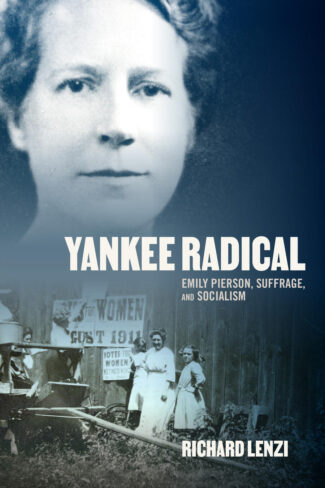
Paul Buhle reviews
Emily Pierson: A Yankee Radical, a new biography of the eponymous Christian radical and communist organizer. As a "strong willed" woman born at the nineteenth century and living well into the twentieth, Pierson is a figure whose work spanned the fight for women's suffrage, public health, the labor movement, and the Russian, Chinese, and Cuban Revolutions, traveling to the latter countries toward the end of her life. As a writer, teacher, churchgoer, and worker, Pierson, Buhle writes, was a presence to be reckoned with throughout her lifetime.
September 1, 2026
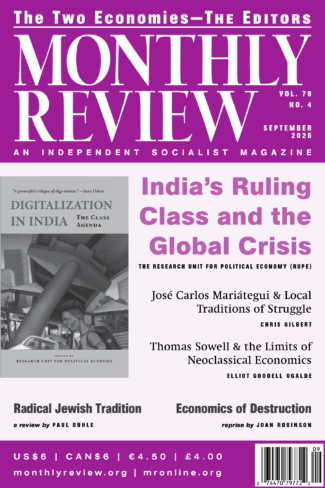
Taking as a starting point two classic works of the mid-nineteenth century—Benjamin Disraeli's
Sybil; or the Two Nations and Frederick Engels's
The Condition of the Working Class in England—this month's "Notes from the Editors" explores the way both authors articulated the plight of workers in their own era, drawing key parallels to our own time. The similarities are particularly conspicuous when examining the so-called affordability crisis, exposing the regime of social murder that accompanies the increasing polarization of economic life.
September 1, 2026
In this 1980 talk by Joan Robinson, first published in
MR in 1983, the economist painted a stark picture of global arms race fueled by military capitalism and imperialism. "The important question," she urged, "is not whether the rate of inflation is high or low or can be brought under control but whether our generation will succeed in destroying the world…. Economics should begin to address the important issue of our impending doom."
July 1, 2026
Considering the "Structural Crisis of Capital" from the perspective of economics, Prabhat Patnaik sheds light on two major aspects that have risen to prominence in our current conjuncture. The first, rampant stagnation and unemployment, is clear and undeniable. The second, particular to the capitalism of the late twentieth century and the shedding of colonies on which imperial nations depended for wealth is particularly salient to Trump's economic strategy of economic recolonization not only through soft power, but direct military action.
July 1, 2026
"Old-style neoliberalism," write Riccardo Bellofiore and Giovanna Vertova "is dead, or at least gravely ill. The new paradigm that may replace it has not yet been born or is not yet recognizable. In the middle, between the times, lies what we have proposed to call the
permanent catastrophe: a regime in which capitalist responses in catastrophic form have become the norm, in which crises are no longer overcome but accumulate."
July 1, 2026
Since the wane of mercantilism in Europe, conceptions of wealth, trade, and productivity have also changed: from one of a zero-sum game reliant only on the productivity of land, to one of the potential for positive-sum wealth created by industry, and, now, to the zero-sum neomercantilism necessitated in a world of resource depletion, where the earth is pushed to its biophysical limits. But the response to this crisis does not have to be further fortification—it could also be a world that organizes itself within the metabolic limitations of nature.
July 1, 2026
The world is being roiled by a crisis of meaning, leading to a pervasive sense of despair and stagnation. Helena Sheehan gives an account of the present-day epistemological nihilism resulting from the corrosion of "the foundations of knowledge production"—that is to say, the devaluing of rigorous scientific inquiry and the rise of irrationalism. Marxism provides us with both an understanding of how this crisis of cognition relates to the "Structural Crisis of Capitalism," as well as the socialist opposition that seeks to resolve its manifold contradictions.
May 1, 2026
Andy Merrifield reflects on Nikolai Gogol's short story "The Overcoat," tying it to "a distinctively Marxist problematic." In the protagonist of the tale, a Russian counsellor whose life is forever changed by the acquisition of a new overcoat, Merrifield finds a character who, like Marx, knows firsthand what a single coat can tell us about the structures of society.
March 1, 2026
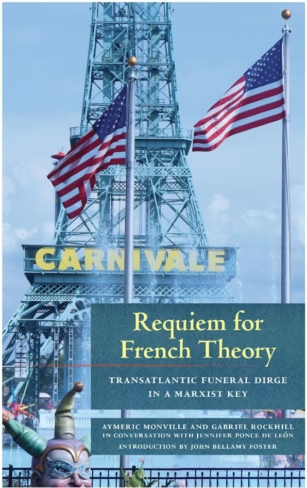
In 1966, Johns Hopkins hosted a seemingly innocuous international conference titled "The Languages of Criticism and the Sciences of Man," featuring leading figures of what would later be known as "French Theory." However, John Bellamy Foster writes, far from a simple meeting of intellectuals, this represented a "politically motivated attempt to create a beachhead for French structuralism in the United States that would counter the radicalization then taking place."
March 1, 2026
Vijay Prashad critiques the argument that colonialism was, at most, ancillary to the transition between capitalism and feudalism in Western Europe. Instead, Prashad argues, "capitalism
as it historically emerged—industrial, global, racialized, and imperial—was inseparable from colonial expropriation." This reality must fuel a Marxist conception of the global struggle for reparations for those who have been oppressed and exploited at the hands of empires past and present.