October 1, 2026
Marking the sixtieth anniversary of Paul A. Baran and Paul M. Sweezy's
Monopoly Capital, the
MR editors situate this key work of political economy within the contemporary political-economic landscape. The tendency toward the overaccumulation capital, they explain, represents a shift from the "
generation of economic surplus…to one of its
absorption." In an age of financialization and market bubbles, the editors note, Baran and Sweezy's work stands as a testament to the continuing necessity of incisive political-economic analysis of capitalism, inequality, and the irrationality that pervading the entire system.
October 1, 2026
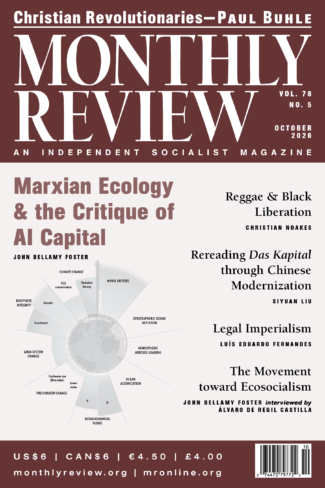
Christian Noakes explores the deep connections between the Jamaican Black Power movement and the political roots of its renowned indigenous musical genre, reggae. From the history of capitalist oppression in Jamaica and the indelible influence of Guyanese revolutionary Walter Rodney, Noakes provides essential context for incendiary political radicalism within reggae. Musically innovative and lyrically radical, reggae, he writes, was "instilled with a sense of militant determination that was at once a reflection of the culture it came from and a source of defiant resilience in the face of rampant inequality."
October 1, 2026
Today's resurgence in U.S. imperialist interventions abroad and the concomitant so-called crisis of the "rules-based order" can be explained, Luís Eduardo Fernandes argues, through the category of "legal imperialism, which refers to how the international juridical form is internalized within societies and in the context of dependency, colonialism, unequal exchange, and monopoly capital. "International law and imperialism," Fernandes writes, "do not stand as opposing poles. They are part of the same unity.… Violence is constitutive of the juridical form."
October 1, 2026
Paul Buhle reviews
Emily Pierson: A Yankee Radical, a new biography of the eponymous Christian radical and communist organizer. As a "strong willed" woman born at the nineteenth century and living well into the twentieth, Pierson is a figure whose work spanned the fight for women's suffrage, public health, the labor movement, and the Russian, Chinese, and Cuban Revolutions, traveling to the latter countries toward the end of her life. As a writer, teacher, churchgoer, and worker, Pierson, Buhle writes, was a presence to be reckoned with throughout her lifetime.
September 1, 2026
In September's Review of the Month, the Research Unit for Political Economy delves into how the crisis pervading the world system, on stark display in the tech sector, global finance, and the sphere of production, lays bare the longstanding vulnerabilities of the Indian economy. As the contradictions in the neoliberal phase become unmistakable, the authors write, it is necessary to take a class-based approach to resolving the questions of how to bring about key questions regarding the productive life and development of India.
September 1, 2026
The relationship between Marxism and other revolutionary traditions is a key question for our time. If we approach the issue incorrectly, we risk Eurocentrism and underrecognizing Marxism's role in the Global South contexts where it is most vital and active. This article examines and extends José Carlos Mariátegui's dialectical approach to the issue, which demonstrates how Marxism is not diluted but strengthened through engagement with the thought and practice of existing struggles, while those struggles can, in turn, gain greater depth and groundedness through the same relationship.
July 1, 2026
This month's "Notes from the Editors," originally published in May by the
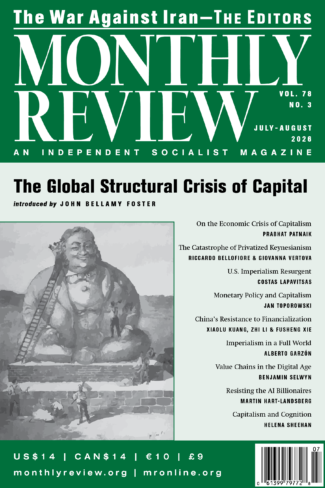
German Quarterly, explores the last few decades of U.S. belligerence in Iran, culminating in the Trump administration's recent acts of war in the region. Together with Israel, the Editors write, the United States "has entrapped itself in an imperialist war that it cannot win," thus underscoring the necessity of a global anti-imperialist peace movement.
July 1, 2026
Considering the "Structural Crisis of Capital" from the perspective of economics, Prabhat Patnaik sheds light on two major aspects that have risen to prominence in our current conjuncture. The first, rampant stagnation and unemployment, is clear and undeniable. The second, particular to the capitalism of the late twentieth century and the shedding of colonies on which imperial nations depended for wealth is particularly salient to Trump's economic strategy of economic recolonization not only through soft power, but direct military action.
July 1, 2026
It is quite evident, Costas Lapavitsas begins, that the world is currently ensnared in geopolitical turmoil, perhaps for over a decade. In this article, Lapavitsas provides insight into the inseparable and interlocking mechanisms of dollar dominance and imperialism backed by the escalatory militarism of the second Trump administration. As Lapavitsas notes: "The dollar and the F-35—monetary coercion and military power—are two moments of a single structure of domination."
July 1, 2026
Over the last half-century, the "financial explosion"—manifest in the unrestrained expansion of financialization and its tools and institutions—has fundamentally reshaped the global economy, impacting countries throughout the Global North and South. China, however, has proven to be a distinctive case. Xiaolu Kuang, Zhi Li, and Fusheng Xie probe the question of how and why China has managed to maintain its emphasis on production above finance, and the development all above the accumulation of capital.