October 1, 2026
Christian Noakes explores the deep connections between the Jamaican Black Power movement and the political roots of its renowned indigenous musical genre, reggae. From the history of capitalist oppression in Jamaica and the indelible influence of Guyanese revolutionary Walter Rodney, Noakes provides essential context for incendiary political radicalism within reggae. Musically innovative and lyrically radical, reggae, he writes, was "instilled with a sense of militant determination that was at once a reflection of the culture it came from and a source of defiant resilience in the face of rampant inequality."
October 1, 2026
Álvaro de Regil Castilla interviews John Bellamy Foster. In the interview, de Regil Castilla and Foster discuss the existential risk to humanity presented by the ongoing planetary crisis wrought by capitalism and its endlessly destructive impacts on society and the earth. What would an ecosocialist movement look like? How do we pursue an equitable and sustainable path toward the development of all, rather than the privileged few? Do we still have time to organize to save the planet—and indeed, all of humanity?
September 1, 2026
In September's Review of the Month, the Research Unit for Political Economy delves into how the crisis pervading the world system, on stark display in the tech sector, global finance, and the sphere of production, lays bare the longstanding vulnerabilities of the Indian economy. As the contradictions in the neoliberal phase become unmistakable, the authors write, it is necessary to take a class-based approach to resolving the questions of how to bring about key questions regarding the productive life and development of India.
September 1, 2026
In this 1980 talk by Joan Robinson, first published in
MR in 1983, the economist painted a stark picture of global arms race fueled by military capitalism and imperialism. "The important question," she urged, "is not whether the rate of inflation is high or low or can be brought under control but whether our generation will succeed in destroying the world…. Economics should begin to address the important issue of our impending doom."
July 1, 2026
John Bellamy Foster introduces our special summer issue on the "Structural Crisis of Capital," illuminating its four main characteristics as first outlined by István Mészáros in
Marx's Theory of Alienation. Capital, Foster says, has found itself in a position akin to Lucian's sorcerer's apprentice: futilely attempting to control a runaway system that he had himself created, accumulating not only contradictions but outright catastrophe—with globe-spanning consequences.
July 1, 2026
"Old-style neoliberalism," write Riccardo Bellofiore and Giovanna Vertova "is dead, or at least gravely ill. The new paradigm that may replace it has not yet been born or is not yet recognizable. In the middle, between the times, lies what we have proposed to call the
permanent catastrophe: a regime in which capitalist responses in catastrophic form have become the norm, in which crises are no longer overcome but accumulate."
July 1, 2026
Martin Hart-Landsberg gives an in-depth account of the oligarchs of Silicon Valley and their embrace of transhumanist ideologies that celebrate individualism and technological advancement above all else. However, he asserts, all is not lost, as growing dissatisfaction with capitalism "is slowly but steadily helping to grow a movement of resistance"—a resistance that must recognize that it is not just tech billionaires but capitalism itself threatening humanity's chance at a better future.
June 1, 2026
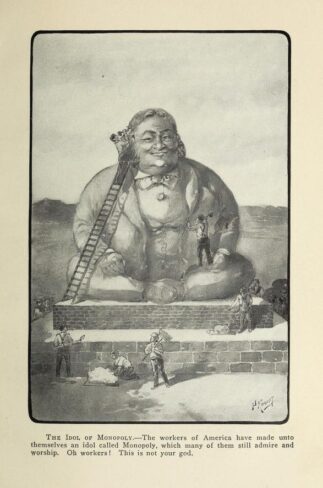
June's "Notes from the Editors" revisits the fundamental concept of monopoly capitalism as expounded by Paul A. Baran and Paul M. Sweezy in their pathbreaking
Monopoly Capital. The recent resurgence of the debate around Baran and Sweezy's work, the editors write, misses not only the enduring relevance of their analysis in an era of megacorporations and hyperscalers, but the revolutionary understanding of the economic system that arises from such an analysis.
June 1, 2026
Te Li unravels the myth of digital dematerialization so heavily promulgated by Silicon Valley and other AI boosters, which presents the technology as a phenomenon that has escaped the material realm and thus, entropy itself. In fact, Li shows that the material and energetic requirements of AI places it squarely in the physical realm, then situates the technology within the context of the metabolic rift under capitalism.
May 1, 2026
John Bellamy Foster takes on sweeping questions of artificial intelligence and its role in today's capitalist society. "The Great Houses of AI are divided against themselves and cannot stand," he writes, "If humanity is to flourish, the forces and relations of production must be revolutionized together…creating a world of sustainable human development."