January 1, 2023
This issue's Review of the Month discusses Marx's role as the foremost revolutionary critic of bourgeois Enlightenment humanism. To this day, his conception of "the universal metabolism of nature" remains a powerful antidote to the phantasmagoric "dark ecology" posited by today's posthumanism.
January 1, 2023
Pyotr Kondrashov takes a deep dive into Lenin's understanding of social dialectics. This exploration gives rise to an approach to that places the active human subject squarely in the center of a revolutionary Marxism that goes "beyond Marx," furthering the struggle for a liberated society.
December 1, 2022
John Bellamy Foster takes readers back to Marx's understanding of the dialectics of nature and society. As Marx and Engels noted, humanity must not only struggle for the advancement of human freedom, but also the capitalist destruction of the earth. Today, the struggle for freedom and the struggle for necessity coincide everywhere on the planet for the first time in human history, creating a prospect of ruin or revolution.
October 1, 2022
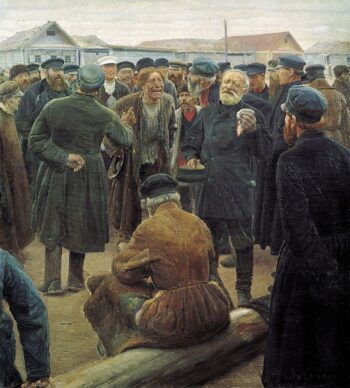
In the past and in his own time, Marx has been portrayed as endorsing the enclosure of the commons as a necessary historical stage on the path to socialism. However, a more accurate account, one that is critical of the enclosure movement, can be found in his response to the destruction of commons-based peasant communities in Russia—while it was actually happening.
October 1, 2022
There is hardly any theme in Karl Marx's theoretical corpus that has garnered as much traction as his theory of fetishism. Ever since Marx introduced the term into his critique of political economy in Capital, fetishism became a field of theoretical force. While much ink has been spilled on the specific content and theoretical scope of fetishism in Capital, young Marx's initial exploration of the term has rarely enjoyed critical attention.
October 1, 2022
Monthly Review was started in 1949 and is now in its forty-fourth year of publication, so you could say that MR's existence is pretty much coterminous with the second half of the twentieth century. What have been the most important characteristics of this half century?
September 1, 2022
More than twenty years after the publication of John Bellamy Foster's Marx's Ecology (2000), ecosocialist scholars continue to explore the evolution of Marx's ecological thinking, from the Greek atomists to his later work on ethnology.
September 1, 2022
John Bellamy Foster's recent work, The Return of Nature, makes a strong case that Marxism's central, materialist conception of nature and history makes it the best possible theoretical basis for radical ecological scholarship.
September 1, 2022
Recent scholarship suggests that the widespread perception of Soviet states as uniquely ecologically disastrous is, at best, exaggerated, and that these environmental legacies must be re-examined.
July 1, 2022
Contradicting previous liberal notions of an "end of history," humanity is now facing unprecedented threats to our species' survival, but an environmental proletariat to combat them is emerging.