October 1, 2026
Marking the sixtieth anniversary of Paul A. Baran and Paul M. Sweezy's
Monopoly Capital, the
MR editors situate this key work of political economy within the contemporary political-economic landscape. The tendency toward the overaccumulation capital, they explain, represents a shift from the "
generation of economic surplus…to one of its
absorption." In an age of financialization and market bubbles, the editors note, Baran and Sweezy's work stands as a testament to the continuing necessity of incisive political-economic analysis of capitalism, inequality, and the irrationality that pervading the entire system.
October 1, 2026
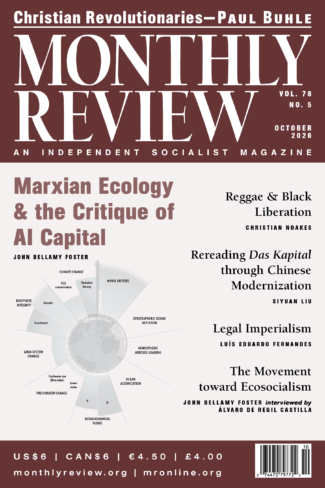
Today's resurgence in U.S. imperialist interventions abroad and the concomitant so-called crisis of the "rules-based order" can be explained, Luís Eduardo Fernandes argues, through the category of "legal imperialism, which refers to how the international juridical form is internalized within societies and in the context of dependency, colonialism, unequal exchange, and monopoly capital. "International law and imperialism," Fernandes writes, "do not stand as opposing poles. They are part of the same unity.… Violence is constitutive of the juridical form."
October 1, 2026
Paul Buhle reviews
Emily Pierson: A Yankee Radical, a new biography of the eponymous Christian radical and communist organizer. As a "strong willed" woman born at the nineteenth century and living well into the twentieth, Pierson is a figure whose work spanned the fight for women's suffrage, public health, the labor movement, and the Russian, Chinese, and Cuban Revolutions, traveling to the latter countries toward the end of her life. As a writer, teacher, churchgoer, and worker, Pierson, Buhle writes, was a presence to be reckoned with throughout her lifetime.
September 1, 2026
In September's Review of the Month, the Research Unit for Political Economy delves into how the crisis pervading the world system, on stark display in the tech sector, global finance, and the sphere of production, lays bare the longstanding vulnerabilities of the Indian economy. As the contradictions in the neoliberal phase become unmistakable, the authors write, it is necessary to take a class-based approach to resolving the questions of how to bring about key questions regarding the productive life and development of India.
July 1, 2026
This month's "Notes from the Editors," originally published in May by the
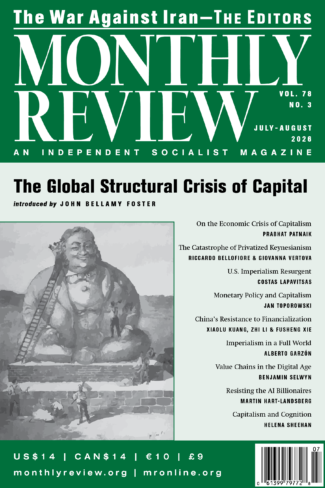
German Quarterly, explores the last few decades of U.S. belligerence in Iran, culminating in the Trump administration's recent acts of war in the region. Together with Israel, the Editors write, the United States "has entrapped itself in an imperialist war that it cannot win," thus underscoring the necessity of a global anti-imperialist peace movement.
July 1, 2026
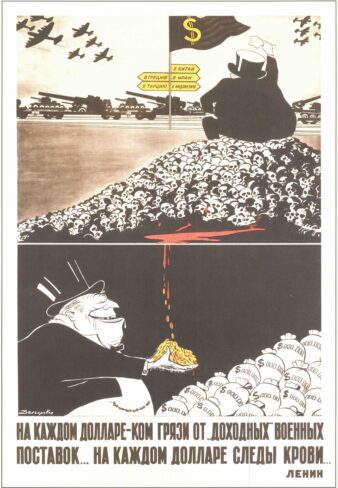
It is quite evident, Costas Lapavitsas begins, that the world is currently ensnared in geopolitical turmoil, perhaps for over a decade. In this article, Lapavitsas provides insight into the inseparable and interlocking mechanisms of dollar dominance and imperialism backed by the escalatory militarism of the second Trump administration. As Lapavitsas notes: "The dollar and the F-35—monetary coercion and military power—are two moments of a single structure of domination."
July 1, 2026
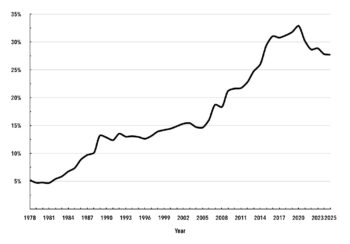
Over the last half-century, the "financial explosion"—manifest in the unrestrained expansion of financialization and its tools and institutions—has fundamentally reshaped the global economy, impacting countries throughout the Global North and South. China, however, has proven to be a distinctive case. Xiaolu Kuang, Zhi Li, and Fusheng Xie probe the question of how and why China has managed to maintain its emphasis on production above finance, and the development all above the accumulation of capital.
July 1, 2026
Since the wane of mercantilism in Europe, conceptions of wealth, trade, and productivity have also changed: from one of a zero-sum game reliant only on the productivity of land, to one of the potential for positive-sum wealth created by industry, and, now, to the zero-sum neomercantilism necessitated in a world of resource depletion, where the earth is pushed to its biophysical limits. But the response to this crisis does not have to be further fortification—it could also be a world that organizes itself within the metabolic limitations of nature.
July 1, 2026
Martin Hart-Landsberg gives an in-depth account of the oligarchs of Silicon Valley and their embrace of transhumanist ideologies that celebrate individualism and technological advancement above all else. However, he asserts, all is not lost, as growing dissatisfaction with capitalism "is slowly but steadily helping to grow a movement of resistance"—a resistance that must recognize that it is not just tech billionaires but capitalism itself threatening humanity's chance at a better future.
July 1, 2026
The world is being roiled by a crisis of meaning, leading to a pervasive sense of despair and stagnation. Helena Sheehan gives an account of the present-day epistemological nihilism resulting from the corrosion of "the foundations of knowledge production"—that is to say, the devaluing of rigorous scientific inquiry and the rise of irrationalism. Marxism provides us with both an understanding of how this crisis of cognition relates to the "Structural Crisis of Capitalism," as well as the socialist opposition that seeks to resolve its manifold contradictions.