October 1, 2026
What is the rise of AI capital, and what does it mean for contemporary work, culture, and the ecological state of our planet? John Bellamy Foster dispels the myth of a "hyperorganized AI capitalism." As Foster writes: "We are not entering a stable new age…but rather a new, capitalist-engendered global disorder in which humanity, according to climate science, is headed ever more rapidly toward a planetary 'point of no return.'" The only way out—the only way, that is, to ensure the survival of humanity—is a radical shift away from the catastrophically destructive regime of capital accumulation and toward sustainable human development through socialism.
October 1, 2026
Álvaro de Regil Castilla interviews John Bellamy Foster. In the interview, de Regil Castilla and Foster discuss the existential risk to humanity presented by the ongoing planetary crisis wrought by capitalism and its endlessly destructive impacts on society and the earth. What would an ecosocialist movement look like? How do we pursue an equitable and sustainable path toward the development of all, rather than the privileged few? Do we still have time to organize to save the planet—and indeed, all of humanity?
July 1, 2026
Since the wane of mercantilism in Europe, conceptions of wealth, trade, and productivity have also changed: from one of a zero-sum game reliant only on the productivity of land, to one of the potential for positive-sum wealth created by industry, and, now, to the zero-sum neomercantilism necessitated in a world of resource depletion, where the earth is pushed to its biophysical limits. But the response to this crisis does not have to be further fortification—it could also be a world that organizes itself within the metabolic limitations of nature.
July 1, 2026
In order to comprehend the environmental crisis that goes hand-in-hand with the "Structural Crisis of Capital," we must also understand the nature of global value chains and how they contribute to environmental degradation and worker exploitation on a global level. Benjamin Selwyn elucidates how global value chains and digitalization sit within a "conjoined dynamic of labor-exploitative accumulation and ecological expropriation."
June 1, 2026
MR associate editor Brett Clark and editor John Bellamy Foster explore "the death drive of late imperialism" and its manifestations in an ecological crisis that is not parallel to, but inseparable from, increasingly open ecofascism in the United States. Drawing from Luckács's
Destruction of Reason and István Mészáros's work on imperialism, Clark and Foster present a materialist analysis that illuminates the cult of unreason so pervasive under capitalism and imperialism while pointing to a path forward that is grounded in the historical-materialist Marxist tradition.
May 1, 2026
John Bellamy Foster takes on sweeping questions of artificial intelligence and its role in today's capitalist society. "The Great Houses of AI are divided against themselves and cannot stand," he writes, "If humanity is to flourish, the forces and relations of production must be revolutionized together…creating a world of sustainable human development."
May 1, 2026
Yiwen Chen dives deep into Frederick Engels's
Dialectics of Nature in order to give context to present-day debates surrounding the juxtaposition of the dialectics of nature and Marxist ecology. "It is hardly surprising that Engels's and Marx's ecological ideas are not entirely identical," Chen writes. "Nevertheless, their ideas do possess an inherent consistency."
May 1, 2026
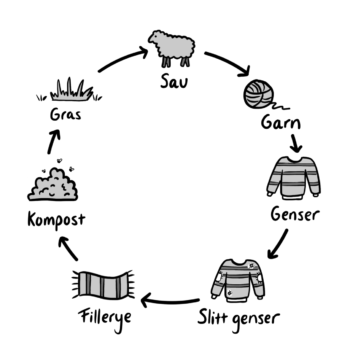
Today, many use the term "circular economy" to describe a shift in the use of industrial waste products in a way that does not challenge the present mode of production. Returning to Marx, Benjamin Selwyn is able to show that this usage of the term is designed to facilitate the acquisitive demands of a capitalist economy, rather than a fundamental shift in resource use.
February 1, 2026
In this talk from the inaugural conference of the Society for Peace, Internationalism, and Ecology, John Bellamy Foster relates the story of Prometheus, as presented in the plays of Aeschylus, to Western Marxism's "dialectic of defeat," in which capitalism is portrayed as an unbreakable bond for the working class. Instead, Foster says, we must recognize Prometheus as a subject who is freed from the seemingly inescapable fetters imposed upon him.
February 1, 2026
Speaking before at the Opening Ceremony of the Fourth World Conference on Marxism in Beijing, John Bellamy Foster discusses the development of eco-Marxism and its relation to Marxist theory. Here, Foster argues, "eco-Marxism as we know it today is not simply another branch of Marxism," but is a pathway to the projects of complete socialism and ecological civilization.