February 1, 2012
This issue of Monthly Review focuses particularly on China. Aside from the Review of the Month by John Bellamy Foster and Robert W. McChesney, which addresses the Chinese economy and its relation to the current phase of the capitalist world economy, we are publishing two separate contributions by Chinese scholars, one by Wen Tiejun, et. al., on the new rural reconstruction movement in China, and one by Zhihe Wang on the development of ecological Marxism in China. Our own thesis is that the era of rapid growth in China is leading to a period of deepening contradiction. The present accelerated growth is based on the intensive exploitation of migrant labor and the capitalization of newly urban land. For various reasons this model is reaching its outer limits, economically, socially, and ecologically. This suggests that China is on the wrong road, and must change directions.
February 1, 2012
Five years after the Great Financial Crisis of 2007–09 began there is still no sign of a full recovery of the world economy. Consequently, concern has increasingly shifted from financial crisis and recession to slow growth or stagnation, causing some to dub the current era the Great Stagnation. Stagnation and financial crisis are now seen as feeding into one another.… To be sure, a few emerging economies have seemingly bucked the general trend, continuing to grow rapidly—most notably China, now the world's second largest economy after the United States. Yet, as [IMF Managing Director Christine] Lagarde warned her Chinese listeners, "Asia is not immune" to the general economic slowdown, "emerging Asia is also vulnerable to developments in the financial sector." So sharp were the IMF's warnings, dovetailing with widespread fears of a sharp Chinese economic slowdown, that Lagarde in late November was forced to reassure world business, declaring that stagnation was probably not imminent in China (the Bloomberg.com headline ran: "IMF Sees Chinese Economy Avoiding Stagnation.")
February 1, 2012
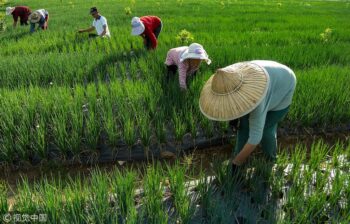
The governments of almost all developing countries are facing the long-term twin problems of capital shortages and high fiscal debts, resulting from their attempts to modernize the state forms and economic and financial relations left by colonialism or copied from western political culture. Whether they claimed to be of the left or the right ideologically, they almost invariably undertook policies to attract foreign investment and encourage domestic private investors to join the global industrialization competition during the twentieth century…. Continental China, the biggest developing country, with the largest population (but also with significant natural resource constraints) has close to 20 percent of the world's population, but only 9 percent of its arable land and a mere 6 percent of its fresh water. Over the centuries, China had its share of drought- or flood-induced famines. But if not for a 6,000-year history of irrigated agriculture, with its related "village rationality" based on traditional indigenous knowledge—which internalizes risks by its multifunctional rural cultures of sustainable self-reliance—China would have been a land of perpetual hunger.
January 1, 2012
In a little more than two months at this writing (December 3, 2011) the Occupy Wall Street movement has ushered in a new dialectic of world revolt. Occupy movements now exist in more than 2,600 cities across the globe. The response of the system has been increased repression. Yet, everywhere the movement has come up with new means of revolt. Had we tried in early October to predict how things would be at the start of November we would never have succeeded. Likewise we cannot predict now at the start of December how things will look even at the start of January. And it is precisely this quality of emergence, i.e. of not being predictable from the current state of affairs, which suggests that we are at a turning point. This global rip in the cloth of imperial capital's supposed inevitability is irreversible; that we are fully ready to predict. Looking back it will be clear that as of late 2011, we are much closer to the start of a great global revolt against the plutocracy, the "one percent," than to its end.
November 1, 2011
It is a sign of the seriousness of the current economic malaise that more and more establishment commentators today are turning to Marx for answers. Thus a September 14, 2011, article in Bloomberg Businessweek, entitled "Marx to Market," acknowledged: "The Bearded One has rarely looked better. The current global financial crisis has given rise to a new contingent of unlikely admirers. In 2009 the Vatican's official newspaper, L'Osservatore Romano, published an article praising Marx's diagnosis of income inequality…. In Shanghai, the turbo-capitalist hub of Communist-in-name-alone China, audiences flocked to a 2010 musical based on Capital, Marx's most famous work. In Japan, Capital is now out in a manga version…. Consider the particulars.… Marx predicted that companies would need fewer workers as they improved productivity, creating an "industrial reserve army" of the unemployed whose existence would keep downward pressure on wages for the employed…. It's hard to argue with that these days…. The condition of blue collar workers in the U.S. is still a far cry from the subsistence wage and 'accumulation of misery' that Marx conjured. But it's not morning in America, either." Bloomberg Businessweek seems unaware that Marx viewed the reserve army of labor as applicable not just to developed countries like the United States, but also to labor throughout the globe.
November 1, 2011
In the last few decades there has been an enormous shift in the capitalist economy in the direction of the globalization of production. Much of the increase in manufacturing and even services production that would have formerly taken place in the global North—as well as a portion of the North's preexisting production—is now being offshored to the global South, where it is feeding the rapid industrialization of a handful of emerging economies. It is customary to see this shift as arising from the economic crisis of 1974–75 and the rise of neoliberalism—or as erupting in the 1980s and after, with the huge increase in the global capitalist labor force resulting from the integration of Eastern Europe and China into the world economy. Yet, the foundations of production on a global scale, we will argue, were laid in the 1950s and 1960s, and were already depicted in the work of Stephen Hymer, the foremost theorist of the multinational corporation, who died in 1974.

October 1, 2011
Samir Amin was born in Cairo in 1931, and studied within the French educational system in Egypt.… He is currently president of the World Forum for Alternatives.… Amin's wide-ranging work can be most succinctly described in terms of the dual designation of The Law of Value and Historical Materialism—the title of one of his books, now in a new edition as The Law of Worldwide Value. Marx's intellectual corpus, he notes, appears to be divided into writings on economics and writings on politics.… For Amin, this basic division of Marxist theory is not to be denied. Nevertheless, he insists that the economic laws of capitalism, summed up by the law of value, "are subordinate to the laws of historical materialism." Economic science, while indispensable, cannot explain at the highest level of abstraction, as in mathematical equations, the full reality of capitalism and imperialism—since it cannot account either for the historical origins of the system itself, or for the nature of the class struggle.
September 1, 2011
In this issue of MR we are reprinting Stephen Hymer's classic essay, "Robinson Crusoe and the Secret of Primitive Accumulation," which first appeared forty years ago in the September 1971 issue of MR. It represents, in our view, one of the most important articles produced by a whole generation of radical political economists associated with the revolt against mainstream economics in the 1960s, and the creation of the Union for Radical Political Economics in 1968.… [Hymer's] final article, "International Politics and International Economics: A Radical Approach," published posthumously in MR in March 1978, started off with the words: "To be a radical, or to be a scientist, is the same thing; it is a question of trying to go to the root of the matter."
September 1, 2011
It is no secret today that we are facing a planetary environmental emergency, endangering most species on the planet, including our own, and that this impending catastrophe has its roots in the capitalist economic system. Nevertheless, the extreme dangers that capitalism inherently poses to the environment are often inadequately understood, giving rise to the belief that it is possible to create a new "natural capitalism" or "climate capitalism" in which the system is turned from being the enemy of the environment into its savior. The chief problem with all such views is that they underestimate the cumulative threat to humanity and the earth arising from the existing relations of production. Indeed, the full enormity of the planetary ecological crisis, I shall contend, can only be understood from a standpoint informed by the Marxian critique of capitalism.
September 1, 2011
The solitary and isolated figure of Robinson Crusoe is often taken as a starting point by economists, especially in their analysis of international trade. He is pictured as a rugged individual—diligent, intelligent, and above all frugal—who masters nature through reason. But the actual story of Robinson Crusoe, as told by Defoe, is also one of conquest, slavery, robbery, murder, and force. The contrast between the economists' Robinson Crusoe and the genuine one mirrors the contrast between the mythical description of international trade found in economics textbooks and the actual facts of what happens in the international economy.… But international trade…is often based on a division between superior and subordinate rather than a division between equals; and it is anything but peaceful. It is trade between the center and the hinterland, the colonizers and the colonized, the masters and the servants…Because it is unequal in structure and reward it has to be established and maintained by force, whether it be the structural violence of poverty, the symbolic violence of socialization, or the physical violence of war and pacification.
