July 1, 2026
"Old-style neoliberalism," write Riccardo Bellofiore and Giovanna Vertova "is dead, or at least gravely ill. The new paradigm that may replace it has not yet been born or is not yet recognizable. In the middle, between the times, lies what we have proposed to call the
permanent catastrophe: a regime in which capitalist responses in catastrophic form have become the norm, in which crises are no longer overcome but accumulate."
July 1, 2026
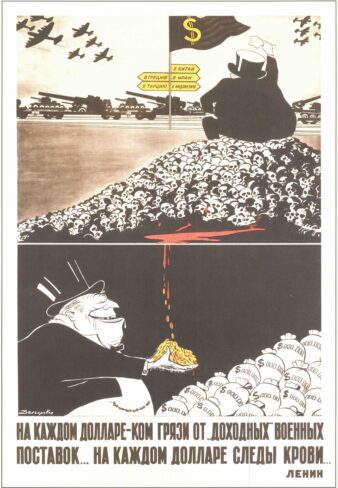
It is quite evident, Costas Lapavitsas begins, that the world is currently ensnared in geopolitical turmoil, perhaps for over a decade. In this article, Lapavitsas provides insight into the inseparable and interlocking mechanisms of dollar dominance and imperialism backed by the escalatory militarism of the second Trump administration. As Lapavitsas notes: "The dollar and the F-35—monetary coercion and military power—are two moments of a single structure of domination."
July 1, 2026
Jan Toporowski explains our contemporary age of "monetary policy dominance": the era in which the setting of short-term interest rates by the central banks is seen as the key instrument for regulating economic activity. This, however, does not reflect an ironclad law of the business cycle but, rather, a set of assumptions that underscores the dependence of capitalism on the accumulation of capital itself. This in turn obscures deeper truths about the effectiveness of monetary policy on the daily lives of the working class.
October 1, 2025
Michael Meeropol, Howard J. Sherman, and Paul D. Sherman give an account of how mainstream economists came to adopt the idea of secular stagnation, even without recognizing its origins in the work of Marxist economist and
MR founder Paul M. Sweezy. The turn, they write, came in the wake of the Great Recession, when the tendency toward stagnation in the U.S. economy became undeniable.
January 1, 2025
Craig Medlen draws on decades of data to reveal how the creeping stagnation of the past half-century has led to the increasing consolidation of corporate monopoly power and concentration of firms by way of mergers and, importantly, the free cash that funds them. This stunning rise in free cash, fueled in part by government deficits, starkly reveals how the ruling class continues to enrich themselves and strengthen their position on the top of the economic heap.
October 1, 2024
Minqi Li and Lingyi Wei look to the Chinese and U.S. economies to illustrate the contradictions of secular stagnation, concluding that both economies will likely face great challenges in the decades to come. However, they write, progressive economic policies could change China's future, encouraging massive investment into the state sector and bringing about the transition to a fully socialist society.
January 1, 2018
"Monopoly capital" is a term for the new form of capital, embodied in the modern giant corporation, that in the late nineteenth century began to displace the small family firm as the dominant economic unit, marking the end of the freely competitive stage of capitalism.
February 1, 2017
Since the 1980s, economic growth in the core capitalist countries has been driven by an enormous expansion of financial capital, accompanied by steady deindustrialization. In recent years, the monopoly power of this financial capital has displayed increasingly tyrannical characteristics: it depends for its continued growth on ever-increasing indebtedness and dependence in developing nations, widening the divide between rich and poor and ultimately fostering state violence that serves to suppress popular resistance.… [Today,] military and monetary strength work together to profit from inequality and instability in emerging economies.
June 1, 2016
On April 8, 2016, in what has already become a historic case on the climate, Magistrate Judge Thomas Coffin of the United States District Court of Oregon ruled against a motion to dismiss, in favor of the youthful plaintiffs in the Children's Trust lawsuit (Kelley Cascade Rose Juliana, et al. v. United States of America, et al.) and against the defendants, consisting of the federal government and the fossil-fuel industry.… The defendants' argument to dismiss was directed principally at what they contended were limits on the federal government's public trust responsibility. It thus turned on whether the United States was obligated simply to follow capitalist precepts with respect to the natural-physical environment, or whether the government had a public trust to maintain the environment for the population and for future generations, going beyond the rules of the market.

April 1, 2016
The March/April 2016 issue of Foreign Affairs, published by the Council on Foreign Relations, is devoted in large part to the topic of economic stagnation.… [Of the] eight articles on stagnation, only one…—"The Age of Secular Stagnation" by Lawrence H. Summers—is, in our opinion, of any real importance.… Summers heavily criticizes those like Robert J. Gordon, in The Rise and Fall of American Growth (2016), who attribute stagnation to supply-side "headwinds"…blocking productivity growth.… Likewise Summers dispatches those like Kenneth Rogoff who see stagnation as merely the product of a debt supercycle associated with periodic financial crises.… Despite such sharp criticisms of other mainstream interpretations of stagnation, Summers's own analysis can be faulted for being superficial and vague, lacking historical concreteness.… In fact, the current mainstream debate on secular stagnation is so superficial and circumspect that one cannot help but wonder whether the main protagonists—figures like Summers, Gordon, Paul Krugman, and Tyler Cowen—are not deliberately tiptoeing around the matter, worried that if they get too close or make too much noise they might awaken some sleeping giant (the working class?) as in the days of the Great Depression and the New Deal.