October 1, 2026
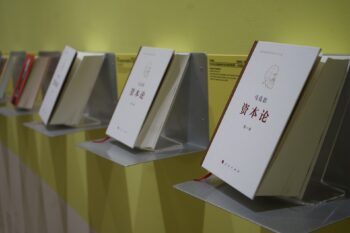
Large-scale investment toward the good of all society, Karl Marx once wrote, "presupposes that society be able to wait." The capital that funds just and sustainable human development, in other words, must operate at time scales much longer than short-term gain and transitory profit margins. Siyuan Liu situates this idea within the Chinese notion of "patient capital" and the institutional requirements for planning a just and equitable future—and a changed horizon for capital.
October 1, 2026
Paul Buhle reviews
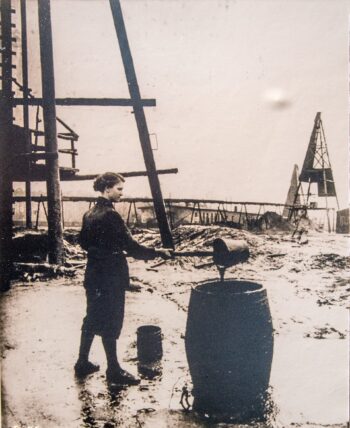
Emily Pierson: A Yankee Radical, a new biography of the eponymous Christian radical and communist organizer. As a "strong willed" woman born at the nineteenth century and living well into the twentieth, Pierson is a figure whose work spanned the fight for women's suffrage, public health, the labor movement, and the Russian, Chinese, and Cuban Revolutions, traveling to the latter countries toward the end of her life. As a writer, teacher, churchgoer, and worker, Pierson, Buhle writes, was a presence to be reckoned with throughout her lifetime.
September 1, 2026
In September's Review of the Month, the Research Unit for Political Economy delves into how the crisis pervading the world system, on stark display in the tech sector, global finance, and the sphere of production, lays bare the longstanding vulnerabilities of the Indian economy. As the contradictions in the neoliberal phase become unmistakable, the authors write, it is necessary to take a class-based approach to resolving the questions of how to bring about key questions regarding the productive life and development of India.
July 1, 2026
Considering the "Structural Crisis of Capital" from the perspective of economics, Prabhat Patnaik sheds light on two major aspects that have risen to prominence in our current conjuncture. The first, rampant stagnation and unemployment, is clear and undeniable. The second, particular to the capitalism of the late twentieth century and the shedding of colonies on which imperial nations depended for wealth is particularly salient to Trump's economic strategy of economic recolonization not only through soft power, but direct military action.
July 1, 2026
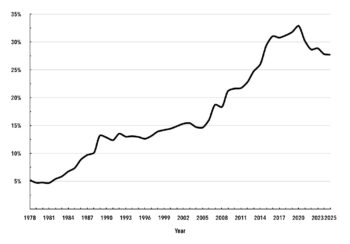
Over the last half-century, the "financial explosion"—manifest in the unrestrained expansion of financialization and its tools and institutions—has fundamentally reshaped the global economy, impacting countries throughout the Global North and South. China, however, has proven to be a distinctive case. Xiaolu Kuang, Zhi Li, and Fusheng Xie probe the question of how and why China has managed to maintain its emphasis on production above finance, and the development all above the accumulation of capital.
July 1, 2026
Since the wane of mercantilism in Europe, conceptions of wealth, trade, and productivity have also changed: from one of a zero-sum game reliant only on the productivity of land, to one of the potential for positive-sum wealth created by industry, and, now, to the zero-sum neomercantilism necessitated in a world of resource depletion, where the earth is pushed to its biophysical limits. But the response to this crisis does not have to be further fortification—it could also be a world that organizes itself within the metabolic limitations of nature.
June 1, 2026
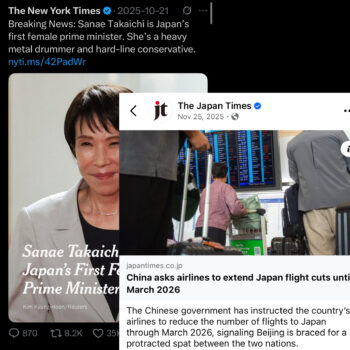
"In the contemporary era of stagnant monopoly-finance capital," Jianlu Bi and Ting Zhou begin, "the maintenance of global hegemony…necessitates the systemic colonization of digital consciousness. In examining the presentation of Sino-Japanese political tension across three media outlets, the authors describe digitally manufactured hatreds that "serve a vital imperialist function: the prevention of horizontal class solidarity" that may threaten U.S. hegemonic power in East Asia.
April 1, 2026
What is really happening in Xinjiang? Vijay Prashad and Tings Chak write: "There is no evidence of a policy of physical annihilation of the Uyghur peoples by the Chinese government, unlike say, direct evidence of extermination by the Israeli government against the occupied Palestinian people. There are no mass graves and no accusations of systematic killing—the hallmarks of a genocide."
April 1, 2026
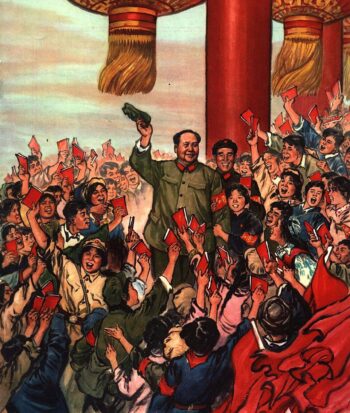
This article examines the resurgence of interest in Mao Zedong among China's youth, particularly at elite universities. This "Mao fever" reflects a complex mindset: indignation toward social inequality, uncertainty within a brutal job market, and a firm anti-imperialist and patriotic stance amidst the "New Cold War." In Mao’s legacy, a new generation is finding the guidance to navigate the sharpening contradictions of the present day.
April 1, 2026
Michael Viola explores the building of the Filipino identity in the context of U.S. imperialism. The broad-reaching effects of this "deadliest phase of imperialism," combined with pervasive anti-Asian racism in the United States, fuels the idea of a collective political project that "comes with the praxis, the power, and the price of a unique lineage" extending across an ocean and intimately connected to the dark history of U.S. militarism abroad.