February 1, 2023
Martin Hart-Landsberg revisits the history of the industrial re-organization of the U.S. economy during the Second World War. What can we learn from our past about the systemic changes necessary to face our future?
February 1, 2023
A new poem by Marge Piercy.
January 1, 2023
In this prescient chapter from 1982, author and activist Anne Braden draws a direct line from the anti-Communist witch hunts of the McCarthy Era to state repression of mass movements from the civil rights era to the rapid expansion of the racist police state that continues to this day. This chapter is reprinted from Anne Braden Speaks (Monthly Review Press, 2022).
December 1, 2022
A visit to a Venezuelan commune reveals a fascinating look into the creative ways communards forge ways of life in urban centers, and how these projects intersect with the much-needed transformations required for a grassroots and socially integrated ecology.
November 1, 2022
Two years after the peak of the 2020 street protests for reproductive rights in Poland, Magdalena Muszel and Grzegorz Piotrowski explore the movement's effects on Polish society. Despite the dissipating energy of the participants and continued intransigence of most major parties, this cycle of protests shifted the values and political preferences of specific gender and age groups, as well as affecting the common perception of protest movements in Poland.
November 1, 2022
Bhima Koregaon is that rare sequence in Indian politics today that can challenge reveal the true powers of being able to retroactively "change the past" in order to liberate the future, much in the manner of Marx's historical materialism. The case, Saroj Giri writes, forces us to revisit the question of historical oppression based on caste from within the present, and beckons us to reject the capitalist accelerationist-futurist "progressive politics" of much of the left, taking us closer to the class struggle of Marx.
October 1, 2022
How are we to understand the origins and historic significance of the concept of ecological civilization? What is its relation to ecological Marxism? And how does all of this relate to the worldwide revolutionary struggle aimed at transcending our current planetary emergency and protecting what Karl Marx called "the chain of human generations"—along with life in general?
October 1, 2022
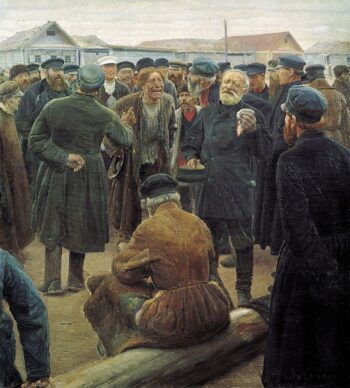
In the past and in his own time, Marx has been portrayed as endorsing the enclosure of the commons as a necessary historical stage on the path to socialism. However, a more accurate account, one that is critical of the enclosure movement, can be found in his response to the destruction of commons-based peasant communities in Russia—while it was actually happening.
October 1, 2022
Monthly Review was started in 1949 and is now in its forty-fourth year of publication, so you could say that MR's existence is pretty much coterminous with the second half of the twentieth century. What have been the most important characteristics of this half century?
July 1, 2022
Between 1949 and 1980, over a hundred articles in Monthly Review dealt with the Soviet Union directly, with many more addressing it indirectly. But, after 1993, treatments of post-Soviet Russia in the magazine largely ceased.